



A growing number of homebuyers are financing their residences through “nonbank” mortgage organizations. Actually, the majority of mortgage loans are now made and serviced by these nonbanks. A recent WatchBlog study examined what’s driving this trend, what its potential risks, and the rise and monitoring of nonbanks in the mortgage market.
Nonbanks, in contrast to regular banks, do not accept deposits in order to provide loans or provide financial stability. Rather, they finance their activities using short-term funding.
Key Findings:
- Many mortgage businesses don’t accept deposits to finance loans because they aren’t banks. Instead, “nonbank” mortgage firms rely on short-term finance, which may make them more susceptible to failure during recessions.
- The majority of loans bundled into federally backed mortgage securities are made and serviced by nonbanks. More loans are financed by the sale of these securities to investors. The government might be responsible for paying losses if a significant nonbank failure disrupts mortgage financing.
- The Federal Housing Finance Agency and Ginnie Mae keep an eye on the financial health of nonbanks, but they do not thoroughly evaluate the funding risks associated with them.
Even though the Great Recession occurred over 20 years ago, Americans nationwide continue to experience its effects. The federal government’s support for the mortgage industry, especially through guarantees of mortgage-backed securities, increased significantly throughout that crisis. Additionally, banks pulled out of the mortgage market after the crisis. Changes in capital regulations that increased the cost of banks holding mortgages were partially to blame for this.
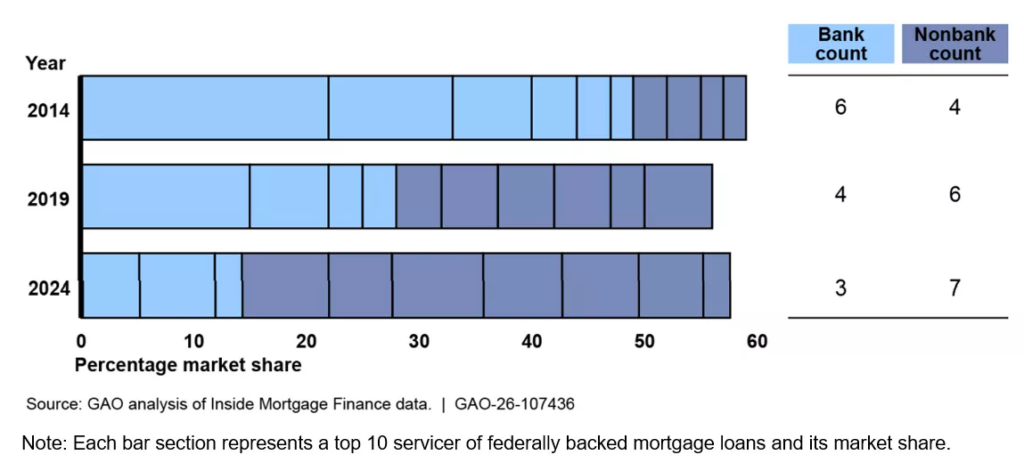
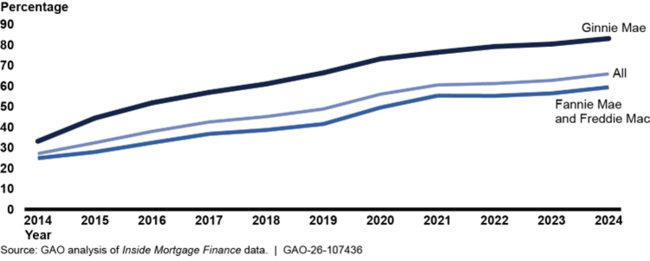
Yet, mortgages were still required for property purchases. As a result, nonbank lending firms like Rocket lending assumed greater responsibility. Banks lost ground to nonbanks as the leading lenders and servicers of federally backed mortgages between 2014 and 2024. For instance, the percentage of these mortgages that were serviced by nonbanks increased from 27% to 66% throughout that period.
Market Share of the Top 10 Servicers of Federally Backed Mortgages:
The Rise of Nonbank Mortgages
What advantages can nonbank mortgages offer?
Nonbanks helped the mortgage market in other ways as well, filling the gap left by traditional banks. Technology that has made getting a mortgage quicker and easier was quickly embraced by nonbanks. As a result, many customers can apply for a mortgage completely online. Additionally, nonbanks are crucial in providing loans to households with lower incomes and other groups that have historically had limited access to credit.
What risks are at the forefront?
Because they depend on short-term loan lines, nonbanks are susceptible to economic downturns. Restrictions on those credit lines may make it impossible for nonbanks to make new mortgages or fulfill their financial commitments during difficult economic times.
The mortgage markets might be affected if a big nonbank failed, or even if several smaller ones did as well. Additionally, American taxpayers may be responsible for paying losses because the federal government backs the market with guarantees and insurance.
The Fed’s Role in Keeping an Eye on Nonbank Risks
There is typically no federal authority monitoring the safety and soundness of nonbank mortgage companies. However, the Federal Housing Finance Agency (FHFA) and Ginnie Mae are two federal bodies that contribute to the stability of the mortgage securities markets and are involved in the oversight of nonbanks.
- Nearly $3 trillion worth of mortgage-backed securities are guaranteed by Ginnie Mae.
- FHFA is in charge of Fannie Mae and Freddie Mac, two businesses under federal conservatorship that create and guarantee mortgage-backed securities worth trillions of dollars.
Percentage of Mortgage Loans in Federally Backed Securities Serviced by Nonbanks, by Dollar Volume, 2014–2024:
Both organizations have procedures in place to keep an eye on nonbanks’ financial health. However, WatchBlog pointed out several areas that needed work:
Financial Data: As part of their monitoring activities, both agencies examine financial data that nonbanks self-report. However, we discovered that FHFA is not doing everything required to guarantee the accuracy of the data. This might make FHFA’s financial analysis of nonbanks less reliable.
Watch Lists: Based in part on financial data, Ginnie Mae and FHFA both create watch lists of nonbanks that present comparatively greater risks. However, we discovered that neither agency thoroughly evaluates the main hazards associated with short-term credit lines. Because of this, it’s possible that the agencies aren’t giving their watch lists enough consideration.
Scenario Analyses: Both organizations examine how the financial stability of nonbanks is impacted by shifting economic situations. However, Ginnie Mae only considers one economic stress scenario, which leaves out a variety of potential consequences. Ginnie Mae’s is less equipped to handle risks that could impact both its financial exposure and the stability of the mortgage market since it does not take into account a variety of stress situations.
To read the full report, click here.