



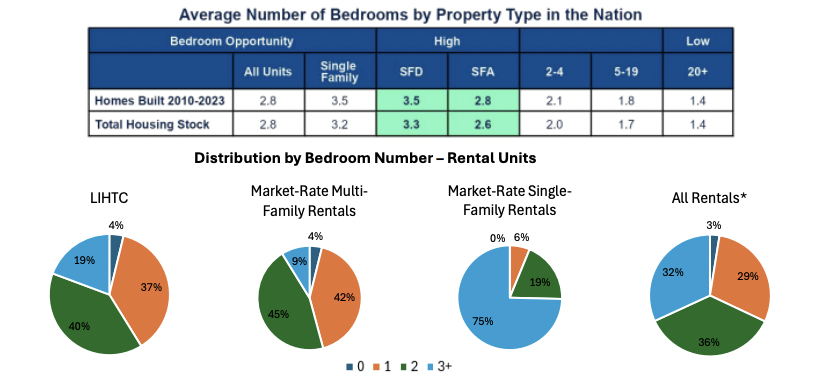
While the average American home has roughly 2.8 bedrooms, single-family homes have an average of 3.2, and multi-family buildings with 20 or more have an average of 1.4, according to new data from the American Enterprise Institute (AEI) Housing Center.
Key Findings:
- Market-rate housing provides 93% of the 5.8 million one-bedroom and 6.3 million two-bedroom multi-family (MF) rentals (with more than fifty units).
- Approximately 85% of the 1.3 million three-bedroom MF rentals are MF market-rate properties.
- The overall number of three-bedroom rentals rises from 1.3 million to 6.8 million when single-family (SF) rentals are taken into account, accounting for 80% of the total.
- Three-bedroom units make up around 85% of the group with three or more bedrooms, four-bedroom units make up about 12%, and the remaining units make up 2%.
Note: Among the 14 million SF rentals in the nation, data used for this analysis tracks roughly 7.3 million. AEI is still working on weighting the single-family vs. multi-family rentals, but we believe the results are directionally accurate.
Examining Single-Family/Multifamily Rental Trends
Data further shows that naturally occurring SF and MF rentals with a reasonable price tag offer the majority of the bottom decile of rental supply. The majority of supply for three or more bedrooms comes from the “Hidden Inventory” of single-family rentals.
As market-rate rental property provides the majority of supply, SF rentals make up a sizable portion, particularly for apartments with three or more bedrooms (71%). Additional percentages include:
- 0-bedroom units (90%)
- 1- and 2-bedroom units (84%)
- 3+ bedroom units (87%)
Three-bedroom units make up around 85% of the group with three or more bedrooms, four-bedroom units make up about 12%, and the remaining units make up 2%.
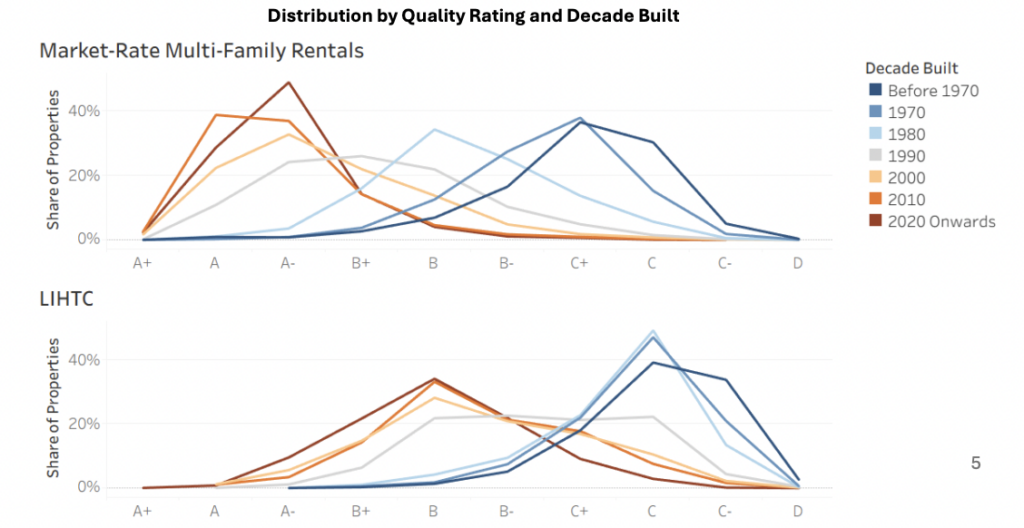
Additionally, like the entire market, Low-Income Housing Tax Credit (LIHTC) properties routinely rank lower in quality than market-rate multi-family (MF) rents when the decade of construction is taken into account. LIHTC properties also lose value more quickly.
Note: AEI uses rental units below the bottom decile of rental price as a proxy for the lowest end of the market. Rental price decile is calculated separately within each market area and unit type (# of bedrooms).
Low-Income Renters & Homeowners Outpace Non-Working Cohorts
AEI research revealed that an estimated 66% of the 24.5 million low-income people in renting families between the ages of 25 and 65 are employed. The majority of low-income workers and non-workers in rental families between the ages of 25 and 65 reside in single-family (42% and 40%) and two-to four-family (19% and 20%) households.
Restricted to those between the ages of 25 and 65 who work more than thirty hours a week, earn a pay or compensation of at least $0 but not more than $40,000 per worker, and have a total personal income of no more than $50,000 per worker.
An estimated 66% of the 32.8 million low-income people in owner-occupied) OO households between the ages of 25 and 65 are employed. Most low-income workers and non-workers in OO families between the ages of 25 and 65 also reside in single-family homes (96% and 95%, respectively).
To read the full report, click here.