



Credit Score vs. Mortgage Cost: How Long It Takes to Improve and How Much It Can Save, State by State, a comprehensive statewide credit score study published by AD Mortgage, shows how credit preparedness directly affects homebuying affordability nationwide.
The data shows that over the course of a 30-year loan, even small increases in a borrower’s FICO score can result in mortgage interest savings of tens of thousands of dollars. The financial impact of hitting the 760-credit score threshold varies greatly by region, even though it is the same nationwide for obtaining the most competitive mortgage rates.
The difference in savings between states with greater property prices and those where borrowers suffer steeper proportionate rate penalty is one of the most noteworthy findings. Over the course of a loan, consumers in California who raise their credit score to 760 can save about $42,753. Borrowers in Texas can save almost $26,881, but they will pay more than 10.7% of the total loan amount, which is one of the largest relative penalties for sub-760 scores.
Key Findings:
- Borrowers nationwide can save between $10,000 and $46,000 in mortgage interest by improving their credit score to 760, depending on the state.
- Hawaii, California, and Massachusetts rank among the states with the highest absolute dollar savings, driven largely by higher median home values.
- Alabama, Mississippi, Georgia, Louisiana, and Texas show some of the steepest rate penalties for borrowers below 760, meaning interest savings can exceed 10% of the total loan amount once top-tier credit is achieved.
- In most states, improving an average FICO score to 760 takes between 1.5 and 3 years, though it can take longer in states with lower average credit profiles.
- When measured against local household income, the affordability impact becomes even more pronounced. In higher-cost states such as Hawaii and California, savings from achieving a 760 score can exceed 40% of annual household income.
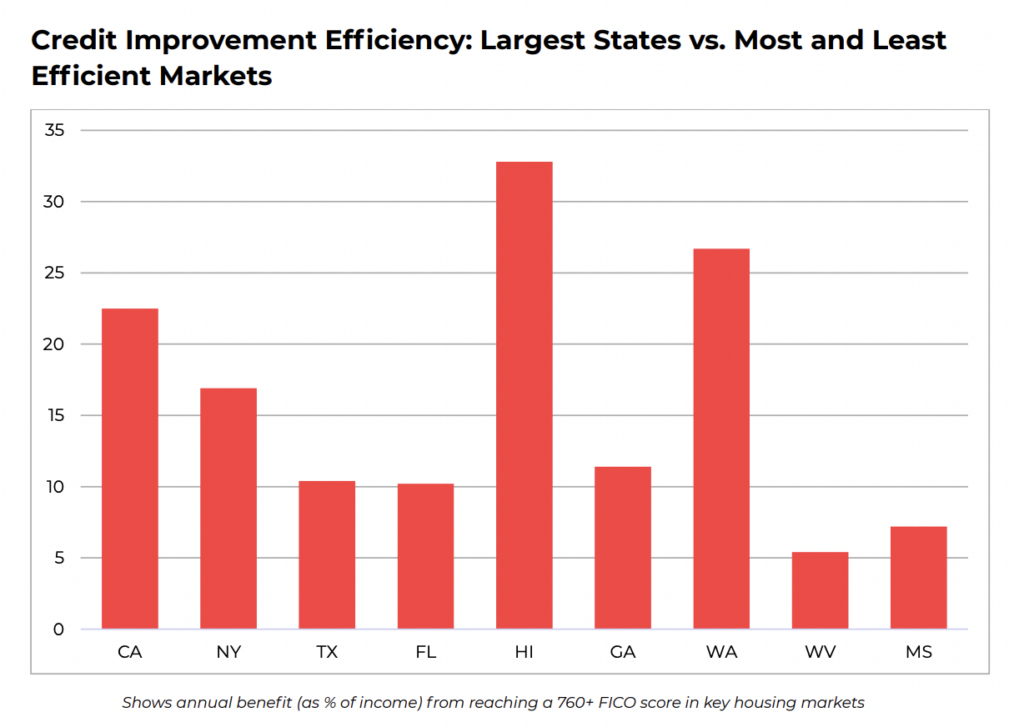
The results demonstrate how disparities in credit scores affect purchasing power in various property markets. Even slight increases in interest rates result in significant lifetime savings in states with higher prices. On the other hand, the penalty for not having top-tier credit is frequently proportionately higher in lower-cost areas in relation to loan amount and income.
“This data reinforces just how central credit preparation is to homebuying affordability,” said Max Slyusarchuk, CEO of AD Mortgage. “Two borrowers with similar incomes can experience dramatically different buying power depending on their credit score and the state in which they purchase. Even a 20- or 30-point difference in FICO can mean tens of thousands of dollars over the life of a mortgage.”
To read more, click here.