



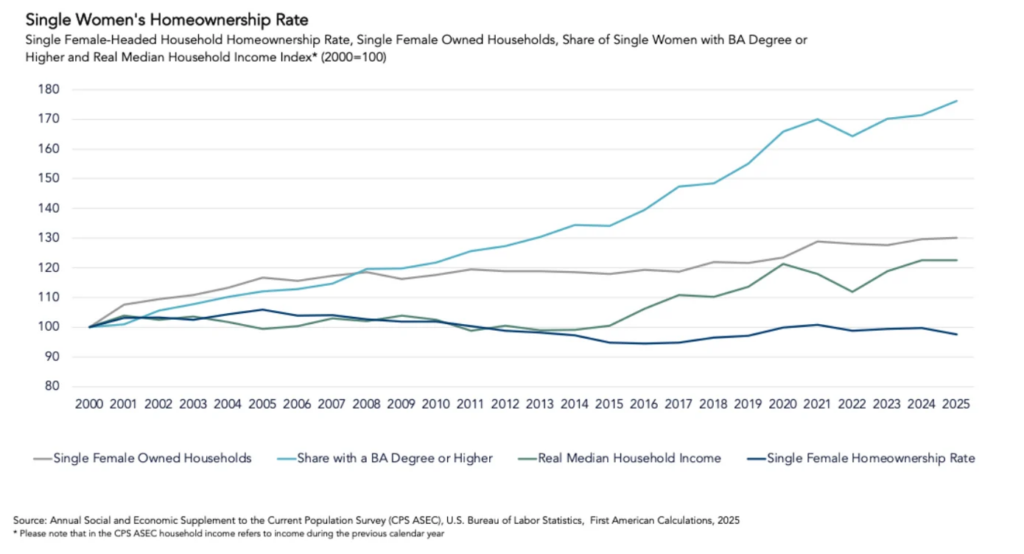
The most recent housing data from First American presents a complex but positive picture of women and homeownership as the country celebrates Women’s History Month and International Women’s Day. Over 20 million single women held homes in 2025, the most ever. However, the percentage of single women who own a home decreased somewhat from 51.9% to 50.9%. That slight decrease could initially seem to indicate a setback. However, a closer examination indicates something different: more single women became homeowners despite a difficult affordability situation.
Per First American experts, knowing what the homeownership rate measures is crucial. It shows the percentage of households that are homeowners. The overall number of single-woman families climbed even more quickly than the number of single women homeowners, which rose somewhat from the previous year. The rate decreased as a result of women’s household formation outpacing ownership expansion.
Top four reasons women purchase properties:
॰ Desire to own home of own: 27%
॰ Desire to be close to friends/family: 17%
॰ Change in family situation: 12%
॰ Retirement: 5%
One other possible explanation for why single women do better than single men when buying homes could be the occupants. Single women are slightly more likely to buy a multigenerational house and are more likely to have children under the age of 18.
“…The rising number of single women homeowners underscores resilience in the face of affordability pressures and confidence in homeownership as a pathway to long-term wealth,” said Deputy Chief Economist at First American.
Single Women Education, Income & Buying Activity Strengthens Nationwide
The ongoing rise in homeowner households led by single women is indicative of longer-term demographic and economic changes, women pursuing higher education more frequently. Higher educational attainment is strongly associated with increased earning potential and a larger chance of becoming homeowners. The percentage of unmarried women with a bachelor’s degree or more increased from 20% in 2000 to 35% in 2025, increasing the number of buyers who are financially equipped.
That trend has also been strengthened by household income growth. The purchasing power of single women has improved over time, with their real median household income rising from $42,000 in 2000 to $51,000 in 2025. These structural improvements in income and education offer a solid basis for homeownership, even though affordability is still tight compared to historical standards.
However, purchasers are nonetheless burdened by the general state of the market. Even if they have decreased from their recent highs, mortgage rates are still high when compared to the majority of the previous ten years. Home prices continue to be high, and inventory shortages continue to exist in many cities. This year, the general homeownership rate also decreased, highlighting the fact that challenges related to affordability are not specific to any one category. Nevertheless, single women became more prevalent in the housing market despite this setting.
A recent National Association of Realtors (NAR) report indicates that single women continue to be a significant and expanding portion of the home-buying demographic. Compared to single men, they make up a higher percentage of purchases, and stability is one of their main driving forces. In order to prepare for down payments and secure a home, many people report making major financial trade-offs, such as reducing discretionary spending, postponing holidays, or taking on more work. This tendency is consistent with what we seen in previous years. Despite the pandemic’s economic disruptions, which were frequently referred to as a “she-cession” because of its disproportionate effect on women’s employment, single women persisted in pursuing homeownership and accumulating wealth through housing.
Household Composition of Home Buyers, 1981-2025:
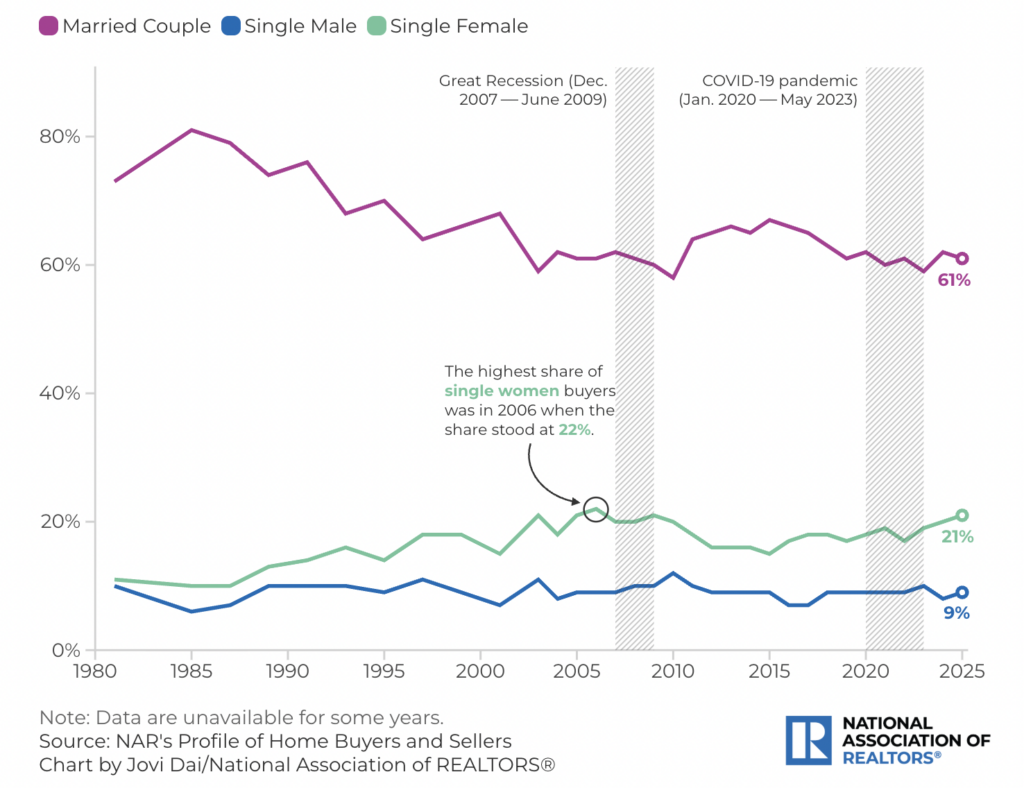
Per the mentioned NAR data pictured above, married couples made up 73% of home purchases in 1981, followed by single women (11%) and men (10%). These percentages are currently 61% married couples, 21% single women, and 9% single men. The percentage of single buyers is even higher among first-time purchasers. Today, only 50% of first-time buyers are married, compared to 75% in 1985. The percentage of first-time female buyers increased from 11% in 1985 to 25% in 2025. The percentage of single men increased little from 9% in 1985 to 10% in the latest figures.
In conclusion, in the U.S., owning a home continues to be one of the main ways to accumulate wealth. With every mortgage payment, homeowners accumulate equity, so turning monthly housing expenses into long-term savings. They also gain from the gradual increase in the value of their homes. A principal dwelling is often the biggest asset in a household’s portfolio. Headline homeownership rates can change annually, but they don’t necessarily give a whole picture.
The possibility of accumulating fortune is still a strong incentive, especially for unmarried women who want financial security and autonomy. Given that affordability is at its highest point since 2022, the market may encourage more women to make the long-term commitment to accumulating wealth through homeownership.
“…Broader market conditions continue to weigh on buyers,” Kushi said. “Mortgage rates, though down from their recent peaks, remain elevated compared to much of the past decade.”