


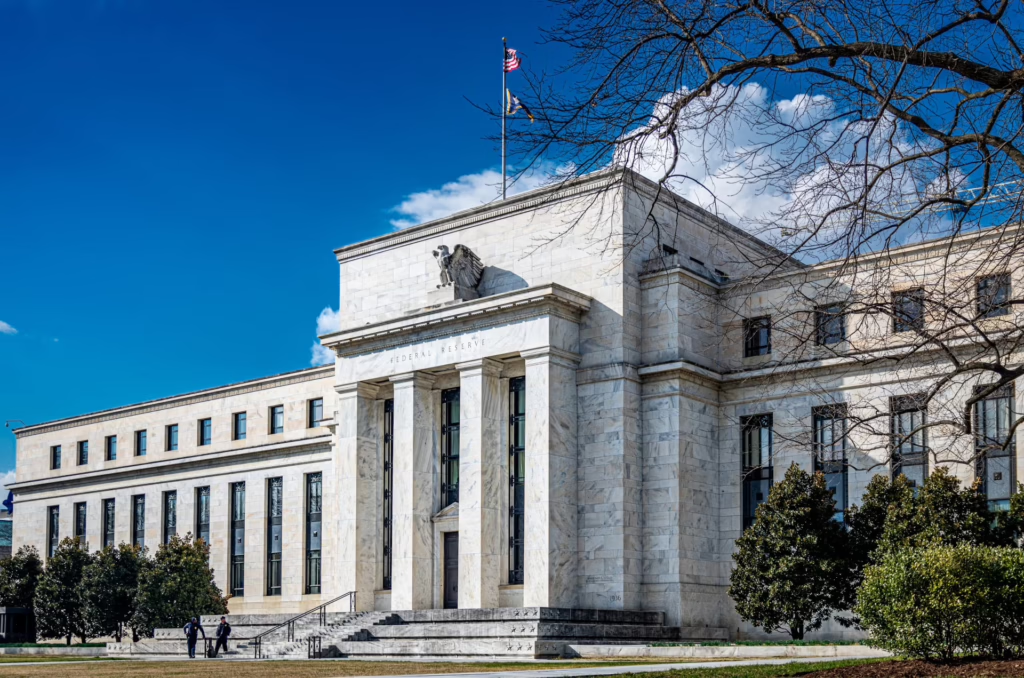
As expected, the Federal Reserve on Wednesday voted to hold its key interest rate steady while policymakers navigate their way through higher-than-expected inflation readings, mixed signs on the labor market, and a war in the Middle East.
And, at a press conference Fed Chair Jerome Powell made it clear he’s not leaving as chair until a DOJ investigation is over and his successor is confirmed.
The Federal Open Market Committee voted 11-1 to keep the benchmark federal funds rate set in a range between 3.5%-3.75%. The rate sets overnight funding costs for banks but influences a broad range of business and consumer borrowing.
Voting for the monetary policy action were Chair Jerome Powell, Vice Chair John Williams, Michael Barr, Michelle Bowman, Lisa Cook, Beth Hammack, Philip Jefferson, Neel Kashkari, Lorie Logan, Anna Paulson, and Christopher Waller. The Fed said that voting against the action was Stephen Miran, who said he preferred to lower the rate by 1/4 percentage point.
View of the Economy
In its post-meeting statement, the committee made few changes to its view on the economy, with a slightly faster pace of growth and higher inflation projections for the full year in 2026.
Despite elevated uncertainty, Fed officials again signaled they still expect a few rate cuts ahead. The “dot plot,” which reflects individual members’ rate projections, pointed to one reduction this year and another in 2027, with timing unclear.
Of the 19 FOMC participants, seven signaled they expected rates to stay unchanged this year, one more than the last update in December, CNBC reported. While future years showed a fairly wide disbursement of forecasts, the median outlook is for an additional cut in 2027 before the funds rate steadies out around 3.1% for the long term, CNBC noted.
The Fed’s statement noted the uncertainty associated over the war with Iran, which has been ongoing for roughly three weeks.
The fighting and its impact on the Strait of Hormuz has upset the global oil market and threatened to keep inflation above the Fed’s 2% target.
“The implications of developments in the Middle East for the U.S. economy are uncertain,” the statement said.
Prior to the Iran conflict, markets had been pricing in two cuts this year, with a remoted chance for a third, CNBC said. Rising oil prices and a string of firm inflation readings — entailing data from before the energy shock — have pushed expectations down to at most one cut in 2026.
Fed officials said that they see gross domestic product increasing at a 2.4% pace this year, somewhat faster than in December. Growth is projected to progress at 2.3% rate in 2027, up three-tenths of a percentage point from the previous outlook, CNBC said.
Upped Inflation Outlook
The Fed officials also upped their inflation outlook for this year. Now, they expect the personal consumption expenditures price index to reflect a 2.7% inflation rate, both on headline and core, CNBC reported. They see inflation falling back near the Fed’s 2% target in ensuing years as the impact of tariffs and the war fade.
Policymakers still expect a 4.4% unemployment rate by year’s end, despite a string of weak payrolls readings.
President Donald Trump continues to press Powell and his colleagues to lower rates. Trump criticized Powell earlier this for not calling a special meeting to ease rates, even with inflation running hot and the uncertainty of the war’s impact.
In his press conference, Powell indicated he would remain as Fed chair until an investigation involving the central bank’s headquarters is over, and would stay on until his successor is officially confirmed.
“On the question whether I will leave while the investigation is ongoing, I have no intention of leaving the board until the investigation is well and truly over with transparency and finality,” Powell said.
Powell also addressed the issue of whether Kevin Warsh isn’t confirmed as Powell’s successor. Sen. Thom Tillis, R-N.C., has said he will hold up the nomination in the Senate Banking Committee until a DOJ investigation into the remodeling is resolved.
“On the question of whether I will then continue to serve as the governor after my term ends and after the investigation is over, I have not made that decision yet, and I will make that decision based on what I think is best for the institution and for the people we serve,” Powell said.
Bright MLS Chief Economist Lisa Sturtevant said geopolitics is playing a big role in The Fed’s action.
“At the beginning of the year, there was optimism that solid labor market conditions and falling inflation would lead the Federal Reserve to cut rates and for mortgage rates to move lower. The average rate on a 30-year fixed rate mortgage did, in fact, dip below 6% briefly in February. But the ongoing geopolitical uncertainty has changed the calculus for the FOMC and for home buyers and sellers this spring,” Sturtevant said.
“If the conflict with Iran is short-lived, mortgage rates could move lower again, even if the Fed holds the federal funds rate steady at its next meeting,” she said. “However, if the conflict is prolonged or expands, the result could be higher inflation and higher mortgage rates. In that case, we may be looking not just at a delay in the spring homebuying season, but at a broader shift in the trajectory of a housing market that had been expected to rebound in 2026.”
The committee cut rates three times at the end of 2025.