



America’s Rental Housing 2026, the latest report from Harvard’s Joint Center for Housing Studies (JCHS), has been released. The study focuses on trends in the rental market and the significant affordability issues that tenants deal with. Rents somewhat decreased at the conclusion of the previous year as rental demand declined.
Despite this recent decline, there has been a longer-term upward movement in rents due to the high cost of building and the growing number of higher-income households in the rental market. The burden of housing costs is still a major issue. As a result, more and more locations are putting laws into place to increase the supply of rentals and make them more affordable.
Whitney Airgood-Obrycki, Senior Research Associate for JCHS, revealed six takeaways from America’s rental housing in 2026.
“At the end of last year, rental demand slowed and rents fell modestly,” Airgood-Obrycki said. “Despite this recent dip, the high cost of construction and the increasing presence of higher-income households in the rental market have contributed to a longer-term upward shift in rents.”
Additions to Apartment Demand and Supply Have Slowed
No.1: Slowing Nationwide Rental Demand
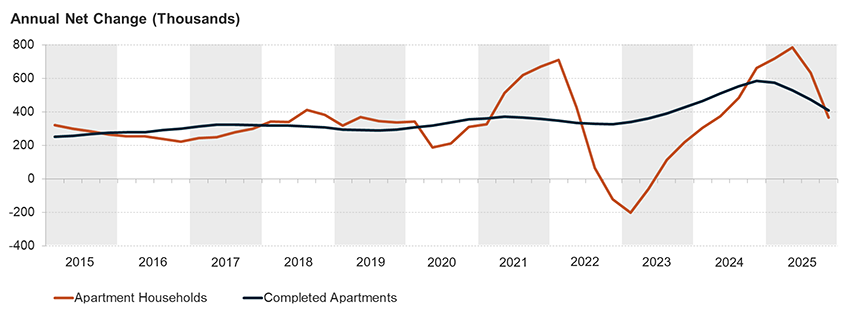
A record-high yearly increase of 784,000 apartment households in Q2 of 2025 was a result of the high cost of homeownership, which fueled robust renter household growth leading up to last year. As the year progressed, demand was significantly hindered by the poor employment market, economic instability, and immigration restrictions. The number of apartment households decreased to 366,000 in Q4 of 2025.
Higher-income households have been the primary source of new rental demand over the past ten years. The number of renter households earning $75,000 or more in inflation-adjusted terms increased by 1.7 million between 2021 and 2024, following a brief decline from 2019 to 2021 when households purchased homes at higher rates.
No. 2: Softening Rental Markets
Rents have decreased and vacancy rates have increased due to a downturn in demand and an influx of new flats. Growth in asking rents has been close to nil since mid-2023, following record-high hikes during the pandemic. Rents for professionally managed apartments decreased by 0.6% year-over-year in the fourth quarter of 2025. This trend was driven by declining rents in the West and the South, areas where new supply has been concentrated.
No. 3: Moderating Multifamily Construction
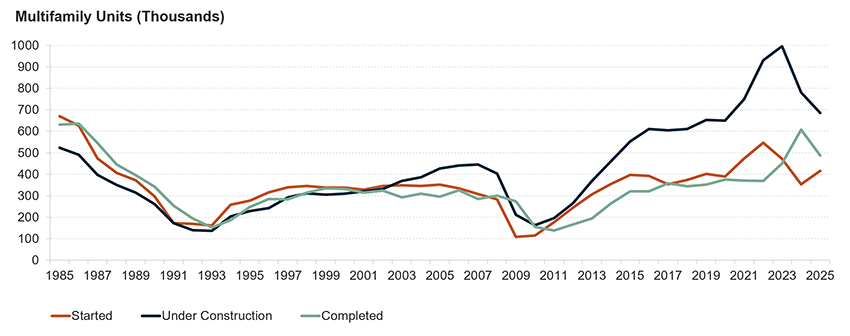
New building has become more challenging because to sluggish rent growth and rising costs. The multifamily pipeline is remains comparatively robust despite indications of decreasing building. 416,000 multifamily units were started in 2025, which is more than the pre-pandemic average but significantly lower than the most recent peak in 2022. Even while the number of units under construction dropped quickly from a record high of 996,000 in 2023 to 686,000 in 2025, it is still rather significant. Further, completions have remained high thanks to this strong pipeline. 608,000 multifamily apartments were finished in 2024, the most since 1986. In 2025, 488,000 units were added to the market despite a 20% decline.
The Heated Pace of Multifamily Construction Has Cooled
No. 4: Shifting Rent Distribution
The longer-term upward shift in the rent distribution has been exacerbated by the increased cost of developing and maintaining apartments after the pandemic. Between 2014 and 2024, the number of units renting for at least $1,400 increased by 11.8 million, with an additional 5.8 million renting for $2,000 or more. Simultaneously, there were 9.3 million fewer units renting for less than $1,400, including 2.5 million less units renting for less than $600.
No. 5: Affordability Setbacks Pose an Issue
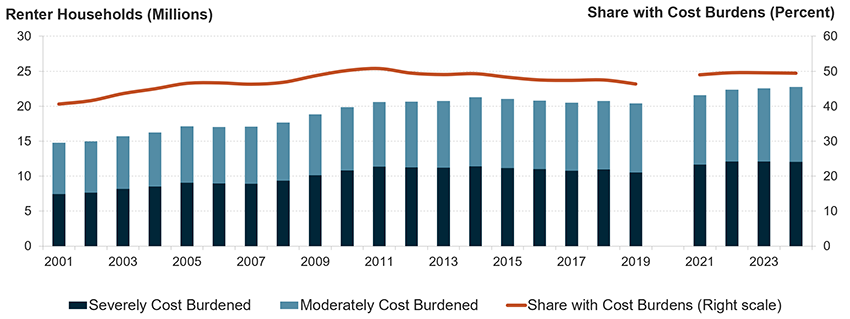
In 2024, the number of cost-burdened renter households reached a new high of 22.7 million (49%). There were nevertheless 2.3 million more cost-burdened households than in 2019 and 7.9 million more than in 2001, despite the fact that slowing rent rise made this a very small annual increase of 170,000 households. Further, 12.1 million renters (26%), who are highly burdened, spend more than half of their income on rent and utilities.
A growing portion of household income is being consumed by rising rents. While rents increased by 30% between 2001 and 2024, renter wages increased by 9% in real terms. Because of this, households’ residual income after rent has decreased, particularly for renters with lower incomes. Despite growing food and healthcare costs, the residual income of lower-income households has dropped by 60% since 2001 to a record low of $210. The social safety net helps mitigate these challenging trade-offs, but recent reductions to SNAP and Medicaid will make it even more difficult for tenants with lower incomes to keep up with rising expenses.
The Number of Cost-Burdened Renters Has Hit Another All-Time High
No. 6: Policy Solutions Driving New Trends
Bipartisan support for policy solutions has been bolstered by widespread unaffordability. The 2025 reconciliation bill permanently raised federal funding for the competitive Low-Income Housing Tax Credit by 12%. The HUD budget was raised by appropriations for fiscal year 2026, defying plans to drastically reduce rental assistance services. Additionally, the House passed the Housing for the 21st Century Act, which includes provisions to enhance supply, expand support for home repair and disaster recovery, and minimize administrative burdens, while the Senate passed the ROAD to Housing Act out of committee.
State and local governments are attempting to close the gaps by utilizing funding sources for rental assistance programs and enacting comprehensive zoning reforms, but federal resources still fall well short of what is required. Additionally, mixed-income and social housing models are becoming more and more popular among local governments; Seattle, Chicago, and Montgomery County, Maryland, are just a few of the locations implementing cutting-edge initiatives. However, the necessity for programs that assist renters in lowering housing expenses is highlighted by the expanding gaps in the social safety net. During a period of severe and pervasive unaffordability, these initiatives offer a bright point.
“Housing cost burdens remain a widespread concern. In response, a growing number of places are implementing policies to expand the rental supply and improve affordability,” Airgood-Obrycki said.
To read the full report, click here.