


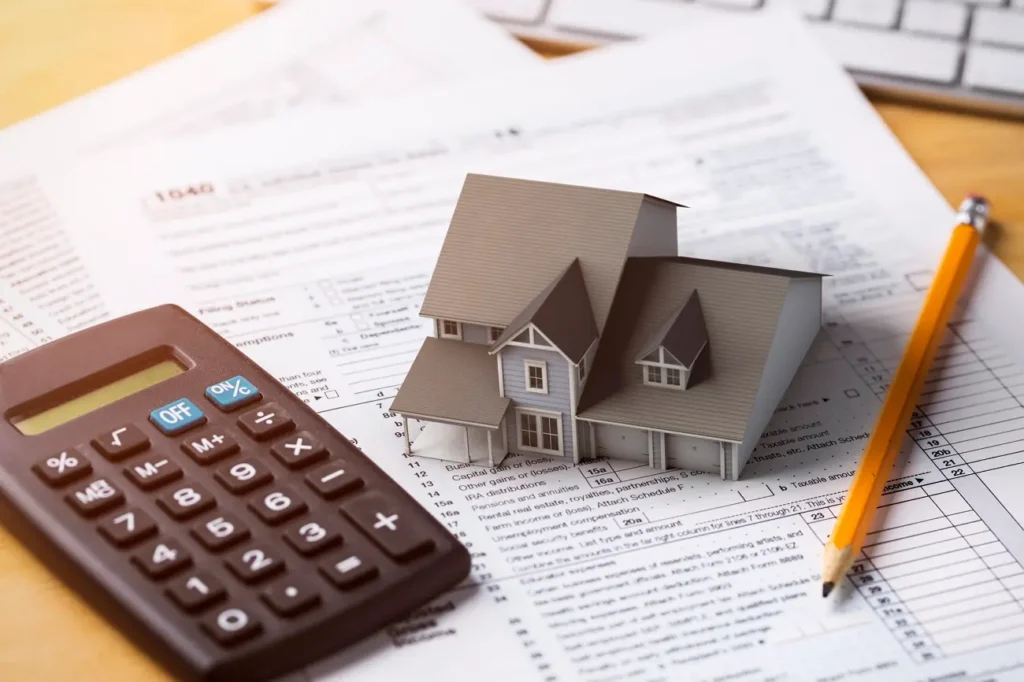
One of the biggest yearly lump-sum payouts that many households will receive this year is the average tax refund of $3,521 thus far in the 2026 filing season. Over the previous ten years, over 72% of filers have received a return, making it a standard benchmark for savings and an obvious point of comparison for more ambitious financial objectives like home ownership.
In a new study, Neighbors Bank examined how the typical tax refund amount has fluctuated over time and whether it may significantly assist in covering the initial cost of purchasing a home. In order to achieve this, the study converted the initial expenditures of purchasing a home into a straightforward metric: the average number of refunds required to recoup those costs. Ashley Harris, Production Manager & Director of Homebuying Education for Neighbors Bank, revealed just how much the typical homebuyer would need to purchase a home with saved tax refunds.
The national median home price in 2025 was $356,484, while the average tax refund was an estimated $3,167. According to those numbers, 12.66 typical tax refunds would be the upfront cost of buying a median-priced property with a traditional 10% down payment. The same benchmark was 6.86 refunds in 2009, indicating that during the study period, the upfront cost has almost quadrupled in terms of refund terms.
Homebuying in 2026 May Take Over a Decade in Tax Refunds
The difference between home prices and refund growth is a major factor in this change. Refund amounts have grown over time, but these increases have been erratic and somewhat small. On the other hand, the amount of money needed up front to purchase a property has increased significantly, making it harder for a single refund to cover that expense.
Tax Refunds Needed to Cover Cash to Close (10% Conventional):
| Year | Average tax refund amount | Median home cost | Average cash needed For upfront homebuying costs | Number of tax refunds |
|---|---|---|---|---|
| 2016 | $2,860 | $200,861 | $22,596.85 | 7.90 |
| 2017 | $2,888 | $212,900 | $23,951.22 | 8.29 |
| 2018 | $2,899 | $226,428 | $25,473.15 | 8.79 |
| 2019 | $2,869 | $237,769 | $26,749.04 | 9.32 |
| 2020 | $2,546 | $252,564 | $28,413.41 | 11.16 |
| 2021 | $2,815 | $290,680 | $32,701.46 | 11.62 |
| 2022 | $3,252 | $333,949 | $37,569.26 | 11.55 |
| 2023 | $3,167 | $341,950 | $38,469.34 | 12.15 |
| 2024 | $3,138 | $353,334 | $39,750.08 | 12.67 |
| 2025 | $3,167 | $356,484 | $40,104.50 | 12.66 |
Note: The average tax refund is calculated by averaging the refunds of all filers, not all Americans.
However, not all buyers make a 10% down payment. Programs that require little or no down payment can lower the initial outlay of funds, making homeownership more affordable for many households. The needed number of refunds is reduced by more than half when switching from a traditional loan with a 10% down payment to a 3% down option. That figure is further decreased by zero-down programs.
A smaller down payment does not, however, remove up-front expenses. Even for 0% down payment programs like VA and USDA loans, buyers must still pay closing costs and other loan-related expenditures, so cash is still needed at closing. In terms of refunds, such remaining upfront cost corresponds to 2.53 refunds for USDA loans and 3.83 refunds for VA loans in 2025. That lower barrier may seem more doable to many people than setting aside money for a 10% or 20% down payment. However, preparation is still necessary. The latest data reflects that disparity.
The average number of tax refunds required to purchase a property in 2025 across all loan types is as follows:
| Loan type | Average cash to close needed | Average tax refunds needed |
|---|---|---|
| Conventional (10% down) | $40,104.50 | 12.66 |
| FHA (3.5% down) | $23,171.49 | 7.32 |
| HomeReady / Home Possible (3% down) | $15,150.59 | 4.78 |
| VA (0% down) | $12,120.47 | 3.83 |
| USDA (0% down) | $8,020.90 | 2.53 |
Interest can help balances increase over time for households that are able to save over several tax seasons. A high-yield savings account (HYSA) is a typical location for a cash-to-close fund. Compared to ordinary savings accounts, HYSAs usually offer greater annual percentage rates, allowing deposits to increase while money is still available. These accounts are a popular choice for short- to medium-term savings objectives like a home purchase because they are frequently offered by banks and credit unions and are typically federally insured within normal limitations.
To put things in perspective, the FDIC national average savings rate was roughly 0.39%3 as of March 2026. These figures can change over time, even though many high-yield savings accounts have lately offered rates between 4% and 5% APY.
To demonstrate, Neighbors Bank looked at how using a HYSA at 4% affects saving for cash to close with tax refunds:
| Scenario | Annual tax refund contribution | Interest rate | Time to reach cash to close for 10% conventional |
|---|---|---|---|
| Without HYSA | $3,167/year | 0% | 12.66 years |
| With HYSA | $3,167/year | 4% APY | 10.45 years |
| With HYSA + $50/month contribution | $3,167/year | 4% APY | 9.08 years |
The average timetable can be shortened by more than two years just by earning interest. It can be further decreased by making even a small monthly donation. Nevertheless, a longer savings horizon may arise from depending solely on tax refunds. That time frame can be considerably shortened with lower down payment alternatives.
According to the data, purchasing a home now requires larger upfront savings than it did in the past. However, they also draw attention to a crucial point: there are other ways to get there. Many purchasers accomplish their goals by mixing techniques over time, whether it’s using tax refunds, saving monthly, or looking into reduced down payment possibilities. These methods can assist shorten the journey when combined with careful budgeting and astute financial planning. The road to homeownership can be more accessible than it seems with the correct strategy.
To read more, click here.