



A record-low 36% of homebuyers reported that their local housing market was overpriced despite a cynical outlook, suggesting that more and more markets are at their lowest, most inexpensive levels in five years. According to Auction.com’s 2026 Buyer Outlook Report, following a surge of confidence in early 2025, auction buyers were more pessimistic about the market in 2026.
“Local community developers buying at auction expect a slow-motion housing correction to continue in 2026,” said Jason Allnutt, Auction.com CEO. “The silver lining is they are also reporting improved affordability in an increasing number of local markets.”
The complete research, which is based on a poll of over 400 Auction.com buyers in February 2026, examines:
- How homebuyers expect home prices and rents to change in 2026
- How homebuyers expect their purchase activity to change in 2026
- Which barriers are limiting additional purchases on Auction.com, led by lack of well-priced inventory and competition from other buyers willing to pay more
Mark Fleming, Chief Economist at First American, explained that with a new record high since Auction.com began conducting the study in 2022, some 43% of all purchasers surveyed anticipate a decline in local property prices in 2026, up from 33% in 2025.
Consumers Weigh in on Today’s Market
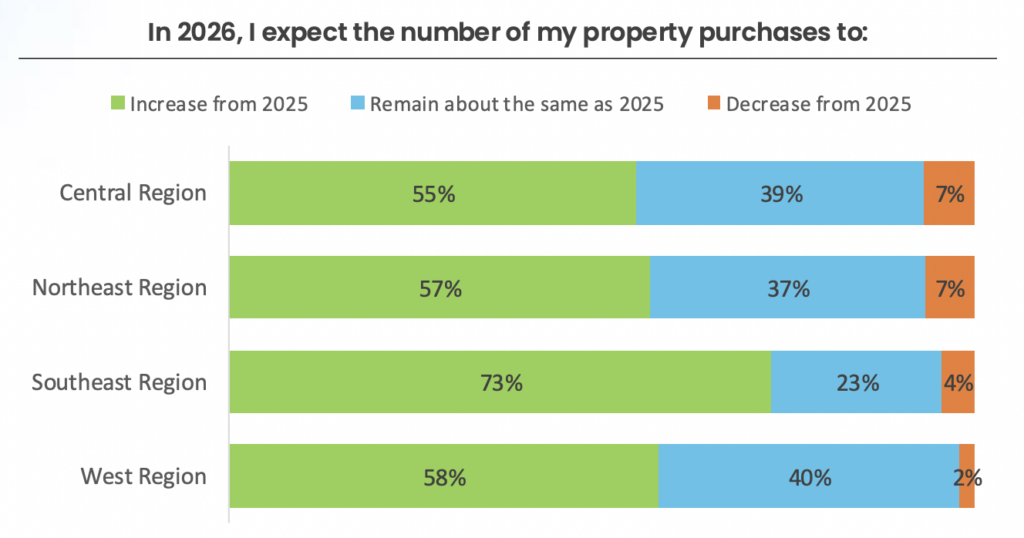
Some 43% of buyers anticipate a decline in local property prices in 2026—the largest percentage since the survey’s inception in 2022. Additionally, a record-high 31% of buyers anticipate a drop in rent in 2026. Additionally, an estimated 59% of buyers anticipate increasing their purchases of real estate in 2026, which is the lowest percentage since 2023 (54%). Despite this, a lot of consumers still anticipate greater price reductions in 2026, suggesting that the market has more to offer in terms of pricing.
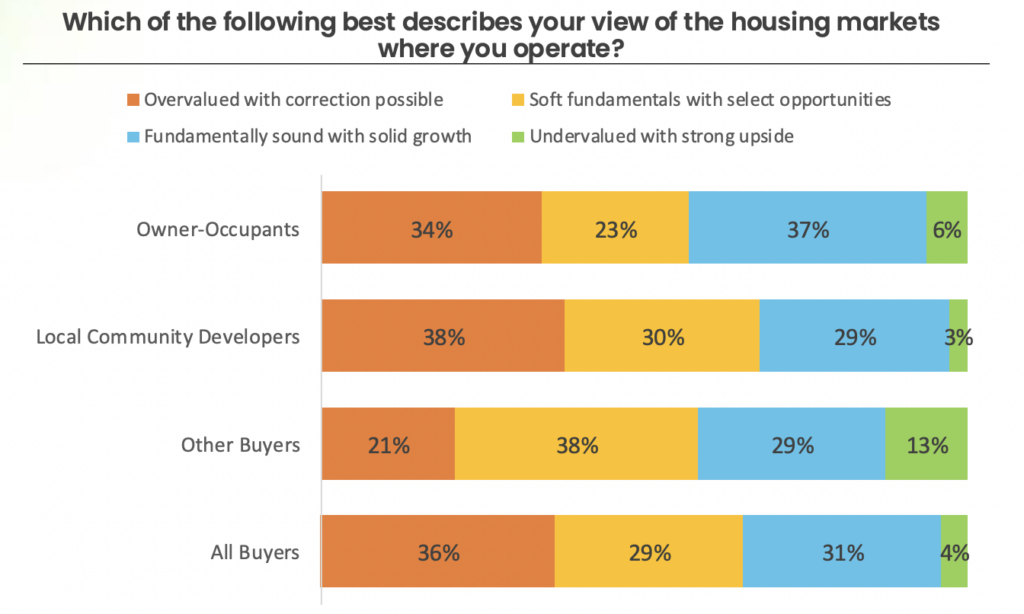
The local house market is “overvalued with a correction possible,” according to 36% of purchasers surveyed. That was the lowest percentage since Auction.com started doing this survey in 2022, down from 43% in the previous year’s survey. On the other hand, 31% of purchasers said that their local market was “fundamentally sound with solid growth,” which is the highest percentage since the study started in 2022 and up from 28% in the previous year.
A new high for the study was reached when 29% of buyers said their market had “soft fundamentals with select opportunities,” up from 26% a year earlier. Unchanged from a year earlier, only 4% of purchasers said their market was “undervalued with strong upside.”
Among all buyer types, roughly 38% of local community developer purchasers said their local market was “overvalued with correction possible.” Only 21% of buyers who were not local community developers and owner-occupants chose to characterize their local market as overpriced. Compared to 29% of local community developers and 29% of other buyers, owner-occupant buyers were the most likely to characterize their local market as “fundamentally sound with solid growth.” Other purchasers were more likely to characterize their market as undervalued (13%) or having soft fundamentals (38%).
Regional, Statewide Differences Affecting Consumer Sentiment
In 2026, buyers in the Central region of the country—which includes Texas, Ohio, Michigan, and Illinois, among other states—were most likely to anticipate a decline in home prices (50%), followed by those in the Southeast (49%) and the West (47%). The Northeast area, which includes states including New York, New Jersey, Virginia, and Pennsylvania, had the lowest percentage of buyers—37 percent—who said they anticipated a decline in home prices in 2026. Of all buyers, 40% anticipate a small increase in home prices of up to 5%, while 17% anticipate an increase of more than 5% in 2026. This is the lowest percentage since the study started in 2022, down from 20% in 2025.
Rent prices in local markets are expected to drop in 2026, according to nearly one-third of all purchasers surveyed (31%), up from 26% in 2025 to a new record high for as long as this question has been asked in the study (2023). Buyers in the Southeast, which includes Georgia, Florida, Tennessee, and Alabama, among other places, were the most likely to anticipate rent reductions in 2026 (42%), followed by those in the West (38%). In terms of the percentage of buyers anticipating declining rents in 2026, buyers in the Central region (28%) and Northeast region (27%) were closely aligned.
Only 11% of purchasers surveyed anticipate rent increases of more than 5% in 2026, a record low for the survey, while the majority (58%) anticipate a mild increase of 1% to 5%. In comparison to 2025, more than nine out of ten buyers (92%) stated that they anticipate their real estate purchases will either rise or stay the same in 2026. This was a minor decrease from the 94% of consumers who predicted that purchases will either rise or stay the same in 2025.
The most likely buyers to anticipate an increase or stagnation in their property purchases were those who renovate and rent (94%), closely followed by those who renovate and resell to owner-occupants (93%). The least likely buyers (70%) to anticipate a rise or stagnation in real estate purchases in 2026 were those who were predominantly using another kind of investment plan.
The Southeast area of the country has the largest percentage of purchasers who anticipate a rise in real estate purchases in 2026—nearly three out of four (73%). Georgia, Florida, Tennessee, and Alabama are among the states that make up the Southeast. Less than 60% of purchasers in all other regions indicated that they anticipated a rise in real estate purchases in 2026, with the West region leading the way at 58%, followed by the Northeast at 57%, and the Central at 55%.
According to the most recent Auction Market Dispatch from Auction.com, several states in the Southeast area recorded some of the biggest yearly gains in foreclosure auction volume in Q4 2025. Florida (up 176%), South Carolina (up 153%), Georgia (up 140%), and North Carolina (up 138%) were among those states.
To read the full report, click here.