
After six consecutive monthly rent decreases, the national median rent increased by just 0.5% in March for the second straight month, according to the Apartment List National Rent Report. This turn indicates that the market is beginning to emerge from the off-season, and as moving activity picks up in the coming months, we’ll probably continue to witness gains in accordance with normal seasonal patterns. As fewer tenants move in the fall and winter, prices often decline. However, as the peak moving summer season approaches, prices start to progressively rise. March is maintaining the pattern of positive rent growth that began in February.
The general trends of this cyclical pattern are constant, but in recent years, the market has seen a sluggish period amid a rush of new multifamily development, resulting in greater winter declines and more moderate summer rises. Since 2022, we have seen both a minor shift in the timing of rental market seasonality and harsher winter reductions. Rent growth used to peak in May, but over the last three years, March has been the hottest month, with rent growth slowing down during the months when prices would rise the fastest before the epidemic. Experts believe consumers may see more soft pricing in 2026 if that trend persists.
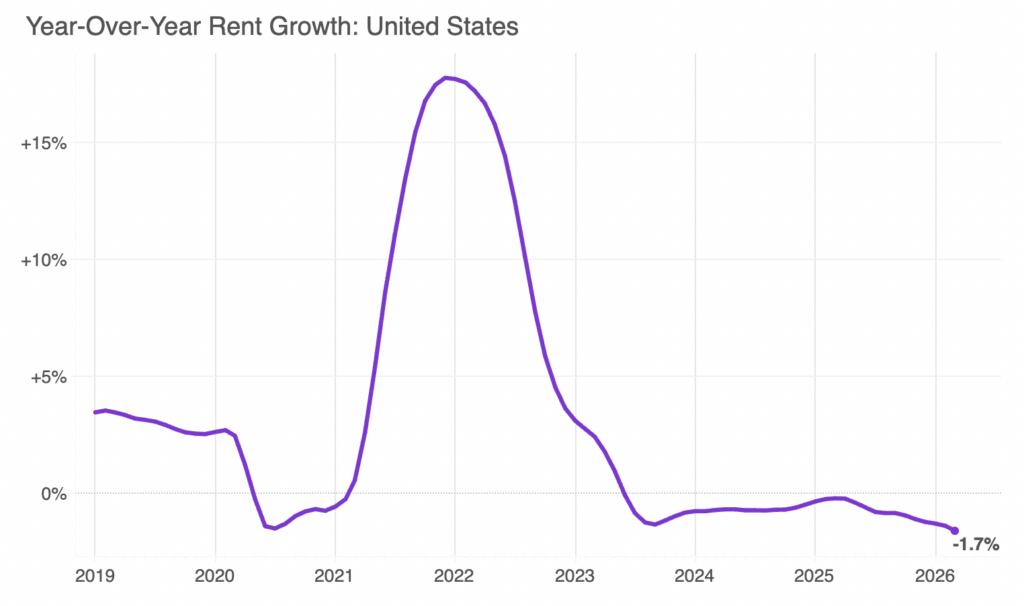
The U.S. housing market experienced a decrease in year-over-year rent growth to -1.7% because this March’s rent increase (+0.4%) was somewhat more mild than last year’s (+0.6%). For the first time since mid-2023, annual rent growth seemed to be on track to turn positive a year ago. However, as demand has slowed due to a more uncertain labor market, that bounce has stopped and reversed course. Since last April, year-over-year rent growth has been steadily declining. This month’s figure of -1.7% sets a new record for the lowest year-over-year rent growth in our estimates, which date back to 2017.
The national median monthly rent is currently $1,363, which is an estimated $23 less than it was in March 2025. After a year and a half of exponential increase, prices reached their high in the middle of 2022. Since then, the median rent across the country has been steadily declining and has dropped by $79 a month, or 5.5%, from that peak. Rent levels are still 19% higher today than they were at the beginning of 2021, notwithstanding the price decline.
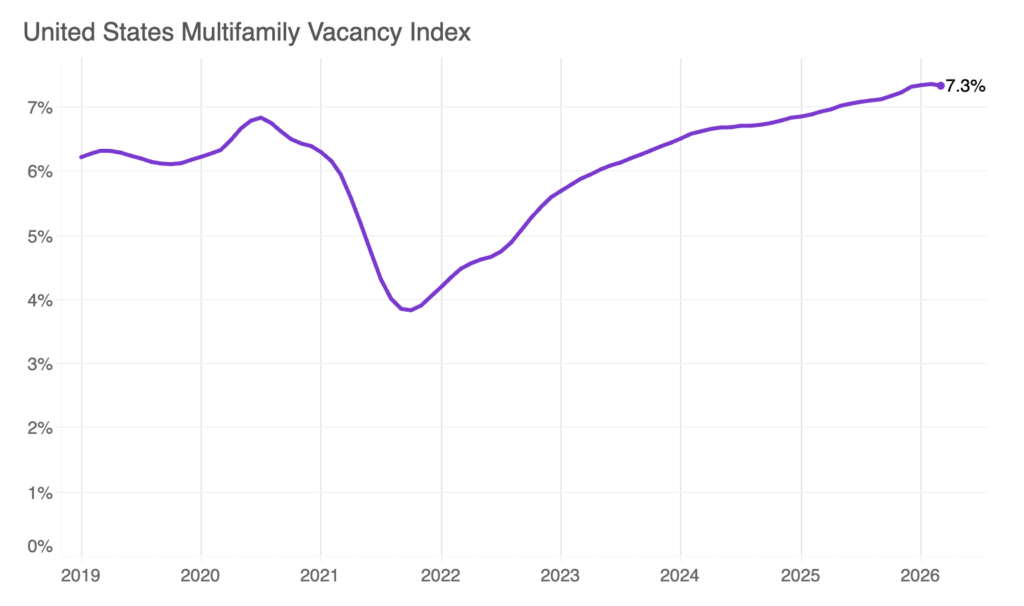
Multifamily Vacancies Hit Their Highest Level Since 2017
A historic spike in multifamily building is the primary cause of the three-year-old depressed market conditions. We are currently over the apex of that supply wave, but it is still ongoing. More than 600,000 new multifamily units were introduced to the market in 2024, the highest number since 1986. Then, less than 500,000 units were supplied in 2025, and even less are anticipated in 2026. However, the number of units anticipated to hit the market this year is still somewhat over the long-run average despite the steep decline, suggesting that supply growth is still rather strong even as we come to the end of the boom.
Due to the increased number of unoccupied units on the market brought about by this new inventory, property owners now have less pricing power and are up against more competition for tenants. The average vacancy rate of stabilized properties in our market is measured by our national vacancy index, which is now at 7.3%. Since at least 2017, when we began monitoring occupancy, this is the greatest level. Occupancy and pricing trends should start to progressively tighten as the market eventually absorbs the surge of new units. However, conditions are still mild for the time being, and if anything, the runway for current slow conditions is probably getting longer.
Employers in the U.S. are laying off workers, according to the Bureau of Labor Statistics’ most recent data, and the Iranian conflict is driving up costs just as inflation was beginning to decline. Due to these causes, many people are experiencing increased financial instability, which in turn reduces demand for property.
The number of unoccupied units on the market has increased along with the length of time such properties have been unoccupied. The “time on market” indicator provided by Apartment List indicates how long it takes for units to be rented after they are initially posted on our platform. This month had a minor decrease in the highly seasonal “list-to-lease” period, which coincided with a positive month-over-month rent growth flip. The average number of days that units rented in March were on the market was 38, compared to 40 days in the previous month.
List-to-lease time is still significantly higher than it was last month, despite a minor decrease. Units are taking more than twice as long to flip over as they did in mid-2021, when the market was at its peak, and this month’s reading is the longest we’ve observed in any March since our tracking started in 2019 (January’s 41 days set the overall record). This longer list-to-lease period is consistent with soft occupancy, negative rent growth, and a generally chilly rental market.
Regional Rental Trends, Declines & More
The nation is home to 56 sizable metro areas with a population of one million or more. Approximately 48 of these markets saw monthly rent increases in March, whereas 36 saw yearly rent decreases. Rent patterns differ greatly by area, with the South and Mountain West currently experiencing the worst annual drops. Despite the winter slowdown, prices are still rising in several cities in the Northeast, Midwest, and portions of the West Coast.
Among major metro areas, Austin, Texas, has had the biggest loss in the country; the median rent for the entire metro area has decreased by 6% over the past 12 months and by more than 20% from its peak in 2022. Another noteworthy aspect of the Austin metro is that it permits new homes at the quickest rate of any major metro in the nation, demonstrating the effect of increased supply on declining rents. This tendency is not unique to Austin; many of the 10 metro areas with the biggest annual rent decreases also have some of the highest multifamily permit rates (e.g., San Antonio, Denver, Phoenix, Tampa, and Orlando). Interestingly, practically all of these markets are found in the popular Sun Belt region.
On the opposite end of the scale, the Virginia Beach, Virginia metro area currently has the fastest rate of rent rise, with prices rising 5.5% in the last 12 months. San Francisco and San Jose, CA, two Bay Area metro areas, complete the top three because of the surge in high-paying tech jobs brought about by the AI boom. Despite mild national conditions, several Midwestern locations, such as Chicago, St. Louis, and Minneapolis, have also maintained consistent positive rent increases, with demand being supported by the region’s relative affordability.
Although multifamily conditions are still favorable, the rental market has started to turn the corner toward the busier spring leasing season. While vacancies and time-on-market are at their highest points, year-over-year rent growth reached a new low this month. Although the development boom that has been causing these conditions is slowing down, it currently seems that lower rental demand could maintain favorable rental conditions. Demand is being negatively impacted by a weak labor market, fresh worries about inflation, and general macroeconomic uncertainty. As a result, even if the building sector slows down concurrently, it will take longer for the market to absorb the recent increase in the rental stock.