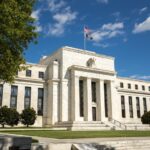



Kevin Warsh made his much-anticipated debut Wednesday as Federal Reserve Chair, announcing that the Federal Open Market Committee voted 12-0 to hold interest rates unchanged at a range of 3.5 to 3.75%, as most observers predicted it would.
While, President Donald Trump appointed Warsh to cut interest rates, most of Warsh’s colleagues on the FOMC signaled in their economic outlook Wednesday that they anticipate hiking rates at some point this year.
Notably, the Fed truncated the statement it publishes along with each vote to be shorter and to remove much of the details about Fed policymakers’ thinking about the state of the economy. Here’s what the committee’s release said:
“The Committee decided to maintain the target range for the federal funds rate at 3-1/2 to 3-3/4 percent, in support of the Federal Reserve’s dual mandate. The Committee reaffirmed its policy of maintaining ample reserves in the banking system.
“Economic activity is expanding at a solid pace despite elevated uncertainty that owes, in part, to the conflict in the Middle East. Productivity growth and capital investment are strong. Job gains have kept pace with the workforce, and the unemployment rate has changed little.
“Inflation remains elevated relative to the Committee’s 2% goal, in part reflecting supply shocks that have driven price increases in certain sectors, including energy. The Committee will deliver price stability.”
Highest Inflation in Three Years
The vote came at a time of the highest inflation in three years, largely because of the U.S. conflict in Iran that has wreaked havoc on oil prices. A tentative deal is in place to end the war with Iran, and the labor market has shown unexpected signs of strength, NBC News reported.
ABC News reported that the policy move will arrive at a moment of flux for the nation’s economy, just days after an agreement between the United States and Iran offered hope for some price relief.
On Wednesday, senior U.S. officials dictated the memorandum of understanding with Iran to journalists after days of secrecy, and Iran suggested that its deal with the United States could be signed by Presidents Donald Trump and Masoud Pezeshkian, the Associated Press reported.
Such a signing ceremony would represent a major step for the two nations, which saw diplomatic relations break off in 1980 over the U.S. Embassy hostage crisis in Tehran.
Senior U.S. officials on Wednesday dictated the memorandum of understanding with Iran to journalists after days of secrecy, and Iran suggested that its deal with the United States could be signed by Presidents Donald Trump and Masoud Pezeshkian.
The U.S.-Iran agreement, reportedly to be formally signed on Friday, came as gasoline prices fell below $4 a gallon for the first time since March, ABC reported. Still, fuel costs stand well above pre-war levels, and an array of grocery prices remain elevated, too.
Warsh Establishes Five Task Forces
In his first post-vote press conference as Chair, Warsh announced he is establishing five new independent task forces to address issue of the economy that he said are “worthy of a fresh look.” Warsh was sworn in as Chair last month.
For the task force initiative, Warsh said he was “enlisting some of the very best minds, both inside and outside the economics profession.”
The five task forces will focus on:
- Fed communications, including reconsidering the central bank’s quarterly Summary of Economic Projections, which shows where individual policymakers at the Fed expect short-term interest rates.
- The Fed’s balance sheet
- The central bank’s “use and reliance on existing data sources”
- “Productivity and jobs in an era of transformation”
- The Fed’s inflation frameworks.
Warsh said the task force leaders will have a “straightforward charge: start with first principles, ask hard questions, examine current practice, consider alternatives and ultimately propose next steps for policy-maker consideration.”
The Fed’s dual mandate of price stability and maximum employment is facing some pressure.
The latest data from the U.S. Department of Labor shows the U.S. added 172,000 jobs in May, outperforming expectations, but with 93% of the new roles coming from the healthcare, hospitality, or local government sectors.
Meanwhile, the financial sector cut 22,000 jobs in May and has 107,000 fewer roles than it did at its peak last year, according to government data. The tech sector also has laid off 116,000 employees this year.
Housing Sector Impact
While the Federal Reserve doesn’t set mortgage rates, its policies help determine the cost of borrowing on most everything, CNN reported.
In other words, decisions made by Warsh could ripple through the housing market, affecting mortgage rates, home affordability, and new home construction. According to CNN, here’s what housing industry experts have to say:
Chen Zhao, Head of Economics Research at Redfin: “It’s clear that we’re in a new era and it’s going to take a while for markets to figure out how to react to today’s Fed meeting. But one thing is certain: the committee as a whole is taking inflation very seriously, which means mortgage rates are unlikely to retreat much in the near future.”
Bill Banfield, Chief Business Officer at Rocket Mortgage: “Home sales are responding more right now to labor market strength than rate moves. If the labor market remains healthy, buyers will continue to enter the market regardless of whether the next move from the Fed is a cut, pause or even a hike.”