



According to the annual Realtor.com Investor Report, investor buying activity remained stable as house sales dropped to a multi-decade low in 2025, hitting 11.3% of all purchases—up from 11.0% in 2024—while investor selling declined for the first time in two years. In 2025, investors bought around 534,000 homes, up 0.7% from the previous year, despite a 2.1% decline in non-investor home sales overall. In the meantime, 442,000 properties were sold by investors, which is 1.5% less than the previous year and the lowest number since 2020. This indicates that investors are no longer liquidating their pandemic-era holdings at the rate observed in prior years.
“The investor market has found a new equilibrium,” said Hannah Jones, Senior Economist at Realtor.com. “With small investors now comprising nearly two-thirds of all investor purchases and large institutional players continuing to pull back, the dynamics shaping competition in entry-level housing are shifting—but that competition hasn’t gone away, particularly in affordable Midwest and Sun Belt markets.”
Investor purchases decreased by 22.6% during the same period, although overall property sales were down more than 25% from the peak of 2021–2022. Zooming out further, investor acquisitions increased 14.6% while overall home sales decreased 14.3% from pre-pandemic levels. This discrepancy highlights investors’ continued involvement even as normal buyers stay on the sidelines.
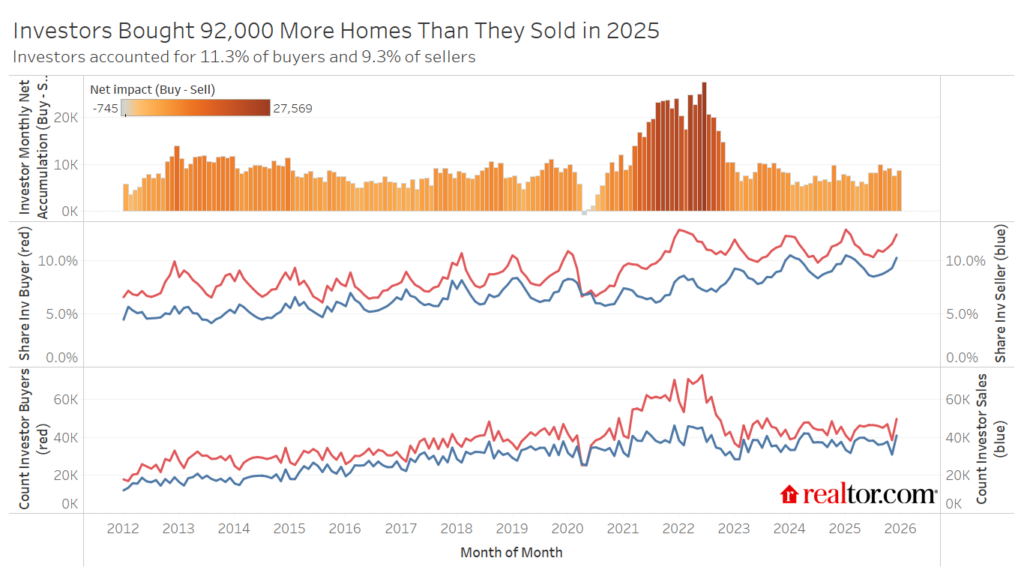
In 2025, investors exhibited significant indications of pulling back from the sell side following two years of record-high selling. Although the absolute number of investor sales decreased from 448,000 to 442,000 in 2025, the percentage of investor sellers remained at 9.3%, which was the same as in 2024. Consequently, the difference between purchases and sales, or net investor accumulation, increased from about 80,000 properties in 2024 to over 92,000 in 2025.
As a result of the aggressive accumulation that occurred in 2021 and 2022, the investor sell share of 9.3% is still significantly higher than the pre-pandemic norm of 6.7%, even with the year-over-year lowering. However, the path of travel has changed. The market seems to have regained a more steady footing, and investors are no longer flooding supplies at the rate observed during the post-pandemic correction.
Mega-Investors Reach a Decade-Plus Low, Small Investor Share Grows
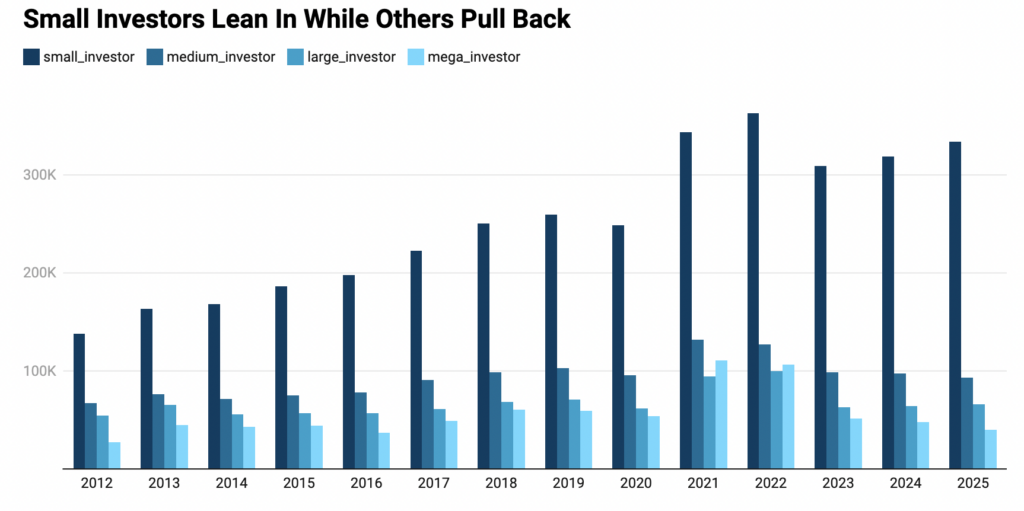
Not only has the number of active investors in the property market changed during the pandemic, but so have the identities of those investors. Mega investors, or those who made 350 or more purchases, saw a modest increase in their average percentage of all investor purchases in 2021 and 2022, reaching a peak of over 16% in 2021. Mega investors made up just 7.5% of investor purchases by 2025, which is their lowest percentage since 2011. Since then, their purchase volumes have decreased by over 70%.
The bulk of the investor buyer market has traditionally been made up of small investors, or corporate entities with fewer than ten total purchases, and this dominance has grown. The percentage of all investor purchases made by small investors increased to over 63% in 2025 as larger operators retreated, marking the highest concentration of small-investor activity in almost 15 years. Small investors continue to be net-buyers, purchasing over 53,000 more properties than they sold in 2025, despite the fact that all other investor size categories have shifted to net-selling in recent years.
“Small investors are the stable floor beneath the more volatile institutional activity,” Jones said. “They purchase at a median of $330,000 nationally—about 25% below the overall market median of $440,000— meaning they are systematically active in the entry-level tier where first-time buyers are also competing. In high-investor metros like Kansas City, that gap stretches to more than $100,000, making the overlap with first-time buyer budgets particularly acute.”
While mega-investor net accumulation has dramatically declined, large investor acquisitions are down about 30% from their peak and are still declining. Mega investors have sold almost 135,000 more houses than they bought over the last three years, which is a significant, if slow, return of supply to the market.
Top 10 Metros with the Highest Investor Buyer Share for 2025:
| Metro | 2025 Investor Buyer Share | YY |
| Memphis, TN-MS-AR | 23.7 % | 1.2 % |
| Kansas City, MO-KS | 21.2 % | 1.5 % |
| St. Louis, MO-IL | 21.1 % | 1.2 % |
| Birmingham, AL | 21.0 % | 3.2 % |
| Oklahoma City | 17.9 % | -1.9 % |
| Las Vegas-Henderson-North Las Vegas, NV | 16.5 % | 2.7 % |
| San Antonio-New Braunfels, Texas | 15.9 % | 1.5 % |
| Dallas-Fort Worth-Arlington, Texas | 15.6 % | 0.8 % |
| Indianapolis-Carmel-Greenwood, IN | 15.1 % | -0.5 % |
| Cleveland | 15.0 % | 2.3 % |
Geographically, investor activity was still very concentrated in 2025. Memphis, TN (23.7%), Kansas City, MO-KS (21.2%), and St. Louis (21.1%) lead the US in investor buyer share among the 50 largest metro areas. This means that approximately one in four or five properties sold in these regions went to a corporate investor. The top five were completed by Oklahoma City (17.9%) and Birmingham, AL (21.0%). These markets are similar in that they have significant rental demand, comparatively low median prices, and enough transaction volume to draw in both local small-investor operators and investors with growing regional footprints.
The image of the Sun Belt is more diverse. Due to population growth and a consistent supply of entry-level inventory, San Antonio, Texas (15.9%) and Dallas-Fort Worth (15.6%) continue to be extremely investor-active. Among major metropolitan areas, Birmingham and Las Vegas experienced the most notable year-over-year acceleration, with investor buy share increasing by 3.2 and 2.7 percentage points, respectively. Part of the reason for the spike in Las Vegas was the lowering of prices, which gave investors who had mostly left the market during the 2022–2023 rate shock fresh chances to make purchases.
“Atlanta is perhaps the most striking reversal in the data,” Jones said. “Once among the most investor-active markets in the country, Atlanta’s investor buy share has now fallen below its pre-pandemic baseline at 10.0% – and investors were net sellers there in 2025 by nearly 1,800 properties, the largest negative net position of any major metro. The combination of elevated prices, a softening rental market, and significant earlier accumulation appears to have pushed that market into an ongoing offload cycle.”
Conversely, among large metro areas, the most expensive West Coast and Northeast markets continued to be the least penetrated by investors. The rates in Portland, OR (5.8%), Sacramento, CA (6.1%), and Hartford, CT (6.1%) were all significantly lower than the national average, which can be attributed to greater acquisition costs, lower rental yields, and, in certain cases, legislative regimes that have reduced the appeal of residential investment. In 2025, Sacramento and Portland both reported as net investor-selling markets as investors continued to sell off holdings from the epidemic.
Instead of continuing to decline, the 2025 data shows an investor market that has found a new floor. Since small investors account for two-thirds of all investor activity, the investor buy share has now remained above 11% for three years running. Even if financing circumstances continue to be difficult, this floor is unlikely to rapidly erode.
Overall, experts suggest one potential source of future growth is eliminated by the composition shift away from mega investors, but it also eliminates the most likely source of significant market exit. The higher but steady investor share in 2025 seems to be the new norm unless there is a major shift in the rental economics that support small-investor profits or local governmental intervention aimed at corporate ownership.
To read more, click here.