



According to the recently released State of the Nation’s Housing study, declining immigration is impeding population growth, making communities more dependent on natural change (births minus deaths) and domestic migration, According to Harvard’s Joint Center for Housing Studies, these two factors (domestic change) differed significantly amongst county types in 2025; this variety will determine which towns may continue to expand while immigration declines.
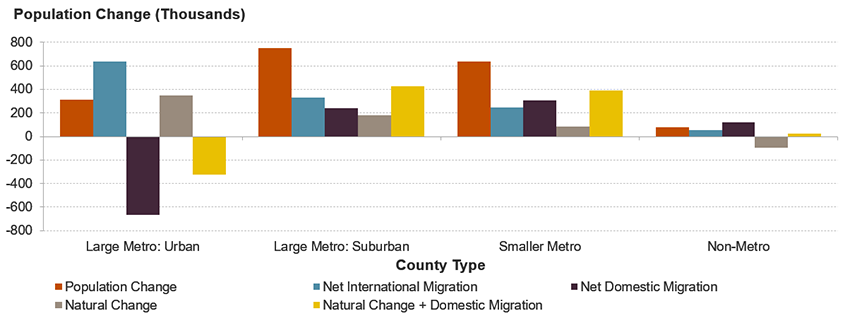
Due to severe losses from domestic migration in big metro urban counties and sharp losses from natural change in rural counties, population growth is most susceptible to drop from reduced immigration. Due to the benefits of all aspects of domestic change, large metro suburban and smaller metro area counties are better positioned for modest but persistent growth.
In 2025, the total population of all county types increased thanks to immigration. Without it, population growth in rural counties would have been minimal, growth in suburbs and smaller metro areas would have been cut in half, and population loss would have occurred in large metro urban counties. Large metro urban counties lost 321,000 residents due to domestic change, with a sharp net domestic outflow of 668,000 individuals offsetting their comparatively robust natural growth of 347,000.
On the other hand, non-metro counties, which are predominantly rural, saw a net domestic influx of 119,000 that barely compensated for their natural loss of 95,000, leading to a domestic growth of only 24,000. The population of large metro suburban counties increased by 424,000 due to both natural growth (181,000) and net domestic inflows (243,000).
In comparison to their major metro suburban equivalents, smaller metro counties had increase from both factors, with slightly larger net inflows (306,000) and poorer natural growth (86,000), resulting in domestic growth of 392,000 people. Further, about 60% of the total population increase in major metro suburban and smaller metro counties and 30% of the growth in rural counties can be attributed to these domestic growth levels.
Urban & Rural Areas Prone to Population Loss
Mapping population change based only on these two factors reveals this difference in domestic change in major metropolitan regions across the nation. Large metropolitan areas’ suburbs had significant aggregate gains from domestic change, whereas their urban cores witnessed significant aggregate losses. For instance, Harris County, Texas (which includes Houston), lost over 8,000 residents due to a net domestic outflow of 43,000 that exceeded the county’s natural growth of 35,000.
The Houston metro’s suburban counties saw 7,000 new residents on average. In fact, in 2025, a number of these counties had some of the fastest rates of growth in the nation. With one regional exception—suburban counties in the Northeast saw aggregate domestic loss due to net domestic outflows—this pattern is repeated in major metropolitan areas across the country.
With the exception of the Northeast once more, counties in smaller metropolitan areas also benefited from domestic change. In contrast to Hampden County, Massachusetts (Springfield) in the Northeast, examples include Ada County, Idaho (Boise) in the West, Cass County, North Dakota (Fargo) in the Midwest, and Hamilton County, Tennessee (Chattanooga) in the South. Smaller metro counties lost 10,000 residents overall in the Northeast as a result of both net domestic outflows and natural loss, while they gained 292,000 from domestic change in the South, 79,000 in the West, and 31,000 in the Midwest.
Domestic change contributed to the overall expansion of rural counties, but whether a rural county benefited or suffered from these factors varied greatly depending on its location. While rural counties in the Northeast, Midwest, and West all experienced losses of 7,000, 6,000, and 500 persons, respectively, due to natural losses that outpaced net domestic inflows in each region, rural counties in the South witnessed an overall gain of 38,000 people from domestic change in 2025.
However, the elements of domestic transformation themselves are deteriorating. According to the American Community Survey, interstate migration decreased in 2024 for the second year in a row. Due to the failure to significantly recover from the epidemic, natural change in 2025 was far below the norm for the preceding ten years, and the Congressional Budget Office predicts that it will become negative nationally by 2030.
In conclusion, these factors are already affecting housing demand, as our State of the Nation’s Housing report points out, and big metro urban and rural counties are most likely to experience the slowdown first and most severely when all three components of population change slow.