


According to First American experts and recent data, for homebuyers this year, spring break might come a bit early. For the first time in over three years, house-buying power exceeded the national median list price late last year. This could lead to a more active spring home-buying season than in previous years as more properties become affordable for buyers.
This comes after housing affordability reached its highest level since the summer of 2022 and improved year-over-year for the ninth consecutive month in November 2025. Even though affordability is still more than 63% lower than its five-year pre-pandemic average, the improvement trend is becoming more pronounced and long-lasting.
Fitting the mortgage payment inside their monthly budget, which is a function of their house-buying power, is more important to most families when purchasing a home than the list price. Based on the current 30-year fixed mortgage rate, the median household income, and the presumption that one-third of a family’s pre-tax income is set aside for a mortgage payment with a five percent down payment, First American’s house-buying power index calculates how much a buyer can afford. The ability to purchase a home rises when mortgage rates decline. The ability to purchase a home improves along with household income.
Household budgets and the ability to purchase a home might fluctuate rapidly due to the volatility of mortgage rates. In comparison, list prices typically change more slowly. List pricing are frequently based on seller biases or recent comparable sales, which may represent historical circumstances rather than the state of the market now.
“House-buying power reached a significant milestone, surpassing asking prices at the national level for the first time in more than three years,” said Sam Williamson, Senior Economist for First American.
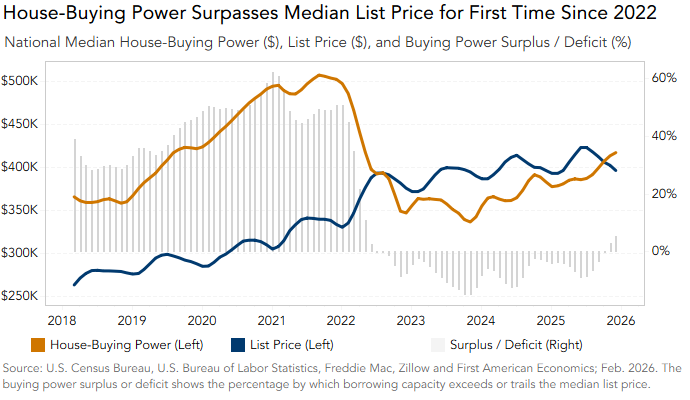
Note: First American calculated the median monthly house-buying power from 2018 to 2025 and compare it to the median list price on Zillow over the same period in order to monitor fast-moving budgets vs stickier prices at the national level. The buying-power surplus or deficit of buyer budgets in relation to the median list price is represented by the percentage difference.
House-Buying Power Dynamics Shift Post-Pandemic
Mortgage rates fell to all-time lows in the early years of the epidemic, and by late 2021, median home-buying power had risen to over $500,000. Strong demand and limited supply caused list prices to rise as well, but at a rate that was about half that of buying power. As a result, there was a 50% difference between asking prices and house-buying power.
In 2022, that dynamic changed. The ability to purchase a home fell below $340,000 as mortgage rates quickly increased. Due to the rate lock-in effect and limited inventory, list prices continued to be high. In late 2023, the surplus turned into a deficit, peaking at 15%.
The gap has steadily decreased since then. While household income has increased and mortgage rates have decreased from their peak, national price growth has essentially remained flat. For the first time since 2022, median house-buying power was back in surplus territory compared to median list price by December 2025, when it reached $417,000.
“Gradual life event-driven market re-engagement should support more inventory and more sales transactions,” said Mark Fleming, SVP and Chief Economist at First American.
Overall, the rise in sales activity in the latter part of last year was accompanied by a return of home-buying power above the national median list price. How supply changes in relation to demand will play a major role in determining whether price increase is restrained this spring. The spring home-buying season may emerge from a three-year depression, if only slightly, if supply stays limited and buyer power continues to surpass list prices.
For more commentary, click here.