



According to a recent study by Redfin, the real estate brokerage powered by Rocket, the average homebuyer would save $150 a month by taking out an adjustable-rate mortgage (ARM) rather than a 30-year fixed-rate mortgage. In terms of both dollars and percentages, that is the largest discount ARM consumers have received since June 2022—5.8%.
This is due to the fact that, in March, the average rate for a homebuyer using an ARM was 5.51%, whilst the average rate for a buyer taking out a fixed mortgage was 6.19%. The ARM has dropped by 0.68 basis points, the largest difference since June 2022. Generally, a homebuyer utilizing an ARM typically makes a monthly payment of $2,578, compared to $2,727 for buyers using a fixed rate.
“Adjustable-rate mortgages are offering meaningful savings in 2026’s expensive housing market,” said Bill Banfield, Chief Business Officer at Rocket. “Even though housing costs have recently come down a bit, it remains tough for first-time buyers to break in—and for existing homeowners to walk away from their ultra-low rates.”
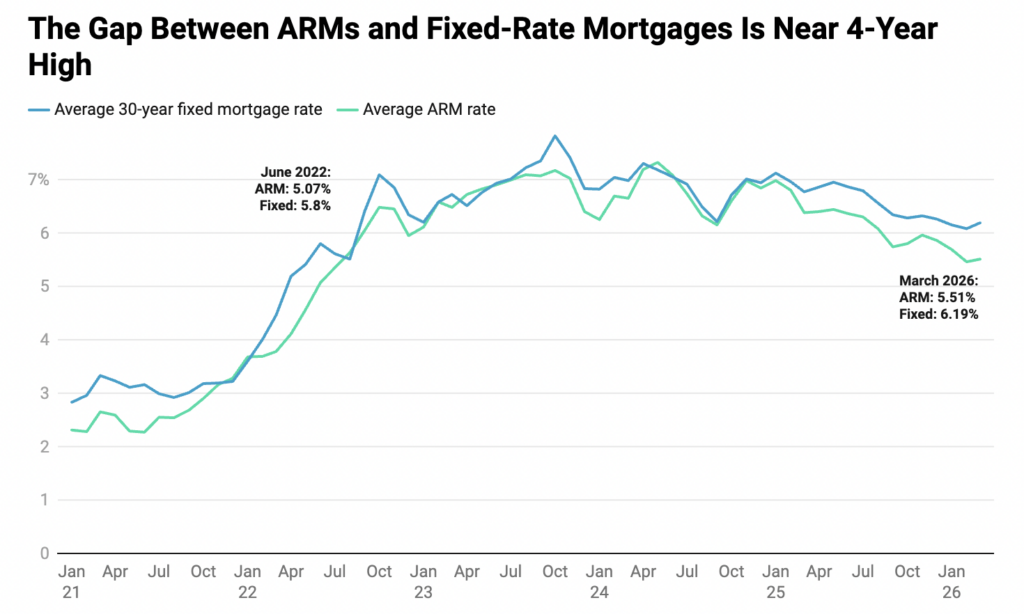
Note: This data is supported by a Redfin study on 30-year fixed mortgage rates and 7/6 ARMs as of March 16, 2026. For the first seven years of the loan, the borrower pays a fixed interest rate with a 7/6 ARM. The borrower’s interest rate changes every six months after that. For the purposes of this report, monthly payments are computed using a 30-year amortization at the initial ARM rate, reflecting the first fixed-rate term (7 years).
ARMs Buyer Trends, Housing Payments & Home Savings
The $2,578 payment that customers utilizing an ARM must make today is 7.4% less than it was a year ago. In contrast, fixed-rate borrowers saw a 5% decrease to $2,727. Homebuyers are somewhat relieved that mortgage rates are generally lower than they were a year ago. However, rates for ARMS have decreased more: the average 30-year fixed rate of 6.19% is down from 6.77%, while the average ARM rate of 5.51% is down from 6.38% a year earlier.
“With ARMs providing borrowers with the biggest discount in nearly four years, choosing an ARM could be a gamechanger, saving buyers hundreds of dollars each month and thousands over a few years,” Banfield said. “ARMs typically make sense when rates are high enough that buyers don’t want to lock them in—like now. When rates are low, like they were during the pandemic, it’s worth locking them in for as long as possible.”
Even at somewhat high rates, a 30-year fixed rate mortgage has the advantage of letting borrowers know exactly what their payments would be throughout the duration of the loan. ARMs are providing lower initial payments in the current market, but there is some uncertainty associated with them. Rates may increase after the original fixed-rate period, increasing monthly payments. Naturally, rates may also drop after the seven-year term.
After the financial crisis, additional regulations were implemented to safeguard borrowers, making ARMs far less dangerous than they formerly were. One feature of ARMs is interest-rate limits, which restrict how much the rate can rise throughout each term and during the loan’s duration. Two, borrowers often have to qualify for an ARM based on a higher rate, so they typically have leftover room in their budget if the rate does increase.
According to the National Mortgage Database, the average mortgage lasts four to seven years before the borrower refinances or sells; frequently, a homebuyer who takes on an ARM with a fixed rate period of seven or ten years never even reaches the adjustable-rate period. Experts suggest buyers taking out a mortgage should discuss if it’s a smart alternative with their lender because the ARM reduction is significant enough. ARMs can be a wise move for borrowers who intend to refinance their loan later, have the financial resources to pay a larger payment, or only intend to stay in a home temporarily. During the fixed-rate period, there’s a good likelihood that rates will drop to the point where refinancing makes sense.