



According to recent industry trends and data, existing-home sales had an underwhelming start to 2026, falling to the lowest level in more than a year. January’s decline raises understandable questions about the strength of the housing market as we head into the important spring home-buying season. Odeta Kushi, Deputy Chief Economist at First American Financial Corporation, revealed the incremental trends behind spring homebuying activity, house-buying power, and more.
January’s sales activity may have also been skewed by unusually low temperatures and more precipitation than usual in some areas of the nation, making it more challenging than usual to determine the true underlying trend. Recent data on pending home sales activity indicates that while weather-related headwinds affected the Northeast, warmer, drier weather appears to have boosted sales activity in the West. In colder climates, some of that lost momentum can resurface as conditions return to normal.
At the same time, there was some short-term volatility in mortgage rates due to changing Treasury market dynamics and geopolitical happenings. While changes in mortgage rates can have an immediate impact on buyer attitude, geopolitical shocks typically have an impact on housing through interest rates and confidence rather than by significantly changing underlying demand. Further, the overall market fundamentals are still stronger than they were a year ago as spring approaches.
February 2026 Existing-Home Sales Outlook Highlights
First American updated its Existing-Home Sales Outlook Report to show that February’s existing-home sales are predicted to rise by 0.9% over the previous month, but they are projected to remain approximately 5% slower than they were a year ago.
The largest contributors to the projected monthly increase in existing-home sales are:
- A resilient economy (+0.5%)
- Looser credit conditions (+0.09%)
- A weaker rate lock-in effect as measured by the lagged* spread between the prevailing market mortgage rate and the average rate for all outstanding mortgages (+0.09%)
- Rising house-buying power (+0.08%)
Note: *The spread is incorporated with a two-month lag in the Existing-Home Sales Outlook model.
Homebuying Trends Spark ‘Cautiously Optimistic’ Outlook
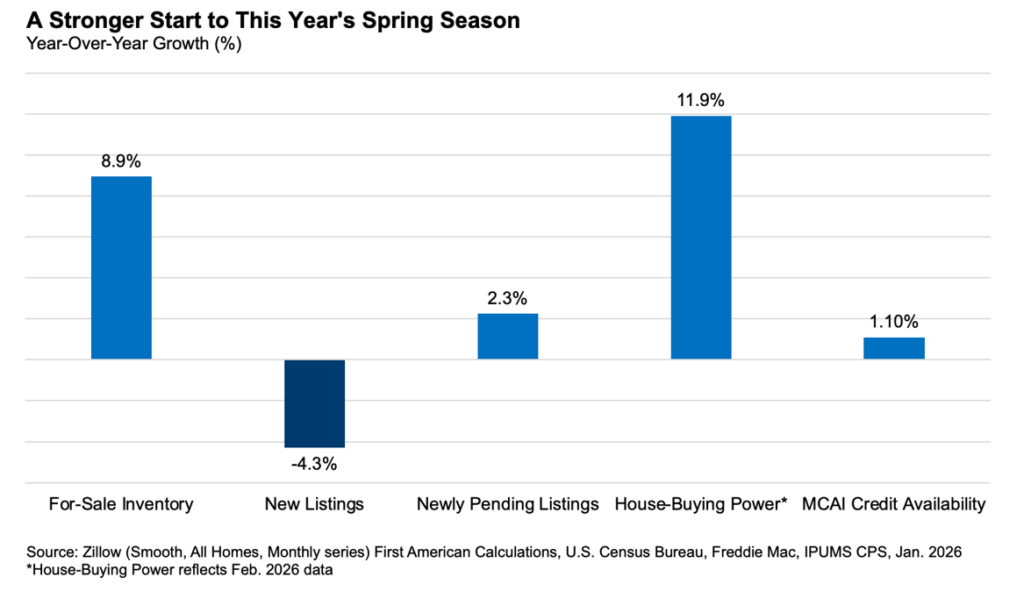
The improvement in for-sale inventory levels over the previous year is one of the most positive indicators leading up to the spring home-buying season. In a market that has historically been characterized by restricted supply, for-sale inventory in January was almost 9% greater than it was a year earlier. When there are more properties available, buyers have more options and can reasonably explore a wider variety of residences due to increased purchasing power. After all, what is not for sale cannot be bought by purchasers. Stronger sales activity is usually fueled by a wider range of available houses.
Improved house-buying power, which is up 12% from a year earlier, will also help prospective homebuyers. Buyers now have greater purchasing power than they did at this time last year, even though affordability is still stretched by historical standards. The significant increase in purchasing power over the previous year is significant, especially for purchasers who were disadvantaged by the combination of high mortgage rates and a restricted supply last year.
In January, Zillow’s newly pending listings—listings that transitioned from for-sale to pending status—were up about 2% annually. An early indication of near-term transaction velocity and closed sales in the upcoming months is provided by a shift to pending, which typically indicates a home going under contract. The MBA’s Mortgage Credit Availability Index (MCAI) indicates that credit availability has also somewhat increased, increasing by slightly more than 1% from the previous year. More qualified purchasers may be able to obtain financing with looser credit requirements.
When taken as a whole, these changes are small but encouraging indicators for the spring home-buying season. The final component needed to kickstart the spring home-buying season is an increase in new listings. January saw a 4% decrease in new listings compared to the same month last year. New listings are the lifeblood of the property market, according to First American research. New listings are what drive sales volume, even when increased for-sale inventory might indicate homes remaining on the market a little longer. The market’s rebound will be gradual rather than strong if more homeowners choose to sell.
2026 Housing Outlook & Conclusion
The housing market has a better base going into the spring season than it had a year ago, despite the slow start to the year. Buyers who put off their ambitions to become homeowners due to financial difficulties and a lack of options nevertheless have a sizable amount of pent-up demand. Potential first-time buyers are not the only ones with pent-up housing demand. Even while life circumstances like job shifts, expanding families, downsizing, or other transitions would normally force a home sale, many current homeowners have also put off moving. These life-cycle requirements build up over time, increasing the underlying demand for transactions on both the purchase and sell sides of the market.
The housing market has a better base going into the spring season than it had a year ago, despite the slow start to the year. Buyers who put off their ambitions to become homeowners due to financial difficulties and a lack of options nevertheless have a sizable amount of pent-up demand. Potential first-time buyers are not the only ones with pent-up housing demand. Even while life circumstances like job shifts, expanding families, downsizing, or other transitions would normally force a home sale, many current homeowners have also put off moving. These life-cycle requirements build up over time, increasing the underlying demand for transactions on both the purchase and sell sides of the market.
To read more, click here.