



American migration trends have changed over the last five years due to quick advancements in remote work, housing development, affordability, and local economic growth. Although there have been significant fluctuations in home demand in several specific markets, overall migration has been somewhat moderating. After the COVID-19 epidemic, longer-distance moves—to new states or cities—were momentarily popular, but they have subsequently decreased as inflation raised concerns about affordability and driving expenses to all-time highs.
The percentage of renters on Apartment List’s platform who were searching for a new residence in a new metropolitan region remained constant at 39% in 2025. Further, the percentage of people seeking a longer-distance move across state boundaries dropped to 24%.
Migration from crowded, pricey areas to more reasonably priced ones is one persistent aspect of the post-pandemic housing market. This is evident from census data, which shows domestic migratory outflows to the Sun Belt and Mountain West regions in states like California, New York, and Massachusetts between 2024 and 2025. Despite net domestic migration, or population change caused by migrants rather than births or deaths, continuing to trend downward, this pattern has persisted for a number of years.
Between 2024 and 2025, the states with the biggest net domestic migration outflows were California, New York, Illinois, New Jersey, and Massachusetts. Particularly in California, 229,000 more people left the state than entered it. Because net positive foreign migration (+109,000) and net positive natural growth (110,000 more births than deaths) countered net negative domestic migration, California’s overall population remained practically unchanged from year to year. Therefore, the state continues to be a large exporter of inhabitants to other regions of the nation as well as a major importer of new citizens from all over the world. The state lost 0.6% of its population due to internal migration.
On the other hand, the states with the highest numbers of new residents due to domestic migration are North Carolina, Texas, South Carolina, Tennessee, and Arizona. Net domestic migration increased North Carolina’s population by +84,000, or +0.8%. At least in terms of percentage growth, the neighbor to the south has solidified itself as the state with the quickest rate of growth in the country. With +1.2% population growth (net +66,000 persons), South Carolina has led the standings for the fourth consecutive year.
Note: This report incorporates the search preferences of users who registered with Apartment List between January 1 and December 31, 2025. The share of searches from the metro (ie. outbound searches) that are destined for apartments outside the metro.
Statewide Differences in Migration Trends & Long Distance Moves
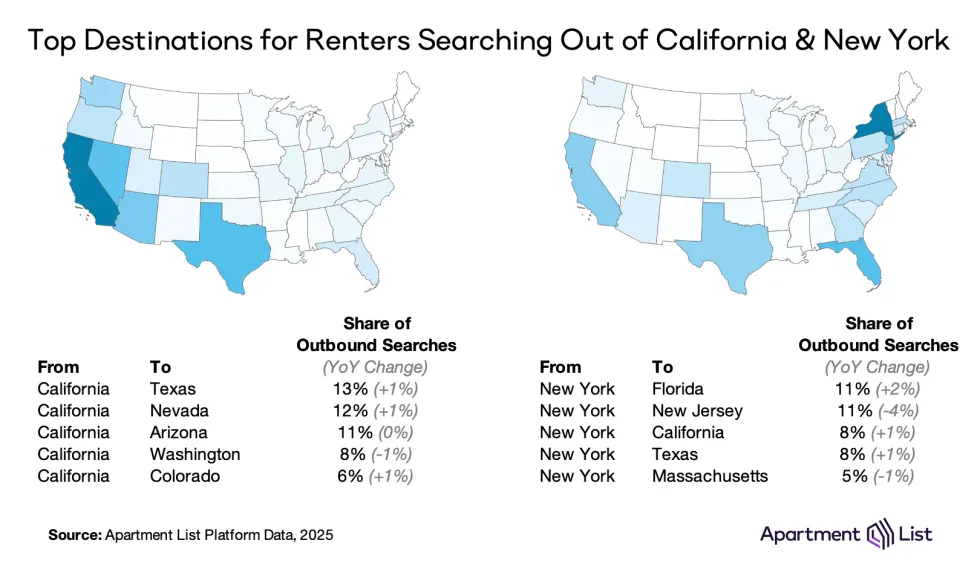
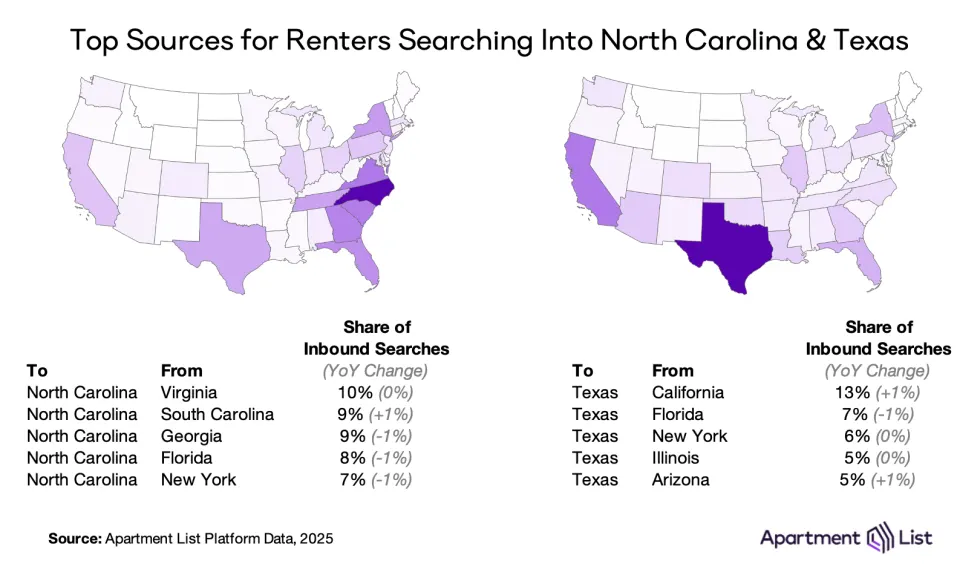
The top destinations for renters wishing to leave the two states that lost the most residents as a result of domestic outmigration (California and New York) as well as the sources of renters looking into the two states that attracted the most domestic movers (North Carolina and Texas) are examined in the report.
Texas was the most sought-after location for tenants wishing to relocate from California, surpassing nearby Nevada and Arizona. Colorado and Washington completed the top five. It’s interesting to note that Florida has been losing favor; in 2025, 3.8% of California’s outbound searches went to the Sunshine State, compared to 4.2% in 2024 and 5.3% in 2023. The yearly percentage point rises in popularity in Texas, Nevada, and Colorado have countered this.
However, the “Sunshine State” of Florida has become more well-liked on the East Coast and is currently the most sought-after location for renters looking outside of New York. Florida has surpassed New Jersey as the top destination, with 11% of prospective New Yorkers looking to relocate there. Outgoing New Yorkers continue to choose California and Texas as long-distance travel destinations.
More people moved domestically to North Carolina and Texas in 2025 than to any other state. New York and Florida are among the top five states when it comes to the most popular sources of incoming rental searches. While search interest in Texas is more dispersed and mostly comes from California, Florida, and New York, North Carolina receives the greatest attention from neighboring southeastern states like Virginia, South Carolina, and Georgia.
The 10 metro areas with the largest percentage of incoming searches from out-of-market renters—renters who reside in another metropolitan area—were—also highlighted in the report.
Top 10 Metros Attracting the Most Out-of-Market Searches:
- Savannah, GA (61.7%)
- Durham (60.7%)
- Charleston, SC (60.7%)
- Ogden, Utah (57.3%)
- Reno, NV (56.6%)
- Cape Coral, FL (65.5%)
- Gainesville, FL (56.1%)
- Myrtle Beach, SC (55.5%)
- Knoxville, TN (55.5%)
- Colorado Springs, CO (55.3%)
This list is dominated by markets in rapidly expanding states, which is consistent with the Census Bureau’s domestic migration data discussed above. The top three cities on the list are Savannah, GA; Durham, NC; and Charleston, SC, where more than 60% of searches originate from visitors. Nearby Raleigh, NC, Charlotte, NC, and Atlanta are the primary sources of incoming searches for these metro areas as tenants from bigger, more expensive markets try to get more for their money in rapidly expanding towns.
Large search channels out of Salt Lake City and into Ogden, Utah; out of Sacramento, CA, and San Francisco and into Reno, NV; out of Denver and into Colorado Springs, CO; and other regions of the country are also seeing this trend. Since these rental markets are expected to keep expanding through 2026, whether there is sufficient supply to accommodate new tenants will have a significant impact on long-term affordability.
Overall, in recent years, America’s migration patterns have been influenced by the geographic freedom provided by remote work as well as declining cost. Data from the Census Bureau and the Apartment List platform indicate continued demand in lower-density, lower-cost areas of the nation, namely the Southeast and Mountain West, even as migration rates are falling. However, popularity in these areas may also decline as remote employment seems to be losing steam, at least in places where wages are not competitive.
To read the full report, click here.