



According to new data from the National Association of Home Builders (NAHB), 2025 had the largest volume of multifamily missing middle housing starts since 2007, but not a significant increase. The construction of medium-density housing, such as townhouses, duplexes, and other small multifamily structures, is part of the missing middle construction industry.
But since the Great Recession, the multifamily sector of the missing middle—apartments in buildings with two to four units—has largely fallen short. Due in part to zoning limitations, this residential construction subsector continues to perform below its potential.
Construction of approximately 19,000 two- to four-unit dwelling units began in 2025, a 6% increase over 18,000 in 2024. For Q4, the development of two to four units accounted for only 5% of all multifamily output. Compared to previous historical patterns, this is still lower. Such house construction accounted for little less than 11% of all multifamily construction between 2000 and 2010.
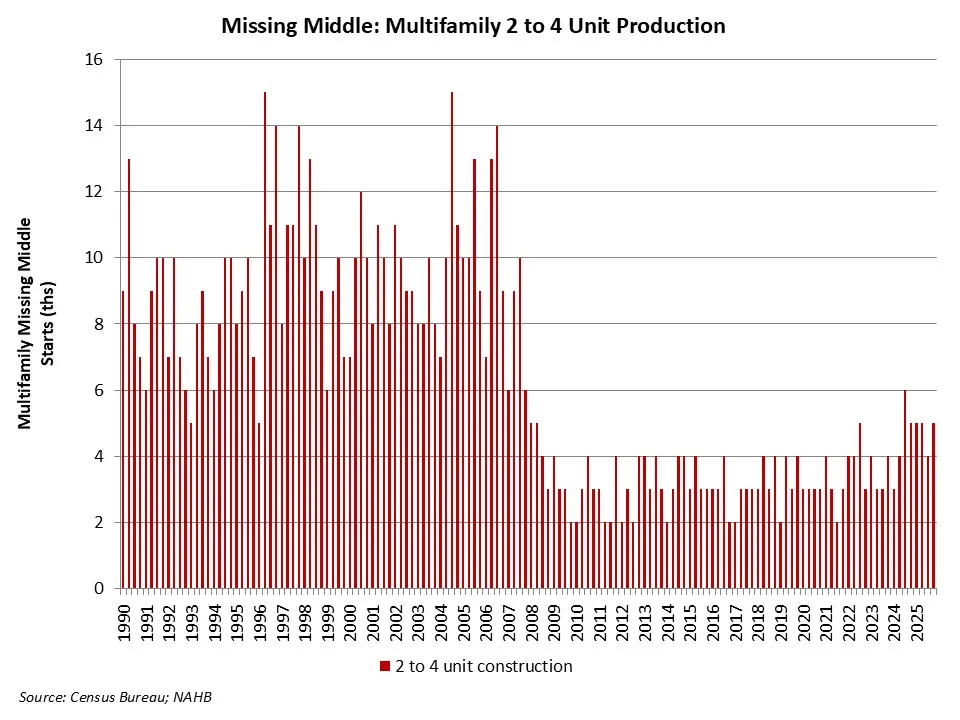
Without zoning change focusing on light-touch density, construction of the missing middle has obviously languished throughout the post-Great Recession period and will continue to do so.
Salim Furth, Senior Research Fellow at the Mercatus Center, further illustrated light-touch density and the state’s role in zoning.
They investigated the effects of gradually and widely replacing single-family homes with duplexes using a case study of communities in Bergen County, New Jersey. They discover that Palisades Park, the borough that was the most accepting of duplexes, saw significant population growth every 10 years and now has newer residences, higher land prices, and reduced tax rates. Compared to nearby boroughs, a new-construction home in Palisades Park, NJ, is less expensive, and the neighborhood’s income distribution is more varied.
“State and local governments now have experience with reforms that allow two- to four-unit buildings, and the impact of those reforms has been incremental,” the pair wrote in a recent report. “The year after Minneapolis, Minnesota, legalized duplexes and triplexes in all zones, just 42 such permits were pulled. Houston, Texas, has always allowed multifamily housing of any size in almost every location, but in 2021 permitted only 255 duplexes, 1 triplex, and 6 fourplexes, compared to 7,146 single-family homes and 7,566 units in 204 multifamily buildings.”
Furth suggests that there are hree types of justifications for superseding local zoning authority:
- Rights to property. The burden of proof should be placed on those who want to restrict residents’ ability to use and enjoy their property normally. Therefore, it is reasonable to prohibit a particular restriction when state legislators determine that there is no compelling basis for it or that its costs outweigh its advantages. In this instance, the government should restrict municipal jurisdiction to enforce that particular restriction until it finds a strong argument that four households shouldn’t live on a land where one household may live safely and profitably.
- Overall fairness. Zoning might be biased to maximize the value of existing properties and exclude families with school-age children because municipal governments are primarily concerned with their current citizens. The interests of Granite Staters who reside outside of the municipalities in question and lack representation there can be weighed against those limited interests by the state legislature. In this situation, the state may take action to support residents’ interests in locating reasonably priced housing in the neighborhood of their choosing.
- Resolving issues across the entire state. When local governments have the crucial levers to accomplish a major state aim, states have the right to preempt them. Recent zoning preemptions, for instance, have been defended as being required to combat climate change or boost economic expansion. In contrast to property rights, it should be the state’s responsibility to demonstrate that preempting a customary area of local authority is indeed required to solve a statewide issue.
These categories complement and overlap one another. For example, when assessing a restriction on property rights, the state must take into account its own policy aims and consult groups with a wide range of interests to determine whether the justifications offered for a particular regulatory tool—like single-family zoning—are convincing.
“The real issue at stake here is not the modest but positive effects this bill is likely to have, but whether the state ought to decrease the regulatory authority it has granted municipalities,” Furth stated in the report. “As a New England native, I am keenly aware that New England towns have been vital institutions for centuries. My hometown elected its own leaders and exerted police powers for a century before the revolution gave it the right to elect a governor. Notwithstanding this tradition, these local powers have never been boundless and have long been contested and restrained.”
To read more, click here.