



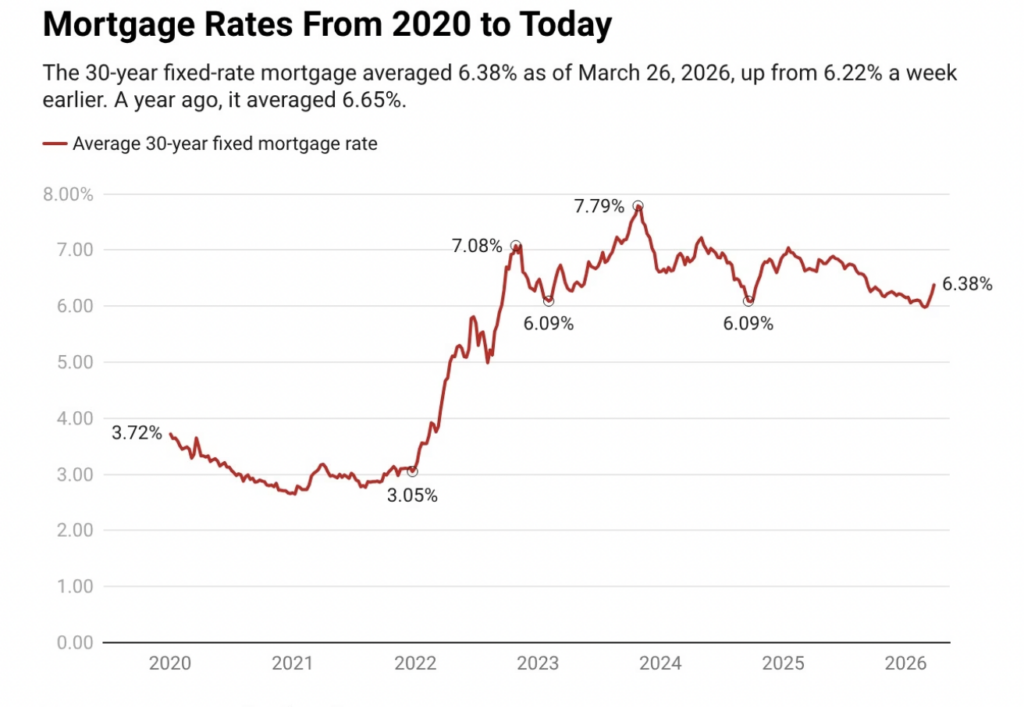
In March, mortgage rates increased by 16 basis points—the biggest increase in a single week in over a year—putting further strain on buyers who are already navigating a difficult market. According to Freddie Mac data, the three-week increase is the sharpest of its kind in over a year and a half. Buyer affordability problems are further being exacerbated by the rate increase.
A squeeze is being created from several angles as rising oil costs are affecting consumer confidence and lowering spending power at the same time. Many homebuyers have had to adjust their budgets, even though rates are still lower than they were a year ago. This change is anticipated to reduce sales activity in the coming months.
Both homebuyers and sellers are pausing and reevaluating their financial expectations this year due to a significant increase in mortgage rates that hit the market last month, which is compounded by skyrocketing gas prices and ongoing pressure from the insurance side, despite the fact that the spring selling season is usually marked by bustling energy.
Due to increased building costs, diminished insurance protection, and a lack of coverage options, this industry-wide pressure has resulted in a situation of underinsurance. The climate crisis, which the Senate Budget Committee considered a “looming economic threat,” is one of the primary causes.
Homer Insurance Heightens Amid Increasing Mortgage Rates
In an economy where people are already cutting budgets and finding it difficult to pay both their premiums and their deductibles, natural disasters are also raising the cost of insurance nationwide as insurers pay out billions of dollars after large losses. Additionally, some home insurers are intentionally pulling out of weather-prone areas, which is radically changing the market and leaving many homeowners with inadequate coverage and fewer options.
In today’s industry, underinsurance is becoming more and more common. Nearly 75% of homeowners had insufficient coverage for their wildfire claims, with more than one-third falling into the “severely underinsured” category, according to a University of Colorado research. According to John Meek, Chief Marketing Officer of HUB International’s Private Client business, if a policy was bought six or seven years ago, it’s likely that inflation has significantly outpaced the replacement cost estimated at the time of purchase.
“With what’s happened externally in the market with the rise of labor costs, material costs, and so forth, sometimes that inflationary increase doesn’t catch up fast enough,”” he says.” Meek said.
New data from Realtor.com indicates some positive indicators on the supply side, notwithstanding the challenges facing purchasers. The average asking price is almost 2% lower than it was a year ago, suggesting that new sellers are lowering their price expectations. However, the number of new postings has changed every week, which limits the amount that purchasers can profit from the lower prices. As homes remain on the market for extended periods of time, the total inventory keeps increasing, indicating a level of patience among buyers who don’t seem to be in a rush to close.
In order to assist account for these changes, many home insurance policies automatically modify the coverage limits at renewal; however, this feature is sometimes unreliable during times of high inflation.
“Even homeowners with inflation guard coverage can still face a shortfall if their policy limits haven’t been proactively updated,” said Lauren Menuey, Managing Director of Goosehead Insurance.
Some U.S. Homeowners Remain at a Crossroads
Some homeowners are left stuck as insurers leave high-risk areas, even if reconstruction expenses are undoubtedly creating their own underinsurance scenario. They have to look into specialized options, which frequently mean giving up coverage—a kind of forced underinsurance.
“They’re going to take a policy that only gives them up to $2.5 million of coverage, even though they may have a home that’s worth $5 million,” Meek said. “But because they can’t find anything else, they’re willing to at least take the $2.5 million. Something is better than nothing.”
It’s one thing to be underfunded; it’s quite another to be uninsured. Certain risks, including earthquakes and floods, are just not covered by regular home insurance. Additionally, coverage for rebuilding to contemporary codes is usually restricted or nonexistent.
Separate coverage is necessary for these risks, but most homeowners are reluctant to pay higher premiums when they are already having financial difficulties. They might continue to be underinsured even if they decide to close these gaps. Ordinance or law coverage, which helps with construction code requirements, is normally set at 10% of your home’s dwelling coverage, however some insurers offer higher limits. Maximum flood insurance limitations are out of date by 20 years.
All of this depends on the timing. Spring has a significant impact on the property market because it often favors sellers due to a seasonal increase in shopping activity. According to Hannah Jones, Senior Economic Research Analyst at Realtor.com, the week of April 12–18, is the ideal time to sell nationwide. However, vendors in a number of markets don’t have to wait that long.
According to Realtor.com Economist Jiayi Xu, there are three main categories of renters today:
- Long-term tenants (36.1%)
- Family households (44.3%)
- Youthful households (31.9%)
These groups together make up over 80% of all renter families, with some overlap among categories. Affordability stands up as the primary obstacle in all three. Further, young households are choosing midsized cities—Colorado Springs, Colorado, Austin, Texas, and Denver at the top of the list—where rent is more affordable and roommates are not as necessary, rather than large metropolitan areas.
The majority-minority areas in California, Texas, and Florida, where family households are most prevalent, and where affordability is most at risk. The markets with the greatest family renter share include McAllen, Texas; Stockton, CA; Bakersfield, CA; Riverside, CA; Miami; and Honolulu.
Given that minority households continue to have lower homeownership rates and that the financial advantages of ownership are not as frequently handed down, generational wealth is a factor. In rent-regulated areas like New York City and Los Angeles, where stabilization laws can keep rents quite low, long-term tenants tend to congregate. However, these policies may also restrict residents’ ability or incentive to relocate.