



According to First American’s Existing-Home Sales Outlook Report, data predicts a slight increase in existing-home sales in April. Despite overall sales remaining below historical averages, the U.S. housing market is beginning to show some indications of improvement as the spring homebuying season approaches and gains some traction.
A change in affordability is partially responsible for that improvement. The First American Data & Analytics Real House Price Index (RHPI) shows that housing affordability has significantly improved over the past year, rising by 11%. Crucially, the improvement was widespread. For the first time since October 2024, affordability increased year over year in every one of the top 100 markets we monitor.
Highlights of the Existing-Home Sales Outlook — April 2026
First American modified its Existing-Home Sales Outlook Report for April to reflect the following:
- April’s existing-home sales are predicted to rise by 0.1% over the previous month, but they will still be 0.9 % slower than they were a year ago.
- A robust economy (+0.4%) and a lesser rate lock-in impact as shown by the lagged* difference between the current market mortgage rate and the average rate for all outstanding mortgages (+0.1%) are the main factors contributing to the anticipated monthly increase in existing-home sales.
Note: *The spread is incorporated with a two-month lag in the Existing-Home Sales Outlook model.
Diving further into detail, the three main factors that determine affordability—mortgage rates, nominal home prices, and household income—interact to produce this improvement. When taken as a whole, these factors have boosted purchasing power and improved the variety of properties available to many buyers. Further, even small improvements can boost overall home market activity, even while affordability is still stretched by historical norms.
Comparing affordability trends with sales across markets prior to the spring home-buying season is one way to see how improving affordability affects market activity. Although the correlation is weak, markets where affordability increased typically saw somewhat higher sales activity. Growth in home prices also affects markets, demonstrating how price dynamics are influencing activity and affordability. The 100-market average is indicated by the vertical and horizontal lines, which divide markets according to whether sales and affordability are above or below average.
Regional Trends, Affordability Patterns & Home Price Shifts
The outlook report revealed that there are a few prominent patterns. Affordability has improved more dramatically in regions like Sarasota, FL, and Cape Coral, FL, rising 16% each, and sales have also grown more sharply. Home prices have dropped in both situations—by 8% and 6%, respectively—which has boosted buyer activity and restored purchasing power.
On the other hand, in places like Allentown, PA, and New Haven, CT, affordability has slightly improved, rising by 1% and 4%, respectively, yet sales are still lower than they were a year ago. These results show that tiny increases in purchasing power might not be sufficient to significantly affect demand. However, stronger sales are not always correlated with above-average affordability gains. Affordability has increased in places like Pittsburgh and Las Vegas, but sales activity is still lower than it was a year ago. This could be the result of more cautious demand or a shortage of inventory, indicating that increased affordability by itself does not ensure a rise in sales.
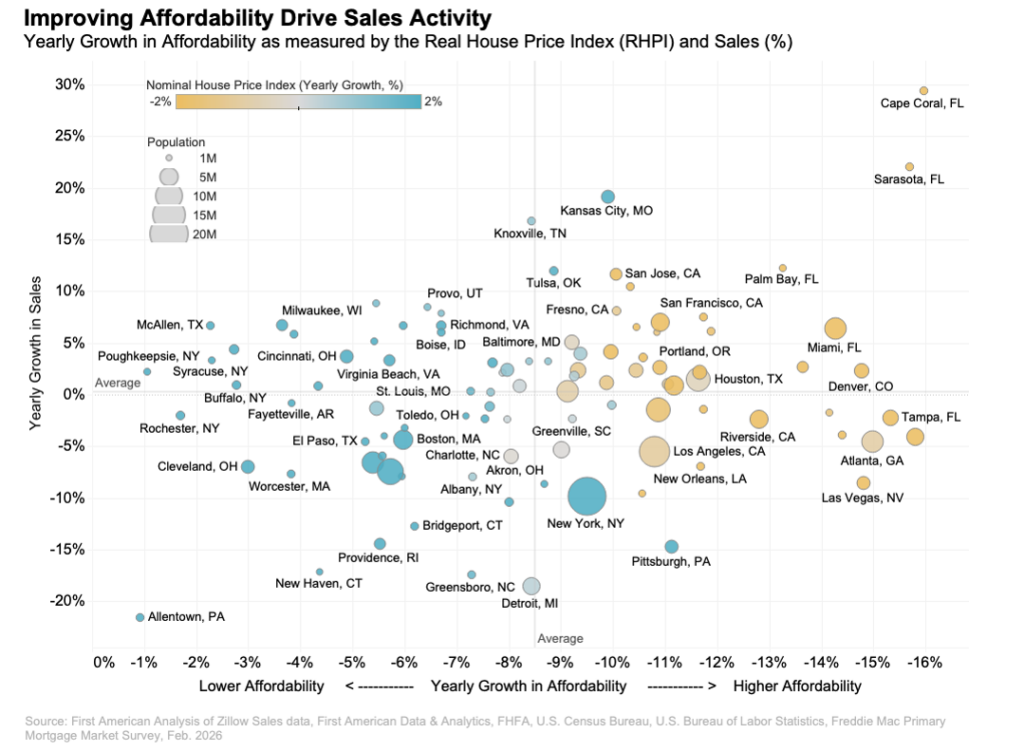
Price movements also have a significant impact on these results in all marketplaces. Larger increases in affordability are typically linked to slower or declining price rise, which in certain situations is sufficient to entice consumers back into the market. In others, the reaction is more gradual, contingent on buyer demand and local supply conditions. However, when considered collectively, the figures indicate that increasing affordability is starting to encourage increased sales activity, at least during the spring home-buying season.
First American experts and report data suggest that overall affordability will continue to be a key driver of housing demand as the spring purchasing season goes on. Buyers who were previously priced out now have support thanks to the improvement over the preceding year. Local circumstances will also influence how that support results in sales. Variation among markets will continue to be driven by variations in inventory, price trends, and buyer demand. Increasing affordability is boosting demand, but it still depends on where you look to see how that translates into sales.
To read more, click here.