



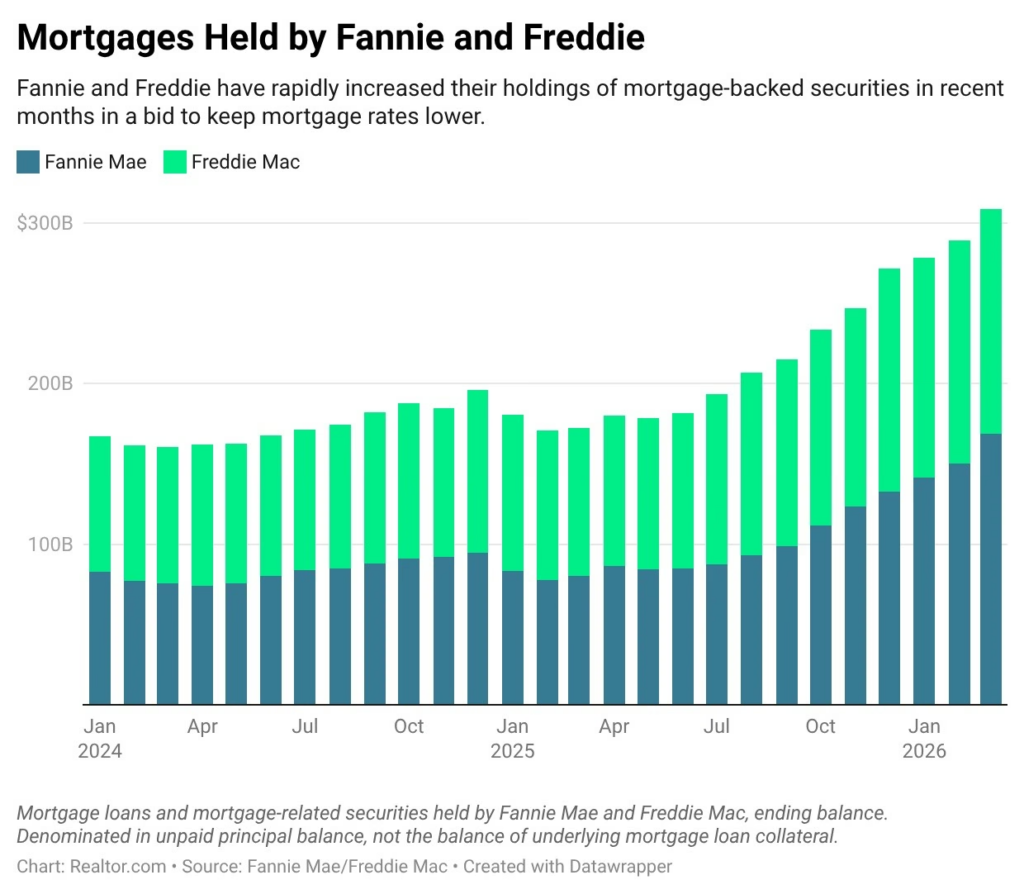
As the Trump administration attempts to curb persistently high mortgage rates, Fannie Mae has more than doubled its mortgage portfolio in the last 12 month. In March, the government-sponsored company added $18.3 billion to its retained portfolio, culminating a quarter-long growth of $36 billion. In an effort to stabilize the faltering home market, Fannie, whose portfolio currently totals $168.7 billion, is on a buying binge.
President Donald Trump ordered Freddie Mac and Fannie Mae to buy $200 billion worth of mortgage-backed securities earlier this year. Additionally, Trump has hinted at a potential $30 billion IPO for the two organizations, which have been placed under conservatorship since the Great Recession.
A $500 billion IPO for the two GSEs might be supported by the purchasing frenzy. However, opinions on whether such a move is a smart idea seem to be divided in Washington. Acting CEO Peter Akwaboah mentioned increasing purchases of mortgage-backed securities in an attempt to strengthen the secondary mortgage market on Fannie’s earnings call last month.
“We remain focused on providing uninterrupted liquidity in all economic cycles to support stability and affordability to the U.S. housing market,” r, opinions on whether such a move is a smart idea seem to be divided in Washington. Acting CEO Peter Akwaboah said.
Expansion Makes a Difference
In 2026, Fannie Mae swiftly accelerated its operations. It made $84.4 billion in purchases, $41.7 billion in dispositions, and $6.5 billion in liquidations during the first quarter. As a result, its portfolio increased from $132.5 billion in December to $168.7 billion at the end of March. Additionally, the $80.3 billion retained mortgage portfolio balance it had in March of last year has more than doubled.
Chryssa Halley, CFO of Fannie Mae, stated during the earnings call that risk is driven by the growth of the retained mortgage portfolio.
However, a $7 billion decrease in its corporate liquidity portfolio and an increase in the retained mortgage portfolio indicate “a shift in our portfolio mix towards higher-yielding investments.”
“We benefited from the durability and quality of our $4.1 trillion Guarantee Book, a leaner cost structure that supported higher earnings, and a strong and growing net worth position,” Halley said. “Together, these strengths position us well to navigate market challenges, deliver solid results, and continue supporting the U.S. housing market.”
According to economist Joel Berner of Realtor.com, Fannie Mae is attempting to reduce mortgage rates for homebuyers, a long-standing pledge made by Trump.
“When more mortgages are kept on Freddie and Fannie’s books away from investors, their value goes up and subsequently a newly issued mortgage can be created with a lower rate,” Berner said. “What we’re seeing is Fannie and Freddie acting upon the president’s orders to buy up more MBS in an effort to make homebuying more affordable for American citizens.”
However, the relocation is just one aspect of the housing problem. According to Berner, the primary problem with housing affordability is still that there aren’t enough properties to satisfy demand. Mortgage rates have been rising since February due to the war with Iran and other inflationary pressures, even if rates alone could stabilize the market. Additionally, Fannie Mae, which typically makes its cash from the guarantee fees it charges investors, still faces increased risk as a result of the buying frenzy.
Fannie would be more directly exposed to losses if borrowers failed to make their mortgage payments, which put the mortgage behemoth in danger during the 2007 subprime mortgage crisis. Since then, a number of safeguards have been implemented, including the conservatorship.
To read more, click here.