



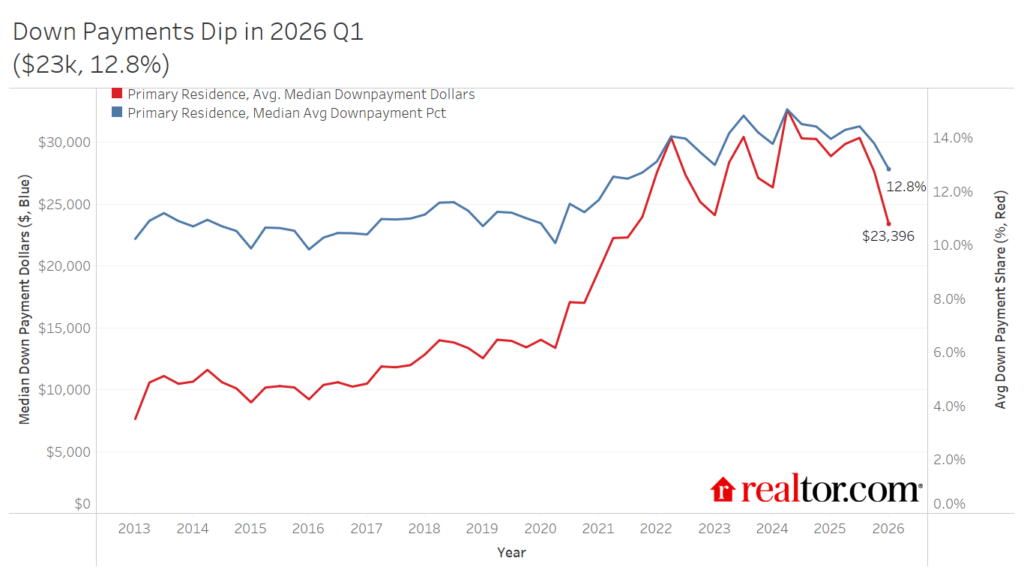
After declining for four quarters in a row, the typical down payment share softened to 12.8% in Q1 of 2026, which is 1.1 percentage points less than it was a year earlier, according to recent Realtor.com data. In monetary terms, down payments dropped by a substantial 19.0% year-over-year (YoY) to their lowest point since Q3 of 2021.
The median down payment in the first quarter of 2026 was $23,400, which was more than $5,000 less than a year earlier and more than $4,000 less than the Q4 of 2025. Even while down payments typically hit their seasonal low in Q1, this notable monthly and annual decline could point to a reversal of the prior upward trend in down payments.
In the past, down payments have increased significantly from spring through late summer before declining when the market slows down into winter. But in 2025, the decline toward winter was more severe and the increase was more moderate. Before declining through Q4 and the start of 2026, down payments for 2025 reached a peak of 14.4% and $30,400 in Q3. Although the figure is still far lower than it was a year ago, the most recent monthly data indicates that down payments increased in March and April of 2026, as is normal for the season. Compared to April 2025 levels of $27,500 and 13.8%, the average down payment in the U.S. in April 2026 was $25,000, or 13.2% of the purchase price.
Elevated Home Prices, Down Payment Declines & Market Conditions
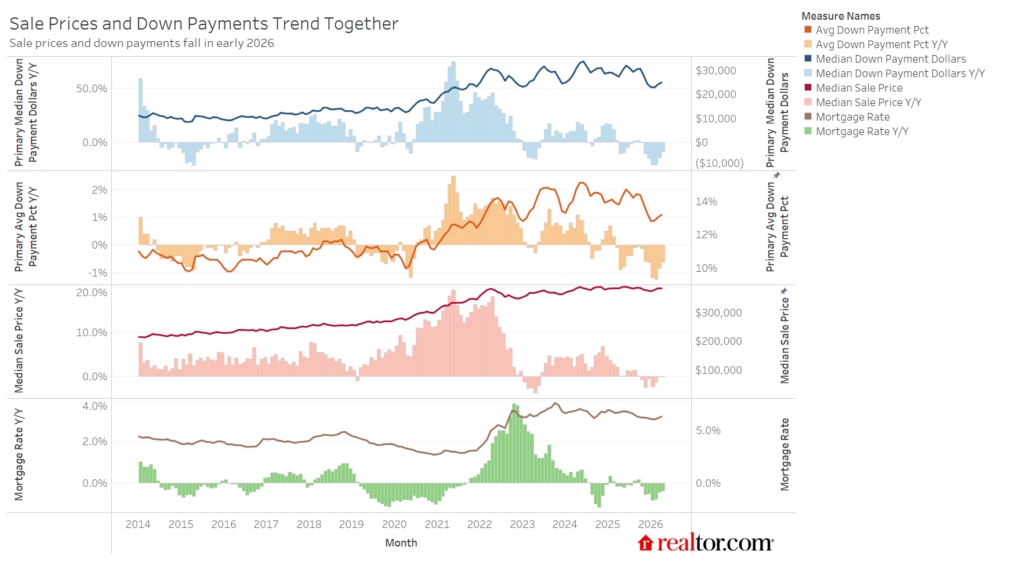
The trend of lowering down payments is indicative of more general housing market problems. According to the Realtor.com April 2026 Monthly Housing Report, active listings increased year over year for the 28th consecutive month while home price growth slowed. This combination gives buyers greater leeway in negotiations and lessens the temptation to make a sizable down payment. According to data from the National Association of Realtors, the national median existing home sale price increased only slightly in Q1 2026, while the median list price fell year over year in April. This is in sharp contrast to the rapid appreciation that caused payments to rise dramatically in 2021 and 2022.
Although still quite high, mortgage rates have also decreased from a year ago. According to Realtor.com’s 2026 estimate, the average monthly payment share of income will fall below 30% for the first time since 2022. This is a slight but significant change for property purchasers who had been on the fence.
When combined, these factors are attracting a slightly different type of consumer to the market. First-time and lower-income buyers who were priced out may be beginning to re-engage as affordability improves at the margins and competition eases. As a result, the market is gradually expanding. Nearly 40% of prospective sellers now anticipate making compromises, up significantly from 30% in 2025, according to the Realtor.com spring 2026 seller poll. This indicates that even sellers acknowledge that buyers have regained some ground. It will be largely dependent on how inventory, rates, and consumer confidence change throughout the second half of the year to determine if the increase in down payments saw in March and April signals the start of a new rising trend or is just a seasonal bounce in a structurally weaker market.
Even while the recent decline is noteworthy, it is important to place these numbers within the larger context of the post-epidemic housing market; in other words, down payments are still higher than they were before the pandemic. The average down payment in the first quarter of 2019 was $12,500 and 10.7%, which is much less than the current average for both accounts.
The average down payment amount has increased by roughly 87.2% over the last seven years, but the average home sale price has only increased by 47.6%. This indicates that buyers are using larger down payments to compete and lessen the impact of rising mortgage rates. In comparison to seven years ago, down payments have increased by 2.1 percentage points as a percentage of the purchase price. The fact that house equity is still close to all-time highs indicates that repeat buyers are well-positioned to use their current home equity to make a substantial down payment on their subsequent purchase.
Notably, down payments peaked in the first quarter of 2025 at $28,900 and 14.0%. The spring and summer markets this year will be crucial indicators of whether this pattern of declining down payments is a harbinger of a long-term slowdown in the housing market or merely an unusually severe winter slump.
Renter Readiness, Housing Demand, Supply & Affordability
In Q1 of 2026, the average down payment for a house purchase was $23,400. Given that many people still struggle with affordability, it is important to examine why housing demand is still so low. Examining whether today’s renters have the funds to meet that need in the first place is one method to do it.
The average tenant has virtually limited access to wealth. The median renter has an estimated $2,600 in liquid assets (checking and savings accounts), as the table below illustrates. The needle is only slightly moved to $2,800 when equities, bonds, and mutual funds owned outside of retirement accounts are added. The median amount available for a down payment hardly changes, at about $2,900, even when renters are allowed to withdraw from IRA balances up to the IRS first-time homebuyer exemption limit.
This pattern also applies to all age groups. According to the most liberal definition, the median renter under 45, who is in the best financial condition of any group, has an estimated $4,200 in accessible assets. The biggest obstacle for the average renter, regardless of age, is their total financial situation rather than deciding which asset on their household balance sheet to liquidate.
| Median Downpayment Potential Among Renters (By asset potential and age group — 2025 Q4) | |||
| Age Group | Liquid Assets Only | + Stocks & Bonds | + IRA |
| All Renters | $2,605 | $2,787 | $2,891 |
| Under 45 | $3,166 | $3,925 | $4,213 |
| 45–64 | $1,570 | $1,701 | $1,818 |
| 65+ | $2,224 | $2,551 | $2,617 |
Note: SCF 2022 asset values aged to 2025 Q4 using Federal Reserve Z.1 B.101h aggregate growth factors. IRA contribution capped at $10,000 (single)/$20,000 (married/partnered) per IRS first-time homebuyer exemption.
Nevertheless, a lengthy, significant tail is hidden by medians. A more complex picture emerges when one looks beyond the usual tenant and asks what percentage of today’s renters could realistically achieve a down payment barrier. Approximately 15-20% of renters have enough assets to make the traditional median down payment of $23,400 (left panel). When the requirement is reduced to a 3.5% FHA down payment on the April 2026 median list price of $425,000, or $14,875 (right set of panels), the statistic increases to roughly 20-26%.
There are roughly 6.75 to 9 million renter households in the US that could afford a $23,400 down payment and 9 to 11.7 million that could afford a 3.5% down payment on the median list-priced property, according to current estimates that place the number of renter households in the US conservatively at 45 million.
With roughly 21% of renters under 45 able to fulfill the traditional criterion under the most lenient asset definition, younger renters are actually in the best situation by age. In contrast to their age peers who have already made the transition to ownership, those who continue to rent into their 40s, 50s, and beyond tend to skew toward lower incomes and lower wealth accumulation. This is somewhat counterintuitive with the typical financial lifecycle, but it is consistent with the idea that older renters are more negatively selected.
Share of Renters Who Could Meet Each Downpayment Threshold:
2026 Q1 Median: $23,400 | FHA, 3.5% Down | |||||
| Age Group | Liquid Assets Only | + Stocks & Bonds | + IRA | Liquid Assets Only | + Stocks & Bonds | + IRA |
| All Renters | 15.3% | 18.3% | 19.9% | 20.9% | 24.1% | 26.0% |
| Under 45 | 17.5% | 20.1% | 21.3% | 24.1% | 27.2% | 28.9% |
| 45–64 | 10.9% | 13.3% | 15.9% | 16.7% | 18.8% | 21.0% |
| 65+ | 15.1% | 19.7% | 21.1% | 17.3% | 22.3% | 24.6% |
Measuring Regional Down Payment Trends
In Q1 of 2026, down payments were highest in the Northeast, where buyers typically put down 17.3% of the purchase price, followed by the West (15.2%), Midwest (13.6%), and South (11.1%). Three of the four regions saw declines in typical down payment shares compared with a year earlier. The South recorded the largest drop, down 1.2 percentage points year-over-year, followed by the Northeast (-1.0 ppts), and the West (-0.9 ppt). The Midwest posted a 0.1 percentage point increase in down payment share year-over-year.
The locations of markets on the Realtor.com Market Clock correspond with these regional trends. The West and South, where inventory has recovered more fully, are showing weaker circumstances that provide buyers greater leeway in negotiations, as evidenced by declining down payments. In contrast, the Northeast and Midwest continue to be more competitive, where buyers are more inclined to make larger down payments in order to secure agreements.
Regional down payment trends were significantly lower in terms of dollars compared to the previous year. With an annual decline of 18.2%, the West experienced the biggest decline, followed by the South (-11.0%), the Midwest (-8.2%), and the Northeast (-6.8%). Due to increased competition and rising housing prices, the Northeast had the highest median down payment of $57,600. Additionally, the Northeast has the biggest difference between what purchasers are paying now and before the pandemic when it comes to down payments.
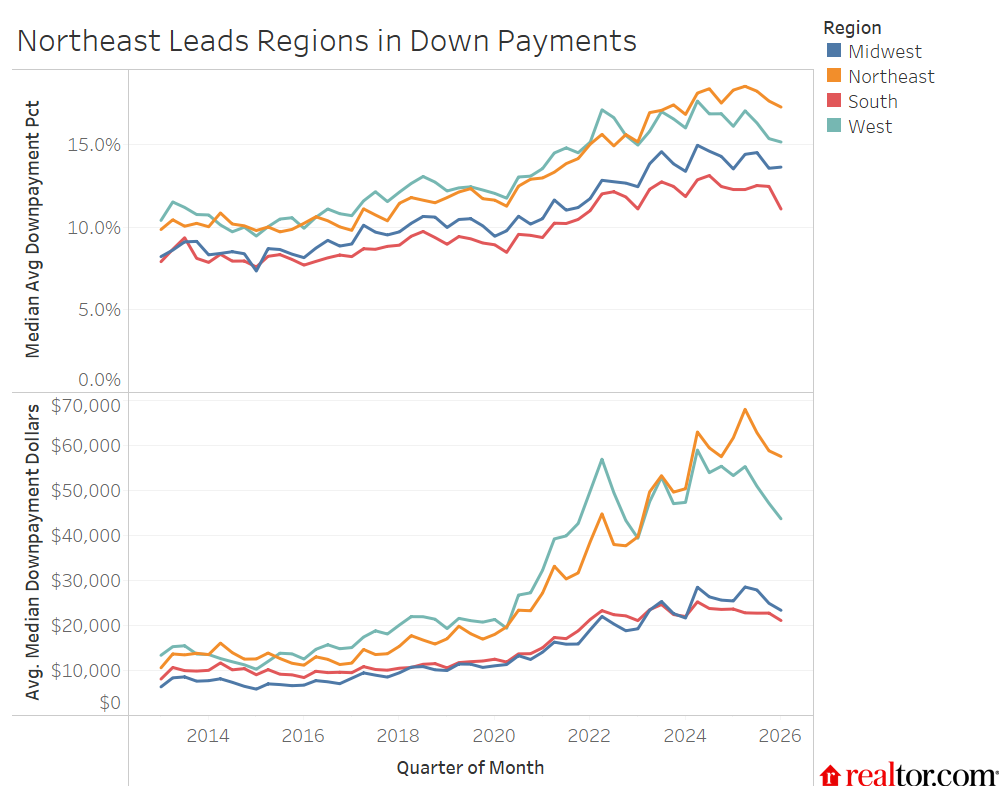
The Northeast has witnessed a 236.8% increase in down payments since 2019, which is much greater than the Midwest’s next closest difference of 134.0%. These patterns are in line with the ongoing rising pressure on home prices in these areas as a result of strong buyer demand and limited inventory. The Northeast and Midwest continue to trail behind by a startling 40 to 50%, reflecting the regional difference in underbuilding relative to demand, despite data indicating that the West and South have recovered in relation to pre-pandemic for-sale housing inventory.
Down payments have also increased dramatically in the West and South compared to before the epidemic, although current patterns indicate a more notable softening in these areas as more buyers enter the market due to plentiful inventory and declining prices.
Median Downpayment in Dollars:
| Region | Q1 2019 | Q1 2025 | Q1 2026 | YoY | Vs. 2019 |
| Midwest | $10,000 | $25,500 | $23,400 | -8.2% | 134.0% |
| Northeast | $17,100 | $61,800 | $57,600 | -6.8% | 236.8% |
| South | $10,600 | $23,700 | $21,100 | -11.0% | 99.1% |
| West | $19,300 | $53,400 | $43,700 | -18.2% | 126.4% |
Moreover, the national softening trend is being amplified by the makeup of the areas where sales are occurring. In 2025, the South—the most economical and supply-recovered significant region—accounted for 44.5% of all home sales, up from 43.0% in 2019. While the West and Northeast both saw a decline in share, the Midwest’s increased from 25.7% to 26.7%. Even though the Northeast is still fiercely competitive, the national average is declining since lower down payment markets are now accounting for a greater portion of the country’s transaction volume.
The apparent softening of down payments is partly a narrative about where purchases are actually taking place, which is increasingly in the reasonably priced Midwest and the well-supplied South. And, according to experts, a key indicator of the general state of the housing market will be the down payment trend through mid-2026.
Property Loans, Homebuyer Credit Scores & More Trends
Before leveling off for the majority of 2025 and declining into late 2025 and early 2026, the median FICO score of homebuyers increased considerably over the previous few years. The average buyer’s FICO score is still higher than pre-pandemic norms at 733, but the directional shift is significant: as mortgage rates fall below levels from a year ago and home prices soften in many markets, the affordability picture improves at the margins, luring back on-the-fence buyers, including those with less perfect credit profiles who had previously been priced or screened out.
The median and average U.S. FICO score decreased between spring and fall 2025, reflecting a larger national trend. It’s important to emphasize that credit-worthiness, as determined by FICO ratings, is still higher than pre-pandemic standards even as it softens, much like the downpayment size trends.
However, many of these re-entering purchasers are depending on government-backed loan schemes to make purchases work rather than going back through traditional channels. While VA loans increased to 11.7% in early 2026, its highest percentage in more than ten years, FHA’s share of buy mortgages has been above 24% for five straight quarters, its longest period of continuous elevation since 2016. In order to close the affordability gap, buyers are increasingly turning to more lenient underwriting standards and lower down payment requirements, which together account for more than a third of all purchase mortgages.
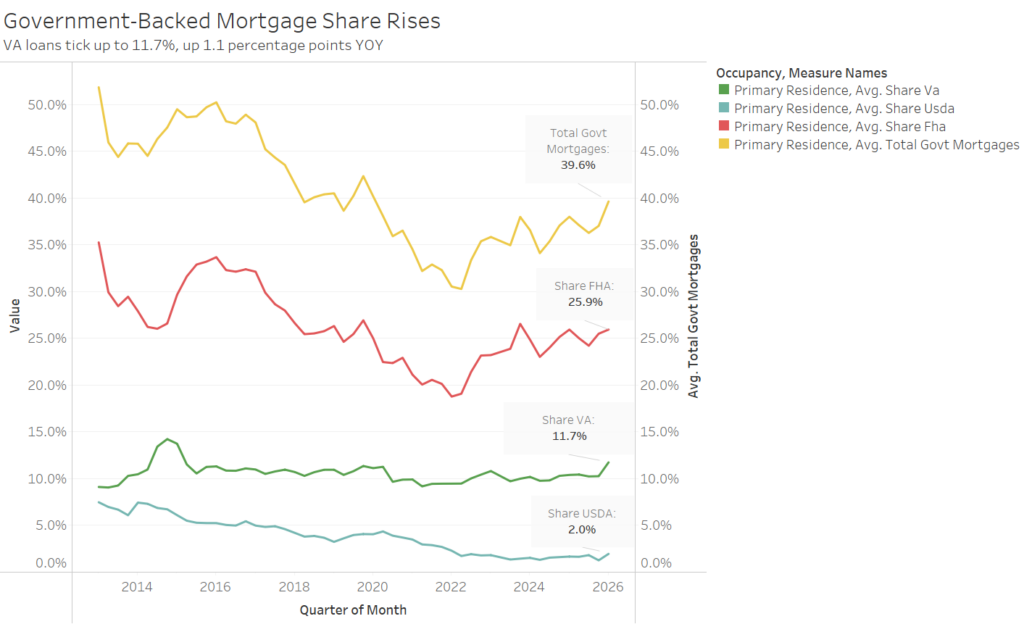
This change has significant effects on inequality and housing demand. Government-funded initiatives are acting as a vital pressure valve, allowing buyers who might otherwise be completely locked out to become homeowners. However, since the percentage of conforming loans has dropped to its lowest level since 2019, the increasing reliance on FHA and VA financing also shows how much the traditional route to homeownership has constricted, indicating that standard financing is still out of reach for purchasers without substantial cash reserves. A widening gap in who can become a homeowner and under what conditions is highlighted by the loosening at the edges, which includes declining FICOs, increasing government-backed shares, and decreasing down payments.
Although more households may be able to become homeowners thanks to government-backed mortgage programs, we have also witnessed an increase in mortgage delinquency in recent quarters, particularly in the FHA segment, indicating that some buyers may find it more difficult to stay in. Buyers who have lower credit ratings and smaller down payments are less equipped to handle unforeseen expenses, job loss, or even small increases in their payments due to rising property taxes, homeowners association dues, or insurance premiums.
To read the full report, click here.