



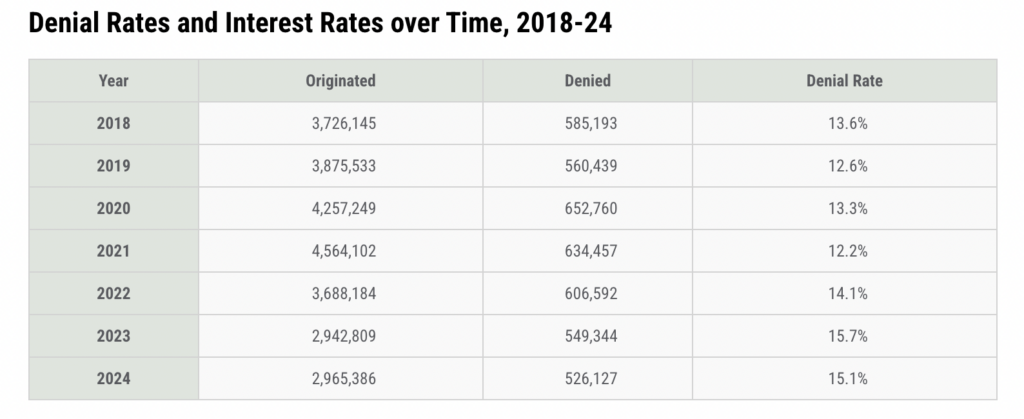
According to a recent study from the Federal Reserve Bank of St. Louis, higher interest rates may prevent people from qualifying for a mortgage in addition to discouraging prospective homeowners, according to CNBC. Researchers at the Federal Bank reported in a recent blog post that the rate of loan application denials increased from 12.2% in 2021 to 15.1% in 2024, coinciding with a spike in mortgage rates from less than 3.5% to over 6.5%.
However, as rates reached at 8% in 2023, fewer customers were applying for mortgages, according to the study. The number of applications decreased from almost 5.2 million in 2021 to 3.5 million that year, when the denial rate was 15.7%. More than 30 million home purchase applications were included in the data used by the St. Louis Fed researchers.
Key Findings:
- By pushing debt-to-income ratios over stringent mortgage-lending standards, rising interest rates actively reject prospective homeowners in addition to reducing demand for homes.
- In 2022 and 2023, denial rates climbed in tandem with rising U.S. mortgage rates, indicating that the rise in rejections was caused by higher borrowing costs rather than weaker applicants.
- The distributional effects of higher interest rates brought on by tighter monetary policy were made clear by rate-driven disqualification, which disproportionately affected borrowers close to underwriting standards.
- A 50% ratio is the actual barrier, according to an examination of denial rates in 2024. At this point, when application ratios exceed 50%, refusal rates start to rise dramatically.
- The debt-to-income ratio range of 50% to 60%, when underwriting restrictions prevent households from obtaining mortgages, should be the focus of research on increasing credit availability.
Per the report, a debt-to-income ratio of 43% was set as the crucial level for “qualified mortgage” status when Congress passed the Dodd-Frank Act in 2010. The 43% figure is one of the most talked-about figures in housing finance since loans that satisfied this requirement provided lenders with a legal safe harbor from ability-to-repay litigation. The Consumer Financial Protection Bureau (CFPB) replaced this ratio-based definition with a price-based norm in 2021, in part because to worries that the 43% limitation was limiting credit to many households, making it impossible for them to buy a home.
Many lenders use the debt-to-income ratio of 43% as a general guideline even though it is no longer a binding cap. However, is mortgage lending limited by this 43% threshold? We discover that it doesn’t using Home Mortgage Disclosure Act (HMDA) data on over 30 million home purchase mortgage applications between 2018 and 2024.1 The actual underwriting cliff, or the point at which denial rates sharply increase, has been at 50%.
According to the St. Louis Fed research, one factor contributing to the increase in mortgage application denials at higher interest rates is the borrower’s debt-to-income ratio being too high. This ratio is used by lenders to calculate how much of a borrower’s monthly income will be consumed by debt payments, such as a projected mortgage payment. According to Fed statistics, purchasers’ debt-to-income ratio was the main factor in 35% of mortgage denials in 2024 compared to 29% in 2018.
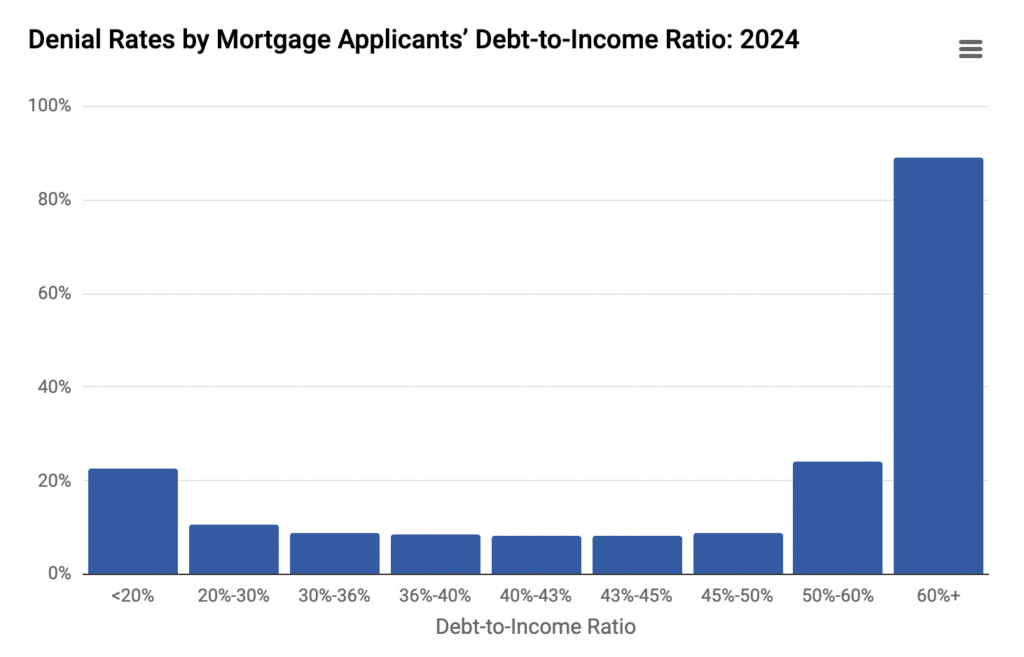
“Even applicants in the highest credit quartile face a sudden, clean four-percentage point jump in rejections the moment their arithmetic touches [above 50%] DTI,” said Carlos Garriga, Director of Economic Research at the Federal Reserve Bank of St. Louis. “Pristine credit or a six-figure income cannot override a blunt software gate that looks only at a binary financial ratio.”
He among other researchers pointed to Fannie Mae’s underwriting software as a reason for that cliff.
According to Jessica Lautz, Deputy Chief Economist and VP of Research for the National Association of Realtors (NAR), student loan debt frequently adds to the debt-to-income ratio for first-time homeowners, in addition to interest rates and property prices that have been consistently higher than they were five years ago. According to her, it is “usually one of the biggest hurdles for young adults to qualify for a mortgage.”
According to experts, although lenders like to see that ratio at 36% or lower, they may approve an application with a greater debt-to-income ratio based on other considerations including income, assets, and credit history. Experts claim that there is a hard cut-off at a 50% ratio for many conventional mortgage lenders.
“When rates rise, the entire distribution of debt-to-income ratios shifts to the right, pushing a larger share of the applicant pool above the hard thresholds where lenders start saying ‘no,'” researchers wrote. “Rising rates don’t just price people out of the houses they want; they lock people out of the credit they need.”
Examining Today’s Mortgage Space
As of Wednesday, the average rate on a 30-year fixed-rate mortgage was 6.61%. According to experts, there hasn’t been much of a shift in affordability difficulties since the research period.
“The dynamics are the same,” Lautz said. “I would say the pressures that the bottom half of the K-shaped economy was feeling are still there.”
The Mortgage Bankers Association (MBA) reported that affordability decreased in April as the median payment asked by mortgage applicants increased to $2,152 from $2,131 in March. And, according to NAR, the median price of an existing home in the U.S. was $417,700 in April, a little increase of 0.9% from $414,000 a year earlier. That amount, however, is 45.6% higher than the median price of $286,800 in April 2020 and almost 22% higher than in April 2021, when it was $341,600.
Denial rates, which ranged from 8% to 10%, were essentially constant across the 20% to 50% ratio range. At 43%, there was no discernible increase. However, refusal rates increased dramatically if the ratio exceeded 50%, and for applications beyond 60%, they exceeded 80%.
This trend shows a significant discrepancy between actual lending practices and the often used benchmark. Long regarded as a bright line in mortgage underwriting, the 43% barrier seems to have little real-world use. Rather, 50% is seen by lenders as the functional barrier, and exceeding it has dire repercussions.
The government-sponsored enterprises (GSEs), such as Fannie Mae and Freddie Mac, were given a temporary exemption from the statutory qualified-mortgage benchmark of 43%. This “GSE patch,” which expired in 2022, permitted them to buy loans with debt-to-income ratios higher than 43% as long as those loans satisfied other qualified-mortgage requirements. This fix essentially eliminated the 43% criterion for the majority of the market because the GSEs sell or guarantee the great majority of conforming mortgage originations.
In the meantime, where compensatory variables like high credit scores, substantial reserves, or low loan-to-value ratios are present, lenders may approve loans with debt-to-income ratios exceeding 43% under the “ability-to-repay” criteria under Dodd-Frank. In actuality, lenders seem to be open to extending this flexibility up to roughly 50%, after which, regardless of mitigating factors, the risk profile becomes too unfavorable.
This result directly affects policy. We explained in the first piece of this series how rising interest rates in 2022–2023 increased borrowers’ debt-to-income ratios, which in turn increased denial rates.Two Many debtors who would have been flagged by the previous regulatory barrier were actually going through it easily because the cliff is at 50% rather than 43%, only to face the real wall farther up the distribution of debt-to-income ratios.
The result is that the 50% to 60% debt-to-income range, when underwriting constraints bind, should be the focus of researchers and governments who are interested in increasing loan access. A barrier that was previously essentially meaningless in practice was addressed by the CFPB’s 2021 reform, which substituted a price-based criteria for the 43% ratio-based qualified-mortgage definition. There is still no similar regulatory focus on the de facto 50% cutoff, where denial rates increase by 15 to 17 percentage points.
The practical message for debtors is straightforward: lenders treat a 45% debt-to-income ratio similarly to a 35% ratio. However, going above 50% completely alters the game.
Note: The public HMDA files report debt-to-income ratios as a mix of exact values and categorical bins (for example, “36%–<40%,” “40%–<43%,” “43%–<45%”). There is no detectable change at 43%, while the jump at 50% is massive.