



In comparison to quarter 1:25 (34 and 36.8 years), the median and average age of first-time homebuyers obtaining mortgage loans in quarter 1:26 (33 and 36.2 years) decreased by one year and 0.6 years, respectively. Since 2000, when the median and average ages of first-time purchasers were 35 and 37.9 years, respectively, there has been a slight decrease. Further, the median and average ages of first-time buyer borrowers were found to have changed from 33 and 36.2 in quarter 1:26 to 34 and 36.2 in quarter 4:25.
The New York Federal Reserve Bank Consumer Credit Panel (CCP), which is published quarterly with little delay, is the source of these findings. It is based on a 5% random sample of all credit reports that include information on the borrower’s age and past home purchases. The CCP determines whether a borrower has previously held a mortgage on a residence by gathering this information. If not, they are regarded as first-time purchasers.
For many, being a first-time homebuyer is difficult right now, as many are facing financial challenges. The report showed that young first-time homebuyers seem to be in dire straits, according to recent age data from the National Association of Realtors (NAR). The average first-time homeowner was 40 years old, which is 9 and seven years older than the average in 2001 and 2021, respectively, according to the NAR’s 2025 study Profile of Home Buyers and Sellers. The average age decreased by 1.7 years in 2001 and by 0.2 years in 2021, according to the CCP.
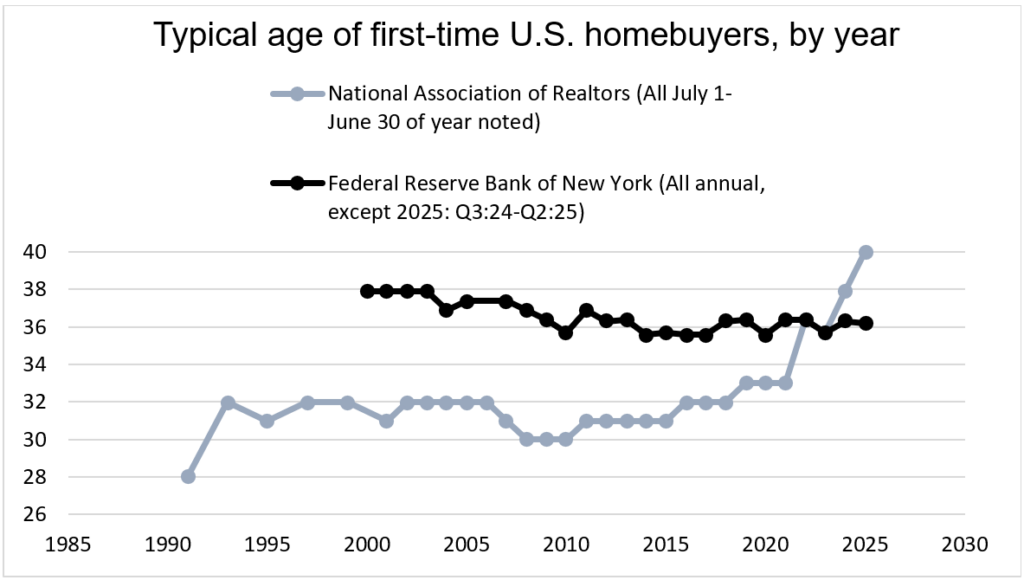
Further analysis of the NAR and CCP results produces useful age-bin distributions. The NAR’s under-35 and 45–74 age categories are underrepresented by 17 percentage points and overrepresented by 18 percentage points, respectively, in comparison to the CCP, despite the fact that both have almost identical proportions for the 35–44 age group. Given that it is a mail survey with 120 questions, which does not lend itself to a high response rate by millennials and Gen Zers, the NAR bias towards a higher age may not come as a surprise.
Note: First-time cash purchases are not included in this data set since credit report data does not indicate cash transactions.
Affordability Crisis Affecting First-time Homebuyers
There is an affordability crisis facing first-time buyers, but one based on home prices, not age. By aggressively buying mortgage-backed securities during COVID-19 and waiting until March 2022 to raise its policy rate, the Federal Reserve helped fuel a massive home price boom. With inflation approaching double digits by 2022, the Fed’s aggressive monetary tightening ultimately led to mortgage rates more than doubling.
As a result, today’s first-time buyers face the dual challenge of historically high home prices and mortgage rates higher than what we have experienced in the last 15 years. From 2019 to 2024, the median first-time buyer income needed to purchase a home increased by 41% nationally. This was about four times the rate of median U.S. household income growth (11%—not inflation adjusted). Overall, lower-income first-time buyers are increasingly being priced out of the market.
The median and average age of first-time homebuyers will now be updated on a quarterly basis.
To read more, click here.