

Inflation jumped for a third consecutive month in May as the war in Iran continued to drive up prices, surpassing 4% for the first time in three years.
The consumer price index, a wide gauge of goods and services costs across the U.S. economy, rose at a seasonally adjusted 0.5% for the month, putting the annual inflation rate at 4.2%, the Bureau of Labor Statistics reported Wednesday. CNBC noted that both numbers were in line with the Dow Jones consensus, though the monthly number was 0.1 percentage point below the April reading.
“Americans are getting squeezed financially by inflation that’s back at a three-year high,” said Heather Long, Chief Economist at Navy Federal Credit Union. “The frustration for many Americans is that so many of the basics are up in price right now — gas, food, electricity, and medical care are all clear pain points that are above 3% inflation. Ending the war in Iran will help to moderate inflation, but the worst is likely still to come for rising food prices.”
CNBC noted that inflation rose above 4% for the first time in three years, though the increase met expectations amid concerns over how much the increase in energy prices would impact the economy. The level was the highest since April 2023 and above the 3.8% reading from April 2026.
Core CPI Accelerated
However, stripping out volatile food and energy prices, the so-called core CPI accelerated 0.2% for the month and 2.9% from a year ago. The annual rate was in line with the forecast, and the monthly gain was below the 0.3% estimate and less than the 0.4% April increase.
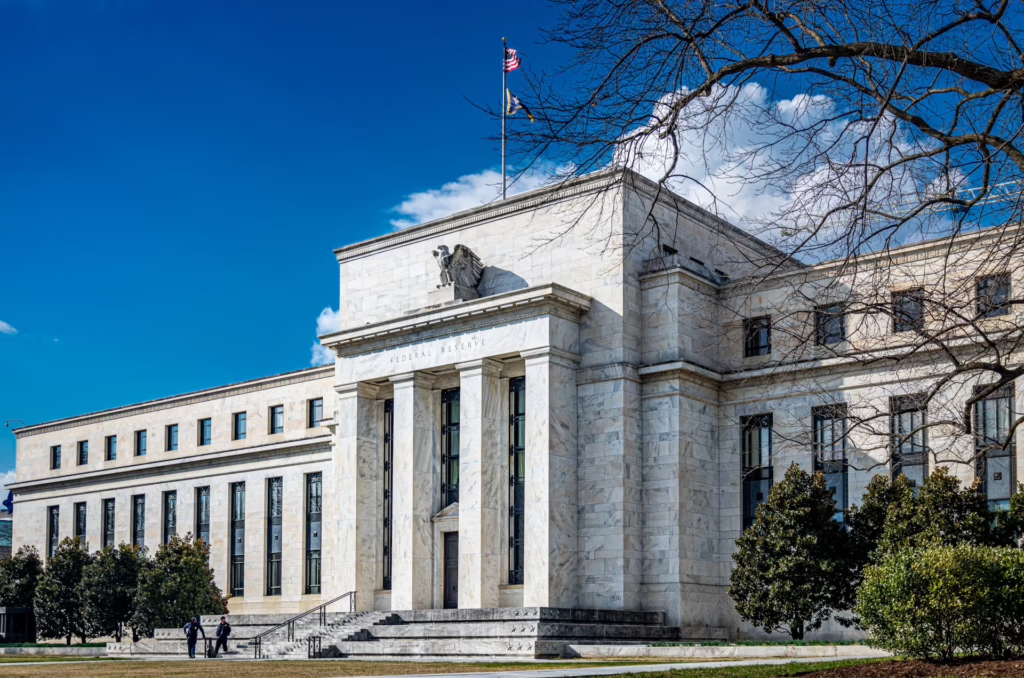
ABC noted that a persistent rise in consumer prices may put pressure on the Fed to raise interest rates to dial back inflation.
For now, futures markets overwhelmingly expect the Fed to hold interest rates steady when the FOMC meets next week, according to the CME FedWatch Tool, a measure of investor sentiment.
The meeting will be the first since Kevin Warsh began a four-year term atop the central bank in May.
During his term as a Fed governor in the late 2000s and early 2010s, Warsh earned a reputation as an interest-rate “hawk,” meaning he generally preferred higher interest rates as a means of ensuring low and stable inflation, ABC noted.
Last year, however, Warsh expressed support for lower interest rates, rebuking the Fed’s concern about inflation risk posed by a flurry of new tariffs.
Threat of Elevated Inflation
At his Senate confirmation hearing in April, Warsh emphasized the threat posed by elevated inflation.
“When inflation surges — as it has done in recent years — grievous harm is done to our citizens, especially to the least well-off,” Warsh said.
As recently as February, inflation was a few ticks above the Federal Reserve’s target level of 2%.
The conflict in the Middle East prompted the Iranian closure of the Strait of Hormuz, a maritime trading route that facilitates the transport of about one-fifth of global oil supply. The standoff triggered one of the largest oil shocks ever seen, ABC reported.
Energy prices soared 23% in May compared to a year earlier, data showed.
The price of an average gallon of gas was $4.15 as of Wednesday, AAA data showed, an increase of $1.17 per gallon since the war began on Feb. 28. That equates to an almost 40% price jump in about three-and-a-half months.
Economist: Tale of Two CPIs
First American Deputy Chief Economist Odeta Kushi said the May CPI was a tale of two CPIs and that mortgage rate relief remains elusive for home buyers.
“May’s inflation report was a tale of two CPIs: higher energy costs pushed headline inflation to its fastest pace in two years, but underlying inflation remained relatively contained. That’s likely enough to keep the Fed on hold, while leaving mortgage-rate relief frustratingly out of reach for home buyers,” Kushi said.
“Consumer prices continued to accelerate in May, with the energy index accounting for more than 60% of the monthly increase in the Consumer Price Index. The Bureau of Labor Statistics reported that the Consumer Price Index increased 0.5% in May and 4.2% from a year earlier, marking the fastest annual pace of inflation since April 2023,” Kushi said. “While inflation remains well above the Federal Reserve’s target, the increase was largely driven by higher energy costs, a development that had been widely anticipated by economists and financial markets.”
Kushi noted that there was some good news in the report.
“The more encouraging news came from core inflation, which excludes the volatile food and energy categories and is generally viewed as a better measure of underlying inflation trends. Core CPI increased 0.2% on the month and 2.9% from a year earlier, with the monthly increase coming in below expectations,” Kushi said. “While higher energy prices continue to push headline inflation higher, the softer core reading suggests underlying inflation pressures remain more contained than the headline figures alone would imply.
How will the report impact the Federal Reserve, which meets next week?
“For the Federal Reserve, this report is unlikely to change the near-term policy outlook. Inflation remains higher than policymakers would like, and a resilient labor market gives the Fed little urgency to lower interest rates. At the same time, the relatively tame core reading should provide some reassurance that underlying inflation has not reaccelerated,” Kushi noted. “The result is likely to reinforce the Fed’s current wait-and-see approach and keep rate cuts on hold for now, as officials look for greater confidence that inflation is moving sustainably back toward target before considering any policy easing. The softer-than-expected monthly core reading also reduces the likelihood that policymakers will need to consider rate hikes.”
Kushi also noted the effects on the housing market.
“For housing, the broader economic backdrop cuts both ways. A resilient labor market supports household formation, income growth, and consumer confidence, all of which help sustain underlying housing demand. Persistent inflation, however, is likely to keep Treasury yields elevated and delay mortgage-rate relief,” Kushi noted. “Mortgage rates are driven more by inflation expectations and bond market conditions than by the federal funds rate itself, and today’s report offers little reason to expect a significant decline in borrowing costs in the near term.”
And, Kushi said, the housing demand hasn’t disappeared.
“The encouraging news for housing is that demand appears to be waiting on the sidelines, rather than disappearing altogether. Existing-home sales posted their strongest monthly gain of the year in May and reached their highest level since December, despite mortgage rates moving higher during the month,” she said. “If inventory levels continue to improve and affordability gradually recovers, stronger confidence in the labor market and broader economy could help bring some of that pent-up demand back into the market, even if meaningful mortgage-rate relief remains elusive.”