



Homebuyers in some of the nation’s most expensive markets continue to opt for high-risk properties over safer alternatives in the vicinity, as indicated by a report from Realtor.com. Approximately 23.1% of homes in the U.S., amounting to a total value of $11.2 trillion, are at severe or extreme risk from wind, flooding, or wildfires. Despite this, buyer interest in certain highly exposed markets remains as robust, if not stronger, than in the adjacent lower-risk regions.
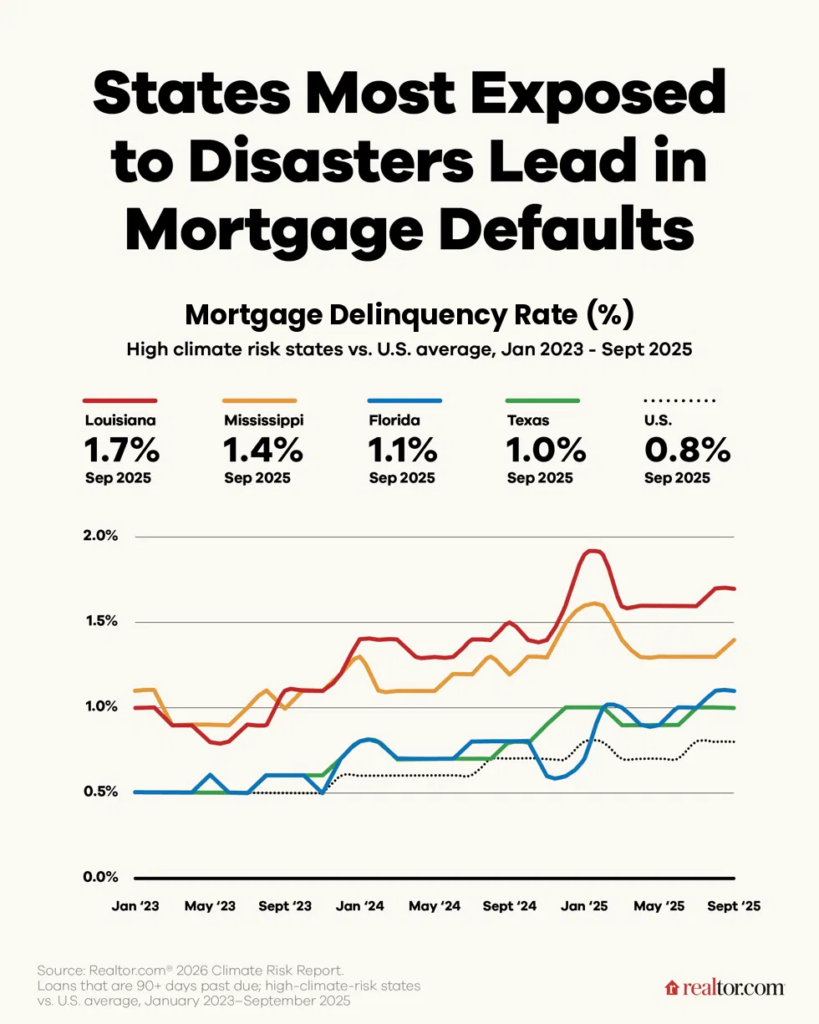
The financial repercussions are no longer contingent upon the occurrence of the next disaster. Homeowners residing in high-risk zones currently incur a median monthly Homeowners Association (HOA) fee of $192, which is 53.6% higher than that of homeowners in lower-risk areas. Additionally, active contracts under the National Flood Insurance Program (NFIP) decreased by 4.5% from May 2025 to May 2026, while serious mortgage delinquency rates in Louisiana and Mississippi have consistently exceeded the national average by more than double.
“Price is still the biggest motivator for a lot of home shoppers, even in places where climate risk is well known,” said Jiayi Xu, Economist at Realtor.com. “But that doesn’t mean the risk disappears. It shows up later, in insurance premiums, HOA fees and financing, often after the sale is already done.”
Top 5 States Where Climate Risk Adds the Most to HOA Costs:
| State | HOA Fee, Severe/Extreme Risks | HOA Fee, Non-Severe/Extreme Risks | Cost Difference by $ | Cost Difference by % |
| Delaware | $177 | $25 | $152 | 608.0 % |
| South Carolina | $296 | $50 | $246 | 492.0 % |
| Oregon | $423 | $114 | $309 | 271.1 % |
| Maryland | $282 | $104 | $178 | 171.2 % |
| Pennsylvania | $332 | $150 | $182 | 121.3 % |
Examining Climate Risk by Region
In several of California’s most affluent counties, the presence of climate risk is associated with a price reduction, and some purchasers are opting to accept this risk. In Santa Clara County, properties that are categorized as facing severe or extreme risk are listed at only 78% of the price per square foot of properties that do not face such risks, and they attract 48% more views per listing.
A similar trend is observed in Los Angeles County, where homes at severe or extreme risk are priced at 75% of those without such risks and receive 23% more views. Even the wildfires in Los Angeles in January 2025 only momentarily disrupted this trend: the ratio of views between severe or extreme risk homes and lower-risk homes fell from 1.21 in December 2024 to 1.11 the following month, before recovering to 1.31 by March.
In contrast, in other markets, buyers of homes at severe or extreme risk are willing to pay a premium rather than a discount. In Anne Arundel County, MD, homes facing severe or extreme risk are priced 44% higher per square foot compared to those without such risks, largely due to their proximity to Chesapeake Bay waterfront. Similarly, in Llano County, Texas, homes at severe or extreme risk are priced at double the rate of non-severe or extreme risk homes, reflecting the demand for Hill Country ranches and river retreats.
The median monthly HOA fee for residences at severe or extreme risk is $192, whereas for homes categorized as lower-risk, the fee is $125, resulting in a disparity of 53.6%. This difference is most pronounced in Delaware, South Carolina, and Oregon at the state level, as well as in Portland, OR; Washington, DC; and Seattle, WA, at the metropolitan level.
Top 5 Metros Where Climate Risk Adds the Most to HOA Costs:
| Metro | HOA Fee, Severe/Extreme Risks | HOA Fee,Non-Severe/Extreme Risks | Cost Difference by $ | Cost Difference by % |
| Portland-Vancouver-Hillsboro, OR-WA | $640 | $104 | $536 | 515.4% |
| Washington-Arlington-Alexandria, DC-VA-MD-WV | $541 | $142 | $399 | 281.0% |
| Seattle-Tacoma-Bellevue, WA | $380 | $110 | $270 | 245.5% |
| Columbus, Ohio | $330 | $100 | $230 | 230.0% |
| Baltimore-Columbia-Towson, MD | $322 | $99 | $223 | 224.7% |
Insurance Costs, Disaster Claims & More
For many, flood insurance coverage is increasingly difficult to maintain. The number of active NFIP policies decreased from 3.62 million to 3.45 million between May 2025 and May 2026, with Texas experiencing the most significant decline at 7.8%. This reduction follows the implementation of the NFIP’s Risk Rating 2.0 pricing model, which aligns premiums more closely with the specific flood risk of a property. In addition to Texas, states such as Oklahoma, Idaho, Mississippi, and Alabama each reported a drop in active policy counts exceeding 6%. Furthermore, median annual premiums are on the rise, with projections indicating they could nearly double over time, increasing from $689 in December 2022 to $1,288.
Data on mortgage performance highlights where the pressure ultimately manifests. Louisiana and Mississippi have consistently reported serious mortgage delinquency rates above the national average, reaching 1.7% and 1.4% respectively by September 2025, in contrast to a national average of 0.8%. Florida and Texas began 2023 close to the national average but have since risen above 1.0%, reflecting both the impact of direct storm damage and the additional burden of escalating insurance costs.
“Having the full financial picture, including future insurance costs and coverage availability, matters just as much as the purchase price,” Xu said. “There’s nothing wrong with choosing a high-risk area for affordability or lifestyle, as long as it’s an informed choice.”
Conclusion
The financial implications of climate risk are significant and increasing: escalating insurance premiums, elevated HOA fees, and mortgage pressures that intensify following major events. These expenses do not vanish simply because a buyer was unaware of them at the time of purchase. Instead, they emerge later, often at the most challenging moments to manage. A buyer opting for a discounted high-risk property in a costly California county, as it represents their only opportunity for ownership, deserves to be informed about potential insurance costs in five years. Similarly, a lifestyle buyer attracted to a ranch in Texas Hill Country should be aware that insurance providers are starting to withdraw from those areas. Neither buyer is making an erroneous choice; both may be doing so with an incomplete understanding of their financial situation.
The purpose of climate risk disclosure is not to dissuade buyers from acquiring high-risk properties or to hinder homeownership in desirable communities. Rather, it is to guarantee that when buyers make their decisions, they are fully aware of the long-term financial implications associated with climate risk from the outset, rather than facing unexpected revelations years later when these costs become unavoidable.
Note: Due to methodology updates from First Street, these figures are not directly comparable to those reported in Realtor.com 2025 Climate Risk Report.
To read more, click here.