


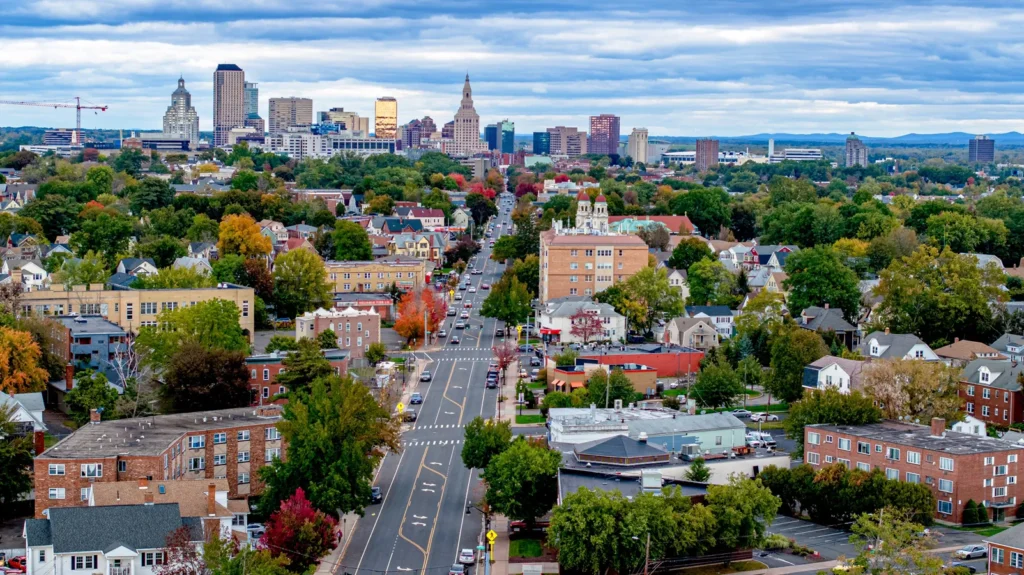
Because of its high concentration of insurer headquarters, many people know this city as the “insurance capital of the world” and “America’s filing cabinet.”
Now, Hartford, Connecticut, has reclaimed the title of America’s hottest housing market after more than a year, Realtor.com noted.
It is the quintessential New England metro that encompasses the cities of Hartford, West Hartford, and East Hartford, and it has emerged as a magnet for buyers seeking relative affordability compared with the region’s high-priced, fiercely competitive and inventory-starved real estate markets of Boston and New York City.
Buoyed by rising demand from shoppers seeking better value within commuting distance from these larger metros, Hartford climbed four spots year over year in the Realtor.com May Hottest Markets report to clinch the top spot, and dethroning April’s leader, Springfield, Massachusetts, which finished fifth.
According to Realtor.com, the market hotness rankings are based on two metrics: 1) market demand, as measured by unique views per property on Realtor.com and 2) the pace of the market reflected in the number of days a listing remains active on the platform.
Hartford attracted 5.3 times the national average number of viewers per property in May, the highest ratio in the entire top 20. Realtor.com said the typical home there sold in just 25 days. That’s five days faster than a year ago and nearly a month faster than the national norm, the website said.
Realtor.com senior economist Hannah Jones said the surging demand and swift market pace together reflect Hartford’s highly restricted supply of for-sale homes and more buyer-friendly conditions compared with its larger and pricier neighbors.
A Better Value
At a median listing price of $475,000, Hartford is significantly more accessible than either Boston or New York, where asking prices in May registered at $849,000 and $775,000, respectively, Realtor.com noted.
“In the post-COVID era, what people have been looking for in a home had evolved, and that has lead to people heading to Hartford from more dense metros like Boston and New York,” Carl Lantz, a West Hartford-based real estate agent at Coldwell Banker Realty, told Realtor.com. “Despite the great increases in prices, and owners’ home equity, we are still a better value than both of those areas.”
Lantz said that Hartford’s growing appeal is a double-edged sword, as the market suffers from a critical shortage of listings. Based on Realtor.com data analysis, Hartford’s current inventory is 75% below its pre-pandemic norms.
“We absolutely do not have the needed inventory, even to support the normal move-up, move-down local buyers,” Lantz said. “That lack of inventory has been the prime driver of prices, and it’s not an easy fix.”
Lantz said that building new homes takes time and money, a challenge that requires a multipronged approach combining incentives for developing workforce housing, adding accessory dwelling units, and providing aid to first-time and low-income buyers.
The metro area offers vibrant shopping, dining and outdoor spaces, including easy access to beaches and mountains.
For home shoppers coming from outside the area, Lantz reminds that Greater Hartford has in store a wide variety of communities to choose from, ranging from the bustling cities of Hartford and West Hartford to more rural Glastonbury and Farmington Valley.
Northeast has Pulled Ahead
“For buyers who feel like they want to wait and save more, I remind them that the market is still moving upwards here, and if they find a home they like now, those increases will be theirs in the next year, but not if they don’t purchase now,” Lantz said. “Prices will likely be higher again next year, so their purchasing power might be diminished in the future.”
For the past two and a half years, the Northeast and Midwest have been the only two regions represented on the top 20 hottest markets list, but recently the Northeast has pulled ahead.
Realtor.com said that in May, 15 of the 20 hottest markets were in the Northeast, with Connecticut alone claiming five spots in the rankings, and New England accounting for the majority of the top 10.
However, Jones said that the metros on the list reflect a variety of price points and buyer profiles, from $330,000 in Rochester, New York, to $847,000 in Bridgeport, Connecticut.
“Until inventory expands meaningfully in the region’s supply-constrained markets, the Northeast’s grip on this list is unlikely to loosen,” Jones said.