


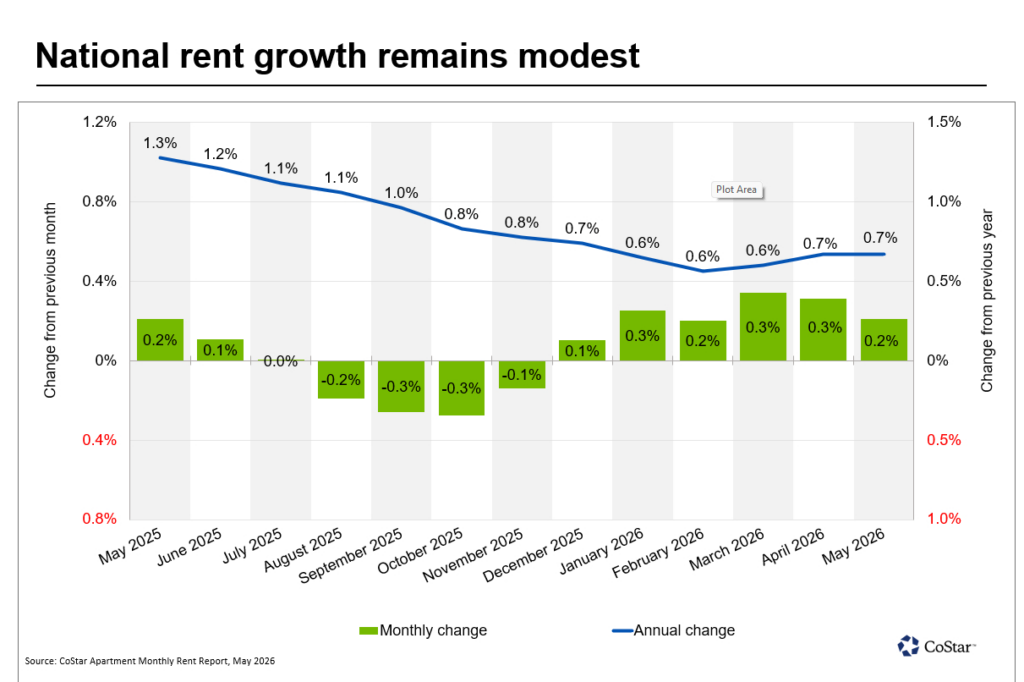
The most recent analysis on multifamily rent trends for May 2026 has been released by Apartments.com. The Multifamily Rent Growth Report for May 2026 showed that the national average for apartment rents in the U.S. rose to $1,737 in May, a +0.2% increase from the upwardly revised level of $1,733 in April. After a stretch of flat to declining monthly performance in the second half of 2025, this is the sixth consecutive month of positive rent growth. Rent growth was unchanged at +0.7% annually in May, which was lower than +1.3% a year earlier and consistent with the April reading.
Initial reports for March and April showed month-over-month increases of +0.2% and +0.3%, respectively. Gains in May were moderate, indicating that spring leasing season momentum is more constrained than in a typical year, even though apartment rent increase usually peaks at this point in the season. Although monthly rent growth has steadied since late 2025, the nation’s price momentum is still being restrained by supply conditions and more measured demand growth.
All five regions had month-over-month increases in rent in May, indicating widespread rent rise. On a monthly basis, the Northeast and Pacific areas both had increases of +0.3%, followed by the Midwest region at +0.2% and the South and Mountain regions at +0.1%. Regional performance was more inconsistent on an annual basis.
At +2.0%, the Midwest had the highest year-over-year rent growth, followed by the Pacific at +1.2% and the Northeast at +1.3%. On the other hand, rents decreased by -1.7% in the Mountain region and -0.8% in the South. Western markets continue to perform differently, with more supply-constrained Pacific cities under less pressure than supply-heavy Mountain metro areas.
Rent rise continued to be prevalent at the metro level in May, with 43 of the top 50 cities reporting month-over-month increases—a modest decrease from 45 markets in April. With a monthly rent increase of +1.2%, San Jose, CA, topped the way, followed by Tucson at +0.9% and San Francisco at +0.8%. Only seven big areas saw monthly rent decreases: Fort Lauderdale, FL, Phoenix, Los Angeles, Louisville, KY, and Las Vegas all saw decreases of -0.1%, Richmond, VA, saw a decrease of -0.2%, and San Antonio saw a small decrease.
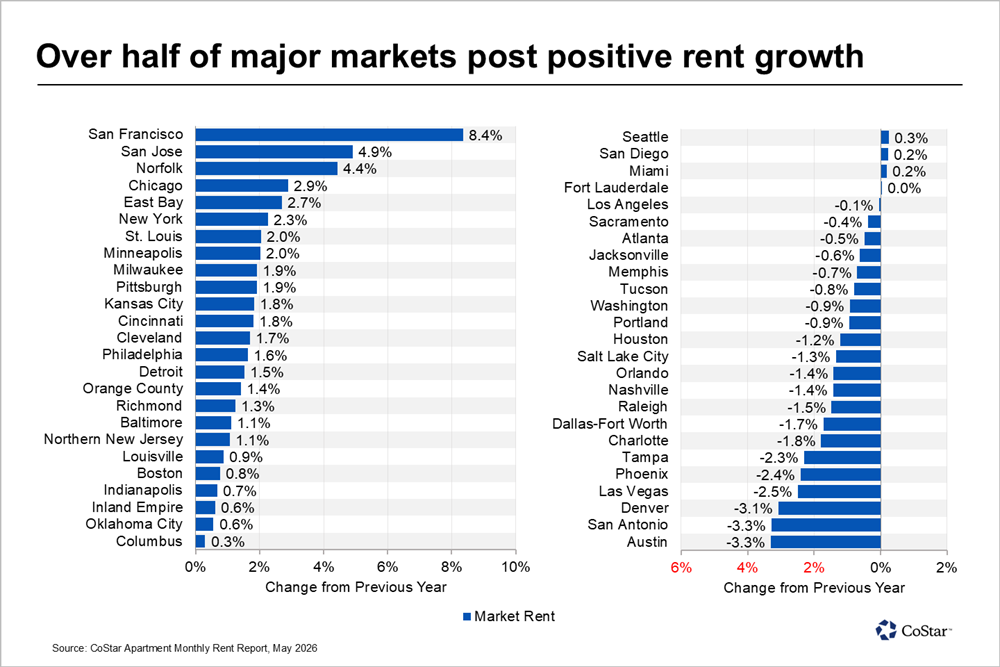
With a rent increase of +8.4% annually, San Francisco continues to lead, followed by San Jose at +4.9%, Norfolk, VA, at +4.4%, and Chicago at +2.9%. The markets with the biggest supply additions, Austin, Texas, and San Antonio, both saw yearly decreases of -3.3%, followed by Denver at -3.1% and Las Vegas at -2.5%, indicating that new supply continued to exceed demand.
Though year-over-year performance is still inconsistent and strongly correlated with local supply constraints, moderate monthly rent increases are increasingly common nationwide. As the 2026 spring leasing season advances, a significant—albeit steadily diminishing—inventory overhang continues to impede rent growth nationwide, even though many cities have surpassed peak building activity.
To read the full report, click here.