

Alan Greenspan, an influential economist who steered U.S. monetary policy during his five terms as chairman of the Federal Reserve under four presidents, died Monday at the age of 100.
NBC News correspondent Andrea Mitchell, his wife of 29 years, said he died from complications of Parkinson’s disease.
“Alan passed away at our home this morning at the age of 100 from complications of Parkinson’s disease,” Mitchell said in a statement. “He was a giant of a man who helped shape the U.S. economy for decades under presidents of both parties, but was always honest in acknowledging his mistakes,” she said.
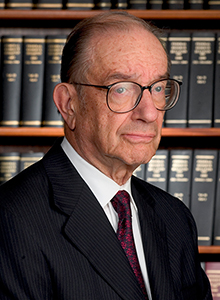
“To me he was my husband, who shaped my life from our very first date in 1984. He had ‘irrational exuberance’ for baseball, the Washington Commanders, tennis, golf and music, especially jazz,” Mitchell said. “He will be remembered for his brilliance and his kindness. Being his life partner was the joy of my life.”
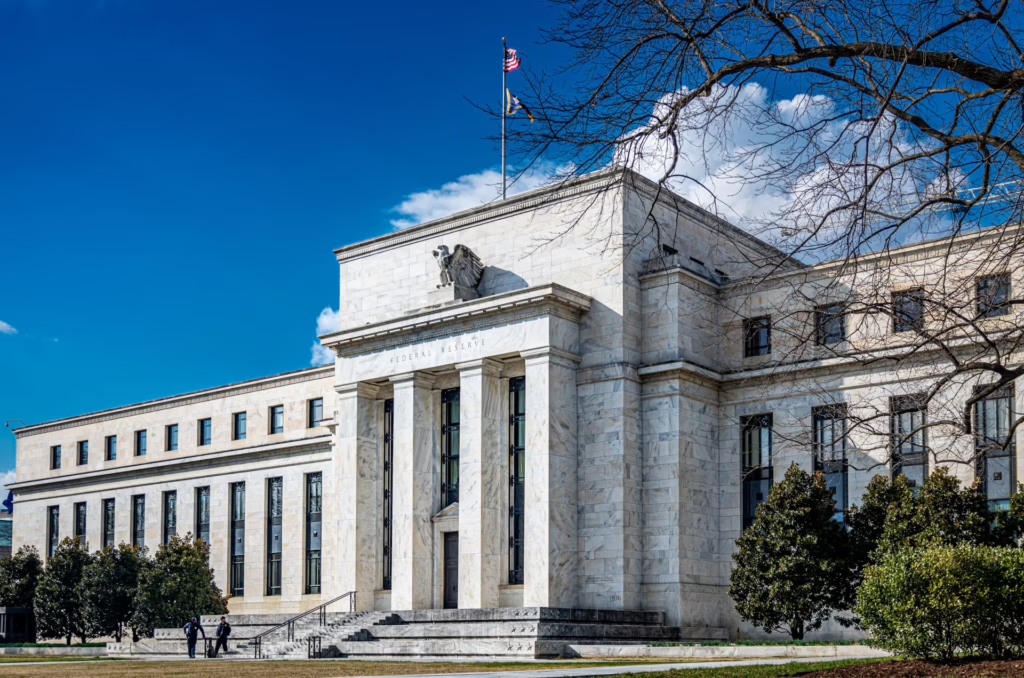
In a statement, the Fed extended its condolences to Mitchell and said Greenspan’s “contributions to monetary policy and economic thought left a lasting mark on this institution, on the broader field of economics, and on the country.”
Profound Influence on Economy
Greenspan’s influence on the American economy was profound and long lasting.
“With the passing of Alan Greenspan, we lose one of the most influential economic architects of the modern era. His decisions at the helm of the Federal Reserve fundamentally altered the landscape of American housing and mortgage policy. For those dedicated to the stability and preservation of the housing market, his tenure remains a profound study in market liquidity, risk management, and the enduring power of central banking,” said Ed Delgado, Principal, Mortgage Policy Advisors, and Chairman Emeritus, Five Star Global.
Greenspan helped define modern American capitalism from the final years of the Cold War-era through the dawn of the digital age, NBC News noted.
He helped define modern American capitalism from the final years of the Cold War-era through the dawn of the digital age, NBC News noted.
He presided over the Federal Reserve during one of the longest economic expansions in U.S. history, a boom stretching from 1991 to 2001, NBC News noted. But Greenspan also was blamed for decisions that critics say created the conditions for the global financial crisis of 2007-08, such as advocating for deregulation of the financial sector.
Greenspan was born March 6, 1926. In his early years, Greenspan attended the Juilliard School and played jazz saxophone and clarinet in a band.
He studied economics at New York University, earned a bachelor’s degree in 1948 and a master’s in 1950, and then began work on a doctorate at Columbia University under economist Arthur F. Burns, also a future Chairman of the Federal Reserve.
In the early 1950s, Greenspan became an associate of the “Atlas Shrugged” writer Ayn Rand, whose “objectivist” philosophy of self-interest and laissez-faire capitalism inspired future generations of political libertarians and conservatives. He embraced some of her beliefs and paid tribute to her in his 2007 memoir.
Served as Nixon Adviser
“Ayn Rand and I remained close until she died in 1982, and I’m grateful for the influence she had on my life. I was intellectually limited until I met her,” Greenspan wrote in “The Age of Turbulence: Adventures in a New World.”
Greenspan’s first venture into the political world came in 1967 when he served as an adviser on Richard Nixon’s 1968 presidential campaign. Greenspan helped with Nixon’s transition to the Oval Office but turned down an official role in the administration.
After Nixon’s resignation in 1974, Greenspan took a position in President Gerald Ford’s administration as chairman of the Council of Economic Advisers, serving until 1977. There, he pursued policies that, together with tighter monetary policy from the Paul Volcker-led Federal Reserve, helped reduce inflation from 11% to 6.5%.
Greenspan returned to government service when President Ronald Reagan appointed him to fill Volcker’s term as chairman of the Federal Reserve. Greenspan’s nomination was confirmed by the Senate on Aug. 11, 1987, during Reagan’s second term.
NBC reported that on Oct. 19, 1987, or “Black Monday,” when the Dow Jones Industrial Average plummeted by more than 22% — the index’s largest one-day percentage fall ever — Greenspan moved swiftly to keep the markets liquid. From then on, Fed moves to support financial markets through episodes of instability became known as the “Greenspan put.”
Longest Expansion
Greenspan was lauded for guiding the economy through what was then the longest expansion in U.S. history, running roughly from March 1991 to the first quarter of 2001. It was a transformative period that saw the acceleration of globalization and the rise of the internet.
Greenspan navigated the Fed through seminal events, NBC said, including the “dotcom” bubble burst and the aftermath of the Sept. 11, 2001, terrorist attacks.
He achieved celebrity status when stocks soared to record levels under President Bill Clinton. The writer Christopher Hitchens called him “America’s least-likely celebrity,” The Economist magazine dubbed him a “rock star,” and his admirers called him “the maestro.”
Greenspan served five consecutive four-year terms and retired Jan. 31, 2006. He has the second-longest tenure as Fed chair, trailing only William McChesney Martin, who served from 1951 to 1970.
In the wake of the financial collapse of 2007-08, Greenspan was scrutinized for decisions that some critics believe set the stage for the meltdown. Despite his infamous warning in 1996 that “irrational exuberance” was unduly inflating stock prices, he was faulted for missing the early-2000s housing bubble.
In 2011, the bipartisan Financial Crisis Inquiry Commission determined that the crisis was caused, in part, by Greenspan’s failure to discourage trade in securities backed by subprime mortgage loans amid an unsustainable housing boom and his promotion of financial industry deregulation.
“More than 30 years of deregulation and reliance on self-regulation by financial institutions, championed by former Federal Reserve chairman Alan Greenspan and others, supported by successive administrations and Congresses, and actively pushed by the powerful financial industry at every turn, had stripped away key safeguards, which could have helped avoid catastrophe,” the report said in part.
‘Credit Tsunami’
In testimony to the House Committee on Oversight and Government Reform in October 2008, Greenspan called the financial crisis as a “once-in-a-century credit tsunami.”
“The crisis, however, has turned out to be much broader than anything I could have imagined,” he said.
After leaving the Federal Reserve, Greenspan started his own consulting company in Washington and authored several books.