

Due to the persistent affordability crisis, the national foreclosure rate has surged to its highest point in almost seven years, with several smaller markets, primarily located in the South and Midwest, now accounting for the largest portion of default listings in the U.S.
A recent report from Realtor.com monitors the latest trends in foreclosures, emphasizing the process that occurs when properties transition to Real Estate Owned (REO) status and are subsequently listed by banks on various multiple listing services and online platforms.
While the experience of losing a home to foreclosure is distressing for homeowners, it offers a chance for astute buyers and investors seeking to acquire properties at significantly reduced prices, as long as they can effectively manage the specific challenges associated with such transactions.
Examining Foreclosed Homes, Default Programs & More
A foreclosed property becomes an REO when it does not sell at a foreclosure auction, providing the lender an opportunity to recover its investment by putting the property on the market, usually in its current condition, without any repairs or enhancements.
Throughout the COVID-19 pandemic, the rate of defaults significantly decreased due to various important federal measures, such as the foreclosure moratorium and mortgage forbearance program established by the Coronavirus Aid, Relief, and Economic Security (CARES) Act, which were designed to safeguard homeowners during a global health emergency.
Even after those programs were discontinued, foreclosure rates stayed low for several years, largely due to substantial increases in home equity, which were supported by payment deferral, loan modification, and forbearance initiatives provided by Fannie Mae and Freddie Mac that concluded only in 2024.
However, since that time, foreclosure rates have consistently risen, driven by high property prices, increasing property taxes, surging insurance costs, and a cost of living that has outstripped wage growth, making it increasingly difficult for homeowners to manage their monthly mortgage obligations.
As of early 2026, the rate of new foreclosures nationwide was 0.24%, closely aligning with the 2019 standard, according to information from the Mortgage Bankers Association as reported by Moody’s.
“Buyers since 2023, when home prices flattened off, are most at risk,” said Joel Berner, Senior Economist at Realtor.com. “They’re newer to their mortgage and don’t have as much of an equity stake in their home, partly because the first few years of mortgage payments are made up of significantly more interest than principal and partly because their home has not appreciated as much as those that were purchased before the price surge of 2021 and 2022.”
For this particular segment of purchasers, the likelihood of becoming “underwater”—which refers to owing more on the property than its current value—is the highest.
Foreclosure Listings Vary by Region
REO properties represented 1.3% of all active listings in April 2026 at the national level. For prospective buyers and investors, these foreclosures offer a substantial discount opportunity: the median REO home sold for 27.2% below its estimated value. Nevertheless, these properties are accompanied by considerable challenges.
Although REO properties garnered 26.5% more page views on Realtor.com compared to standard listings, they remain on the market for an average of 11 days longer. This extended duration is due to the properties being sold in their current condition, receiving less marketing attention, and having to navigate local regulatory obstacles.
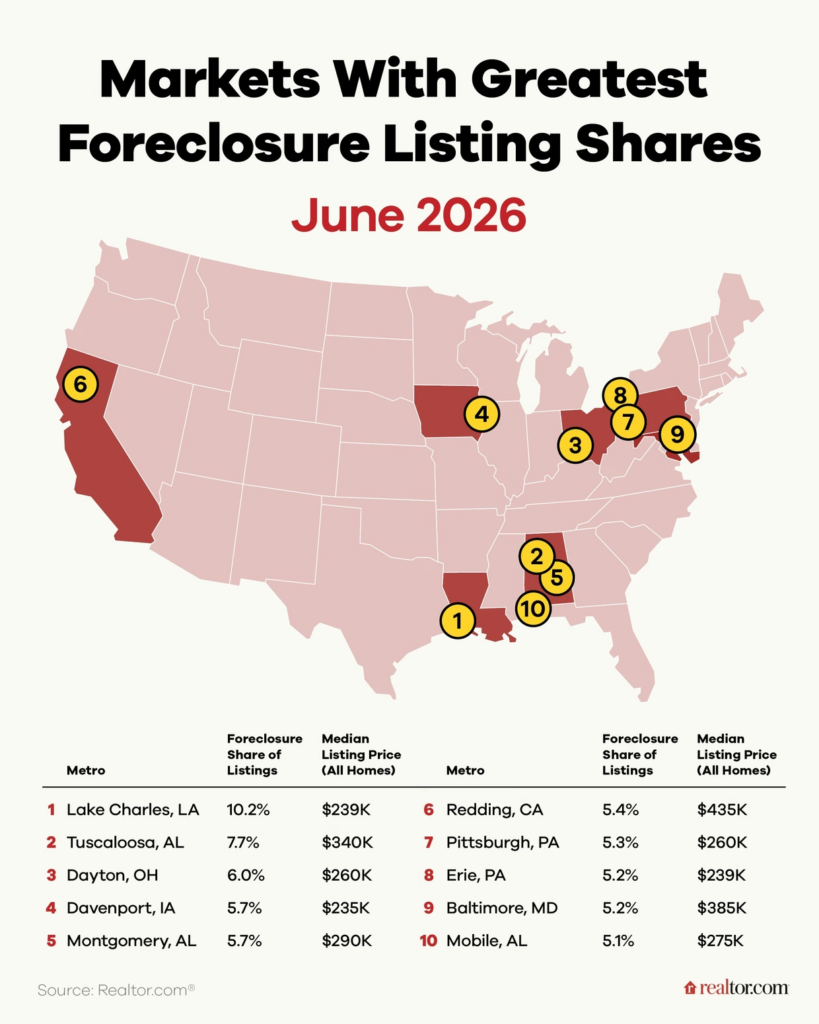
Top Five Markets with the Greatest Share of Foreclosure Listings:
- Lake Charles, LA (10.2%)
- Tuscaloosa, AL (7.7%)
- Dayton, Ohio
- Davenport, IA (6%)
- Montgomery, AL (5.7%)
Although large metropolitan areas like Chicago, Philadelphia, and Houston exhibit the greatest absolute number of foreclosure listings, each exceeding 570, it is the more affordable markets that experience the highest density of foreclosures.
Lake Charles, LA, a metropolitan area with a population of approximately 240,000, situated 200 miles to the west of New Orleans, currently holds the highest rate of foreclosures in the nation, with these properties constituting over 10% of its market. According to Danette McManus, a local real estate agent, the elevated default rate in the market is significantly linked to the severe climate risks faced by Southwestern Louisiana.
“After Hurricanes Laura and Delta, many homeowners found themselves in lengthy battles with insurance companies,” McManus said. “Claims often took months—or even years—to settle, and in many cases, insurance proceeds weren’t enough to cover the actual cost of repairs. With hurricane deductibles commonly around 5% of a home’s insured value, many families were suddenly responsible for tens of thousands of dollars out of pocket.”
Alongside the financial burden imposed by the storms, the housing market in Lake Charles has been adversely affected by rising insurance premiums, escalating property taxes, inflation, and soaring daily living costs, which have collectively fostered an environment conducive to defaults.
“There were homeowners who desperately wanted to stay in their homes, but after draining savings, taking on additional debt for repairs, and then facing continued increases in insurance costs, they simply ran out of options,” McManus said. “While every foreclosure has its own story, those experiences are part of what makes Southwest Louisiana different from many other markets. Foreclosures don’t happen overnight, so I believe some of what we’re seeing today reflects financial hardships that have been building for several years.”
Affordability Poses a Persistent Challenge
Alongside the financial burden imposed by the storms, the housing market in Lake Charles has been adversely affected by rising insurance premiums, escalating property taxes, inflation, and soaring daily living costs, which have collectively fostered an environment conducive to defaults.
“This is a market where overall demand has fallen enough that foreclosures make up a bigger slice of a smaller pie,” said Jake Krimmel, Senior Economist at Realtor.com. “And those foreclosed homes are sitting.”
The economist advises that individuals seeking to purchase foreclosed properties in Lake Charles should exercise patience, as there is still potential for prices to decrease further. The most suitable buyer is likely to be an investor or house flipper who has the luxury of time, rather than a first-time homebuyer. In addition to Lake Charles, Tuscaloosa, AL, ranks second in the nation for the highest percentage of default listings at 7.7%. Following closely is Dayton, Ohio, with 6% in third place, while Davenport, IA, and Montgomery, AL, both share a rate of 5.7%, completing the top five.
As noted by McManus, a clear advantage of acquiring an REO home is the initial cost. Foreclosed properties are generally priced below market value, providing an opportunity to increase equity through renovations. In agreement with Krimmel, the local agent emphasizes the necessity for buyers to fully understand what they are committing to prior to finalizing the purchase.
“The biggest risk is that many of these homes have been vacant or neglected,” McManus said. “In our climate, that can mean moisture issues, mold, deferred maintenance, storm-related repairs, or other problems that aren’t immediately visible.”
McManus noted that insurance is an additional challenge that buyers often overlook until they are already bound by a contract.
“Finding affordable insurance on some distressed properties can be difficult, and if the home needs major repairs, financing can become another obstacle,” McManus said. “Buyers need to do their homework before assuming they’re getting a bargain.”
Although foreclosed properties typically draw the attention of wealthy investors who have established connections with contractors, McManus notes that she is increasingly observing regular buyers expressing interest in REOs as concerns about affordability rise. Nevertheless, upon examining the troubled Alabama markets included in the report, Realtor.com emphasizes a significant warning that prospective buyers must consider prior to making an offer: the statutory right of redemption in the state. This legislation permits a previous homeowner to regain their property following a foreclosure sale by reimbursing the buyer for the purchase price along with interest, taxes, insurance, and other permissible fees.
“If looking to buy a foreclosed property in Alabama, it’s definitely more ‘buyer or investor beware’ than in other states, simply because of the rules and regulations,” Krimmel said.
Even after a buyer has finalized the purchase of a property, the previous owner can legally compel them to relinquish it, posing significant risks, particularly for buyers intending to renovate the home immediately.
In conclusion, when analyzing the markets that exhibit the highest proportions of default listings, economists identify several recurring factors. These factors predominantly pertain to lower-priced housing markets, where a greater number of renters have the opportunity to pursue homeownership compared to more expensive metropolitan areas. To put it differently, in these markets, the transition from renting to owning is more feasible, as down payment requirements are lower than the national average. Nevertheless, this increased accessibility presents a double-edged sword for buyers with low incomes.
“The affordability advantages of these metros that made homeownership possible for buyers on the margin lead to a selection bias that leaves the typical homeowner more susceptible to foreclosure,” Berner concluded.