


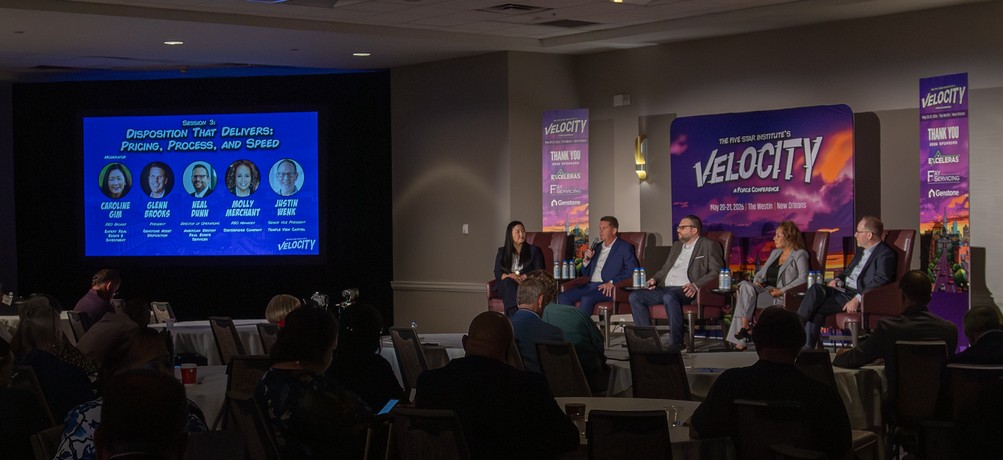
Extended days on market continue to challenge agents nationwide, and this session at the recent Velocity A FORCE Conference in New Orleans focused on the disposition strategies that experienced operators use to move assets efficiently while protecting value.
Topics included pricing discipline, buyer positioning, and execution practices that reduce stagnation and unnecessary price reductions.
Panelists included moderator Caroline Gim, Broker at Expert Real Estate & Investment; Glenn Brooks, President of Genstone; Neal Dunn, Director of Operations at American Destiny Real Estate Services; Molly Merchant, REO Manager of Statebridge Company; and Justin Wenk, Senior Vice President at Temple View Capital.
Panelists said that communication, pricing discipline, and preparation are becoming the keys to successful asset disposition.
Best Execution is More Important Than Pure Speed
They said that as inventories rise and distressed properties slowly return to the market, the industry’s priorities have shifted from the rapid-fire liquidation strategies of the post-2008 housing crisis to a more deliberate approach focused on maximizing value.
That was the consensus during the discussion on REO disposition, where asset managers, servicers, and investors agreed that while speed remains important, today’s market demands better execution, stronger communication, and tailored strategies for each property.
“We’ve been more about best execution,” Brooks said. “Speed is important, but so is preparation.”
Brooks, who has worked through two major REO cycles since entering the business in 1995, said today’s environment differs significantly from the aftermath of the financial crisis. During the foreclosure wave of 2008 through roughly 2014, lenders emphasized getting properties listed and sold as quickly as possible, he said. Now, each asset requires a customized evaluation.
Rather than treating every foreclosure the same, Brooks said his team evaluates repair opportunities immediately after gaining access to a property, balancing the potential return on investment against additional time required to complete renovations.
“We’re about speed, but we’re more about best execution,” he said.
Rising Costs Complicate Dispositions
Dunn said the biggest challenge facing asset managers today is controlling costs while preparing properties for sale.
Inflation has pushed up labor costs, contractor fees, insurance premiums and utility expenses, he said, making it more difficult to bring properties to market while protecting investor returns.
“You really have to step back and analyze that and make sure you’re making the right decisions for the property without costing the seller additional fees,” Dunn said.
He said that preparing homes to be financeable and insurable has become increasingly important as buyers have more choices.
Wenk said increasing inventory is creating additional pressure across many markets.
“I’ll tell you that inventory pressure is probably the biggest challenge that we see on REOs,” Wenk said. He noted that buyers now have substantially more options than they did during the pandemic housing boom.
Every property requires a customized strategy
Panelists emphasized that disposition strategies should be driven by the individual property’s condition, location, and investor objectives rather than standardized timelines.
Merchant said successful disposition requires evaluating each property individually.
“It’s not a cookie-cutter solution,” Merchant said. “One solution you apply to one doesn’t necessarily fit the other.”
Merchant said that some investors prioritize obtaining top dollar regardless of marketing time, while others focus on rapid liquidation and are willing to sell properties with minimal repairs.
Understanding those differing objectives requires close collaboration between asset managers and brokers, the panelists agreed.
Communication is the Industry’s Biggest Competitive Advantage
Asset managers urged brokers to provide more than status updates, instead offering local market expertise, pricing recommendations, and proposed solutions whenever issues arise.
Merchant said that agents should avoid simply reporting problems.
“My ideal communication from a vendor would be summarizing the issue, telling me what type of research was done, providing the options good or bad, and then providing a solution,” she said.
Dunn agreed, encouraging brokers to rely on their firsthand market knowledge rather than simply generating comparable sales.
“We want your personal opinion,” he said. “You guys are the boots on the ground.”
Panel members said that conversations often accomplish more than lengthy email exchanges or task updates within servicing platforms.
“If one of my asset managers is not answering their phone or not calling you back, I need to know about it,” Brooks said. “I can get on the phone with an agent in 10 minutes and it would be a week of back-and-forth emails.”
Wenk said responsiveness remains a major factor when selecting listing agents.
“If you don’t answer your phone, we’re probably not selling a lot of houses with you,” Wenk said.
Preparation Influences Pricing and Buyer Perception
Panelists also emphasized that presentation has become increasingly important as market conditions normalize.
Rather than rushing properties onto the MLS, the panel members recommended waiting until landscaping, cleanup, and photography are complete whenever possible.
Poor listing photos, overgrown lawns or visible code violation notices can immediately discourage buyers, they said.
“We don’t want to look like the REO when you pull up in front of our house,” Brooks said.
Dunn said even lower-priced properties can benefit from technology that enhances listing photos.
“We’ve noticed that it does help,” he said, referring to AI-assisted image enhancements that improve listing presentation without the expense of professional photography.
Relationships Continue to Drive Success
The REO business remains relationship-driven, panelists agreed.
While workflow systems help track timelines and investor requirements, experienced asset managers said trust, credibility, and open communication continue to separate high-performing brokers from the rest of the field.
As distressed inventory gradually grows, those relationships may become even more valuable.
“The beauty of being in a room like this,” moderator Gim concluded, “is as the inventory grows, we’re going to start to see more agents, we’re going to start to see more inventory, and this is how we set ourselves apart.”