



In 2024, America’s housing shortage experienced a significant change, as it nearly ceased to grow for the first time since the 2008 financial crisis. A recent analysis by Zillow, based on the latest American Community Survey data collected throughout 2024, revealed that the national housing deficit remained close to 4.7 million homes, with an increase of only 43,000 from the previous year, marking the smallest rise since the onset of the pandemic. In contrast, the deficit had expanded by 257,000 homes in 2022 and by 159,000 in 2023. The increase of 43,000 indicates that the growth has effectively stalled.
“Stopping the bleeding is progress, but making a real dent requires more than the status quo,” said Orphe Divounguy, Senior Economist at Zillow. “Behind every missing home is a family doubling up, unable to find or afford a place of their own.”
Zillow characterizes the deficit as the count of families residing in a shared home with another family, subtracted by the number of homes that are unoccupied and available for rent or purchase. In 2024, the nation introduced approximately 1.4 million homes, whereas the increase in families sharing accommodations with others was merely 26,000.
In response to a significant rise in housing demand during the pandemic, builders ramped up their activities. However, they are now scaling back on new developments, with a decrease in permit applications, and analysts predict that construction will revert to more typical levels.
Going Forward with Change, Relief & Policy
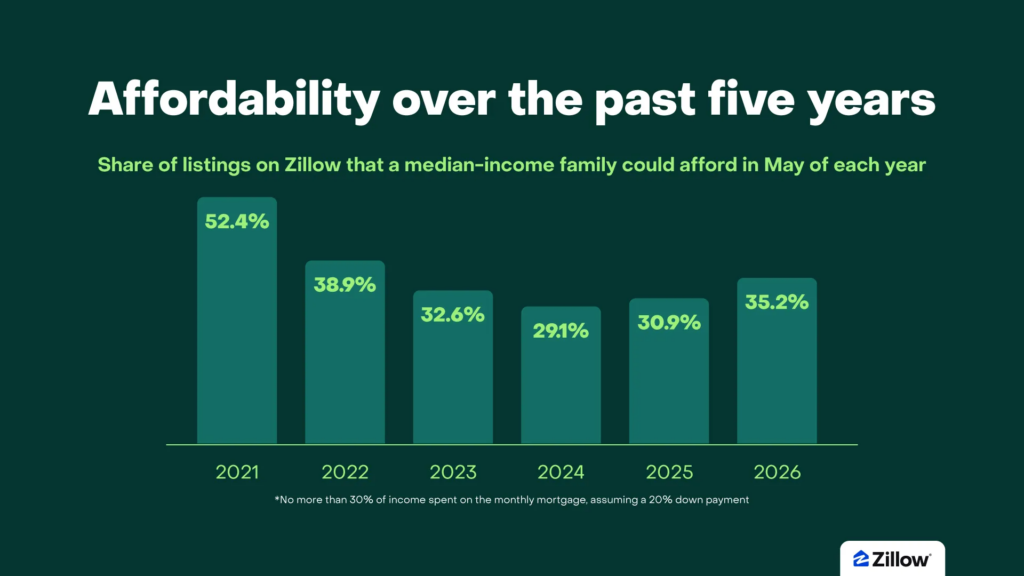
In May 2021, a family with a median income could afford around 52% of the homes listed for sale on Zillow. However, as prices and mortgage rates increased, that percentage decreased to roughly 33% by 2023. It further declined in 2024 to about 29%, before starting to rebound: this May, 35% of the listings were deemed affordable, an increase from approximately 31% a year prior.
Nevertheless, purchasing a home remains challenging. The average home in the U.S. is valued at about 50% more than it was in 2019, and according to Zillow’s own data, a median-income household can only afford the typical home in just 11 of the 50 largest markets, a significant drop from 39 five years earlier.
However, the enhancement bypassed the most costly markets. The scarcity remains concentrated in high-priced coastal metropolitan areas, closely aligning with regions where housing is most unaffordable. Among major metropolitan areas, the most significant shortage is observed in Boston, followed by San Diego and Los Angeles. In cities such as New York, Los Angeles, Boston, and San Francisco, the proportion of affordable listings is in the low to mid-teens or lower, compared to 35% nationwide.
The key differentiator is regulation: in regions where builders encounter fewer obstacles, particularly throughout much of the Sun Belt, supply has increased sufficiently to stabilize prices; conversely, in areas with stringent zoning and slow permitting processes, the shortfall has barely changed.
The report was released shortly after Congress enacted the 21st Century ROAD to Housing Act, the most comprehensive federal housing legislation in a generation. This newly established law seeks to reduce construction costs and expedite the building process by providing guidance on zoning reforms, clarifying standards for manufactured housing, and broadening financing options for small-dollar loans.
One provision that Zillow supported was included in the final bill: the elimination of a requirement mandating that manufactured homes maintain a permanent steel frame. Experts suggest that this change could lower the construction cost of such homes by $5,000 to $10,000.
“It’s encouraging to see a bipartisan emphasis from Congress in finding solutions to the housing affordability crisis,” Divounguy said, “because this is an issue that matters to everyone.”
In conclusion, Zillow experts are urging cities to take additional steps: permit duplexes and townhomes in areas designated for single-family homes, facilitate the construction of backyard cottages and in-law apartments, broaden the availability of manufactured housing, and expedite the approval process for developments on vacant lots. Addressing a shortfall of 4.7 million homes is a distinct challenge compared to merely preventing it from increasing. The trajectory of this gap will depend on the outcomes following the conclusion of the pandemic-driven construction surge.
To read more, click here.