


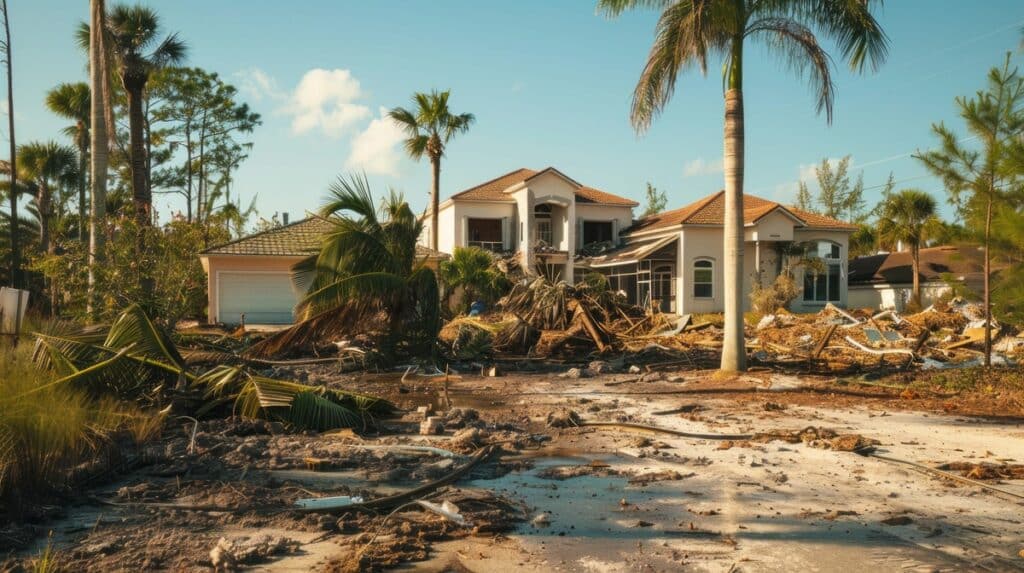
As weather and natural disasters grow more frequent and costly, mortgage servicers are confronting a form of risk that doesn’t fit traditional models.
In this Q&A, one of the authors of the National Mortgage Servicing Association’s recent white paper on the topic—Cotality’s Anand Srinivasan, Head of Research and Development—breaks down why natural hazards represent an “asymmetric, unpriced risk” in housing finance, and what the industry must do to better prepare borrowers,

manage rising insurance pressures, and close the information gap around property-level exposure.
Q: Your white paper describes natural hazards as an “asymmetric, unpriced risk” in mortgage servicing. What makes this risk fundamentally different from traditional credit or interest rate risk?
Srinivasan: There are two vectors that the mortgage process focuses on. One is on the asset, and the second is on the consumer. There is an incredible amount of emphasis on the consumer and the ability to alleviate the risk associated with a financial instrument.
The homeowner is borrowing capital, so it is their obligation to repay the loan, the principal, and the interest. When it comes to the asset, a significant portion of that risk is outsourced to the insurance company. The insurance company is expected to cover the asset, and whatever is not covered by the insurance company is covered by the consumer. The mortgage company requires them to get insurance. If they are in a Special Flood Hazard Area (SFHA), then they are required to specifically have flood insurance, but beyond that, there is no detailed analysis done on the April 2026 assets to see how the risk is changing, the impact of that risk, and whether it’s a disproportionate risk or whether the insurance coverage adequately covers
the asset.
The reason we say it’s asymmetric is that it’s not along the vectors of credit risk. It has nothing to do with whether the homeowner can pay back principal interest. It marches to a different drumbeat, and a significant portion of flood risk, for example, is outside of the FEMA articulated Special Flood Hazard Area (SFHA). So, the homeowner may not have been required to get flood insurance, but if they are disproportionately at risk of being impacted due to floods, and that risk is in fact rising, it is an asset risk that is perhaps not priced in. These extraneous factors come into play. The same thing applies to severe convective storms. Even though a property might be in the wind corridor in the central United States, there’s no requirement to have obtained sufficient insurance.
Then there is the additional layer of building codes and standards of how a property is made and potentially retrofitted, which are different across different counties or states. Enforcement aside, these are important factors to consider, but they are not all considered here. So, it’s a very different risk.
Q: How should the industry rethink mortgage servicing in a world where climate and weather volatility are accelerating?
Awareness is a great place to start. We’ve articulated in the paper that the mortgage servicers are often the first line of defense from a communication standpoint. “Hey, my mortgage and my escrow payment just went up.” They’re the first line of defense, even though they may not have had anything to do with it. So, it’s a pass-through effect.
An informed consumer is a prepared homeowner. Mortgage servicing is not simply articulating what one owes anymore. It’s about bringing that customer along, both over the life of the loan and during acute events. Servicers can become a source of information, both when it’s blue skies and a sunny day, and when it’s not so pleasant.
Q: What are the biggest operational gaps servicers face when trying to incorporate weather risk into their existing frameworks?
It’s not so much on operational gaps as we must create the process because the risk has not been incorporated. We just have to build a new process to take this into account, and servicers are very, very good at putting operational processes in place and putting the financial metrics needed for those processes and for communication to the homeowner. It’s just that this one hasn’t been done yet. So, I’m sure that, in the course of time, this will factor in more and more, particularly as we see sticker shock in many locations.
As we become more and more aware of these things, and as we can translate more effectively what the impact is to a specific property on a financial basis, both from an education standpoint and from a process standpoint, that impact could be dramatically reduced.
Q: How can servicers better prepare for borrower distress following major weather events, based on lessons from disasters like Hurricane Harvey?
I don’t know if we can prevent these natural disasters as much as we can lessen the financial impact of these natural disasters on the homeowner. Awareness of these processes before, during, and after an event is particularly important. Prevention here is reducing the financial impact on the customer.
The time to get homeowners to pay attention is not two days before the event: it’s two months before the event. Before hurricane season begins, here is the list of things one needs to do. Based on historical events, these are the places that are least affected. Here are some shelters in the area. And here are some of the financial things one can do to keep mortgage payments current and not run into a delinquency issue.
Q: The report highlights how rising insurance premiums and escrow shortages are impacting affordability. How significant is this issue compared to interest rates and home prices?
Five, seven, 10 years ago, taxes and insurance were run-of-the-mill operational costs, the frictional cost of owning and operating a home. Now it’s way more than that, and it bites into whether one can even afford the home to begin with.
We cannot run away from taxes and insurance; this is a serious affordability issue, but it is also a matter of awareness. There’s a high degree of visibility in mortgages, particularly in a fixed-interest loan. The lack of visibility in taxes and insurance and their variability have become pain points, and there is sticker shock in areas like Florida or California. If the property does not have insurance, the owner has a bigger problem, because then they have to go to the FAIR plan, and get substantially lower coverage for a substantially higher price. A FAIR plan is meant to be a lower common denominator or a backstop rather than the homeowner’s best coverage provider.
Q: Are we at risk of creating a new class of “climate driven delinquencies” in mortgage servicing?
What we want to do is bring about awareness to this issue. These events are occurring with a greater degree of frequency and a greater degree of impact than ever before. Reconstruction costs have also risen over the last several years. When combined, the financial impact of natural hazards is rising, and it is also asymmetric in how it impacts the property. Further, properties that were not at risk before may now be at risk. Hazards that didn’t occur in some locations before are now happening.
Seasonal differences were stark, but these differences are shrinking or expanding in many locations. And if we have multiple hazards occurring, properties may get impacted one after the other, and it’s amplifying the impact because homeowners haven’t had a chance to recover from the first before they get hit with the second.
Florida’s a good example of that, between floods and hurricanes. There used to be a clear boundary between those two hazards, both geographically and from a time perspective. Those boundaries are fading, and the gap between those perils and the geographical regions where they’re “supposed to occur” is also shrinking. The impact is higher.
It’s also important to look at insurance to see how it’s priced. Because it is regulated at the state level, insurance companies can’t offset one state’s impact with another, which is why some firms that have been financially impacted decide to walk away from entire states. This reduces options for the homeowner, but awareness is key.
How insurance is priced is important so that one can get the best coverage and premium for a particular structure, and the risk may be higher as we move forward. Some places are already pretty high on an absolute basis, and relatively, they might be worse, but regardless, most properties, in most parts of the country, the risk is rising. It is also more volatile. If an area had a good rainy season last year, it was set up for a good wildfire season the next year. If a location had high wildfires, the proclivity for floods in that location having a higher impact in the next season is higher because if it rains, things may get washed out a little bit more easily because we have fewer plants absorbing the water as much as they did before. We can’t fight nature, but we can be prepared.
Q: How viable are alternatives like parametric insurance for residential borrowers, and what barriers remain to adoption?
Parametric insurance is specialty insurance that protects against the peril from a financial impact perspective rather than reducing its physical impact. If an event of a certain magnitude were to occur in a certain location, the coverage level and threshold breach of a particular hazard would dictate that the coverage holder is paid out.
That could help property owners reduce the financial impact such an event may have had on their property, and that’s the way that parametric insurance is meant to be used. That said, it’s a more sophisticated product. It’s not widely popular, particularly among homeowners. It’s typically a commercial product or a municipal product, and they have to be deeply aware of the hazard thresholds that go into place for a particular location. So, how one
retrofits that for traditional insurance coverage is something to think through. It’s a complicated product.
Q: Do you see a growing role for government-backed programs like the National Flood Insurance Program in stabilizing the market?
Private insurance is critical for most homeowners, most of the time. It is best for a homeowner to have private insurance for the home in most cases. It will have wider access, homeowners drive more competition pushing down premiums, it will have better variants in the policy, so one can tailor that to match the property and affordability, and various deductible choices, etc. So, private insurance, for most people, is the right answer.
The question then becomes, how does one augment that with things like the National Flood Insurance Program, parametric insurance, or FAIR plans?
In some cases, where one does not have access to private insurance or a plan is mandated due to being in a flood zone, these become the primary support.
Q: How do we overcome the information asymmetry between buyers and sellers when it comes to property risk?
It’s important to have trustworthy, accurate information across this subject matter coming from all parts of the industry, whether it’s the origination, a government body, a financial institution, or from a servicer, and they’ve assumed ongoing work to collect a mortgage. Consistent, clear information across stakeholders will reduce that asymmetry, but it’ll take time, and more communication is good. We have to align that communication, because at the end of the day, this makes the homeowners’ market healthier and transactions more pervasive.
The other part of it is resilient construction, which is about money. It’s about affordability. Metal roofs cost more. These are things we can do when there is no storm in sight. Resilient properties, particularly for severe convective storms, have a payback of one to two events. One shouldn’t think of it in terms of long-term average annual losses. One should think of it as blunting the impact of a big one. Homeowners should be aware of the financial
impact, and then consider, okay, how can they reduce the financial impact of events like this?
Q: What role should servicers play in encouraging or even incentivizing property-level resilience improvements?
We have to expose our consumers to this. When the health trend started in the 1960s, cigarette smoking went way down. Healthy exercise became a trend. We are substantially healthier than we were 50 or 60 years ago. The same thing has to happen here as well. Retrofitted properties where floods occur. Elevated first-floor heights should become part and parcel of the equation. These things should become popular.
It’s not one-size-fits-all, though. One property has to cure for floods, another for fires, and a third property for wind.
We have to incentivize local programs, and those incentives could be from an insurance rebate perspective. For some insurance companies, if we drive at a lower speed and we put one of those monitors in a car, we get a premium discount. Similar models can be applied here as well.
If there’s a standardized insurance discount, or better yet, private companies competing with each other, the mortgage servicer can announce or
expose those programs to the homeowners. Awareness is a key factor. If we start communicating en masse, this will catch on.
Q: What policy changes would have the greatest immediate impact on improving insurance affordability and availability?
It takes more practice. Just awareness and consistency of this information, in a widespread way, we think, will be a game-changer, because a lot of it is local. If one is in California versus Florida or Maine, there are several different things one should be aware of. One policy does not fit all. But if one focuses on natural hazards expanding in severity and frequency, posing a financial impact to the property, that is the common theme. How do we reduce
or alleviate the financial impact on a property as a result of these natural hazards?
If we focus on the principle of that—it could be improved first-floor height due to code changes for construction. It could be, if there is a property built in 1960 or prior, one installs roof braces that will protect against hurricane winds. If the property is in a fire-prone area, we have to clear brush and not have vegetation within 20 feet of the foundation on all sides. It could mean that we don’t plant a certain kind of plant within 50 feet of the property.
That applies both at the HOA level as well as at the individual property level. It could mean that properties may need external sprinkler systems.
But the underlying consistency is that natural hazards are getting more frequent, more severe, and have a financial impact, and homeowners are faced with reacting. Mortgage servicers can help educate the consumer so that they are aware of these things before they are faced with sticker shock.
Q: How effective are current state-level approaches, such as FAIR plans, in addressing high-risk properties?
People don’t go to FAIR plans because it’s the be st plan on the market. People go to FAIR plans when they don’t have any other options. Typically, they’re not as efficient or cost-comparable to private insurance. That’s why we say private insurance, in most cases, is the best option. Are FAIR plans effective? It depends on what we mean by effective.
If 20% of the state signs up for the FAIR plan, is it considered effective? Or does it mean that 20% of the state couldn’t find other affordable insurance?
How do we address the system so that insurance companies can offer different plans to the widest swath of consumers, and how can they be effective? How can they be financially healthy?
It’s not good if the insurance company is not able to sustain policies in any location. With a variety of such insurance players in any state, we get competitive insurance policies, and then the FAIR plan is just a backstop.