



After two assessments indicated that the economy was getting hotter, rates increased. According to the May employment report, 172,000 new jobs were created, about twice as many economists had predicted, while the unemployment rate remained at 4.3%. The three-month average was raised to 188,000 after upward adjustments to March and April adding a combined 93,000, allaying concerns raised by April’s poor three-month average print of 48,000.
A few days later, the May CPI report revealed that core inflation was at 2.9% and energy costs were the main driver of inflation, which accelerated to 4.2% year over year from 3.8% in April and the highest level since 2023. The facts collectively support a “higher-for-longer” perspective: Treasury yields increased, mortgage rates resumed their upward trend, and markets have essentially given up on expectations of rate decreases this year.
The percentage of listings that are affordable for a median-income household is still greater than it was last year, and mortgage rates and the average monthly payment are also lower than they were a year ago. However, if rates rise, the gains in affordability quickly disappear. Any savings on property are being swallowed up by the cost of everything else because inflation is growing more quickly than salaries, making the average buyer net poorer.
| Period | Owners’ Equivalent Rent | Rent of Primary Residence | ||||||
|---|---|---|---|---|---|---|---|---|
| Month-over-month | Year-over-year | Month-over-month | Year-over-year | |||||
| Forecast | Actual | Forecast | Actual | Forecast | Actual | Forecast | Actual | |
| December 2025 | 0.27% | 0.31% | 3.25% | 3.36% | 0.21% | 0.27% | 2.93% | 2.92% |
| January 2026 | 0.26% | 0.22% | 3.29% | 3.26% | 0.21% | 0.25% | 2.78% | 2.84% |
| February 2026 | 0.18% | 0.22% | 3.14% | 3.19% | 0.19% | 0.13% | 2.74% | 2.68% |
| March 2026 | 0.21% | 0.28% | 3.02% | 3.10% | 0.17% | 0.19% | 2.55% | 2.56% |
| April 2026 | 0.44% | 0.53% | 3.20% | 3.30% | 0.39% | 0.55% | 2.63% | 2.79% |
| May 2026 | 0.25% | — | 3.27% | — | 0.20% | — | 2.76% | — |
The May market data, which shows a decline in both home sales and new listings compared to the previous year, reflects these challenges. With sales now predicted to remain unchanged for the year, most of the optimism about 2026 has diminished.
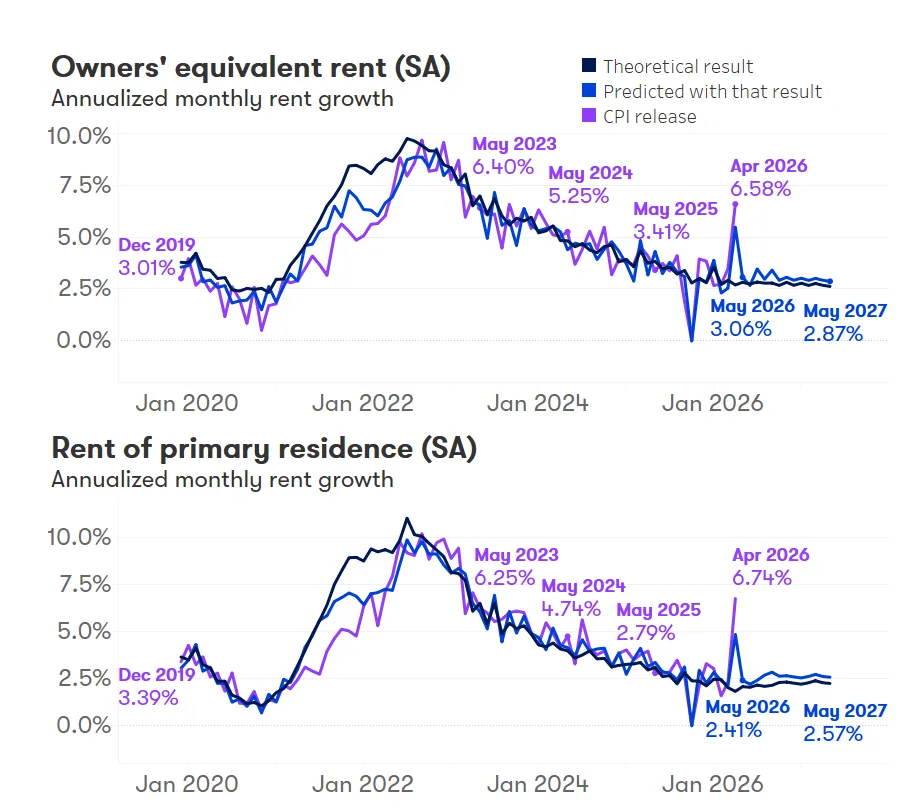
In May 2026, Owner’s Equivalent Rent (OER)—a measure of what homeowners would potentially pay to rent their own homes—is expected to have climbed by 0.25% (some 95% confidence interval: 0.12% to 0.38%). As a result, the index’s yearly growth would reach 3.27%. Over the course of the year, Zillow analysts anticipate that the monthly increase will trend toward a 0.24% pace. Experts predict that OER will increase by 3.32% in 2026, matching the 3.36% increase in 2025.
In May 2026, Rent of Primary Residence, which monitors rent payments, is expected to have climbed by 0.20% (95% confidence interval: 0.05% – 0.34%). As a result, the index’s yearly growth would reach 2.76%. Over the course of the year, we anticipate that the monthly increase will trend toward a 0.21% pace. The Rent of Primary Residence index is expected to increase by 2.83% over 2026, which is only a minor decrease from the 2.92% increase in 2025, according to analysts.
Zillow updated its projections about the rise of single-family unit on-market rent: By the end of 2026, single-family rent increases are predicted to have increased from 2.7% in April to 3.2% annually.
Multifamily rentals are predicted to increase by 2.1% year over year by the end of 2026, up from 1.3% in April, according to Zillow’s updated projections for on-market rent increases for apartments. The shelter components of the CPI, which represent both new lease pricing and rent adjustments for renewing and longer-term tenants, are still rising more quickly than these on-market rent trends.
It appears that the steady drop in house inflation over the past few years has reached a plateau. In the past, a diminishing percentage of longer-tenure units rented much below current market rates and weaker market rentals caused these indicators to drop. Landlords now have an incentive to hike rents more aggressively across their portfolios due to increased costs and the additional heat in listed unit rentals this spring. However, experts do not believe that this upward pressure will continue. Market rents, which are likewise close to historic averages, won’t have much incentive to rise higher because vacancy rates have returned to around their historical normal.
Overall, housing inflation was once again greater than anticipated, according to the May CPI data, especially for primary residence rent.
Note: These forecasts are based on predictions from a model that makes explicit the relationship between on market rents (measured by the Zillow’s Observed Rent Index) and the shelter components of the Consumer Price Index (CPI).