



At the end of 2025, affordability was at its highest point in almost three years. According to the First American Data & Analytics Real House Price Index (RHPI), affordability increased by almost 9% in December compared to the same month last year. This is the strongest level since 2022 and the ninth consecutive month of year-over-year growth. According to preliminary statistics from January, the improvement has persisted into early 2026. All 50 states and 48 of the top 50 markets reported yearly growth, demonstrating the widespread improvement. The recent recovery is a great relief for home buyers, even though affordability is still below its pre-pandemic five-year average.
December 2025 Real House Price Index Highlights
The First American Data & Analytics’ Real House Price Index (RHPI) showed that in December 2025:
- Real house prices decreased 0.6% between November 2025 and December 2025.
- Real house prices decreased 8.6% between December 2024 and December 2025.
- Consumer house-buying power, how much one can buy based on changes in income and mortgage rates, increased 0.8% between November 2025 and December 2025, and increased 10% year-over-year.
- Median household income has increased 4% since December 2024 and 59.4% since January 2015.
- Real house prices are 24.9% more expensive than in January 2000.
- Unadjusted house prices are now 64.8% above the housing boom peak in 2006, while real, house-buying power-adjusted house prices are 12.3% below their 2006 housing boom peak.
First American examined how inventories affected price growth on a national scale. This month, a detailed examination of specific markets shows how significantly local supply circumstances are influencing the rate of recovery.
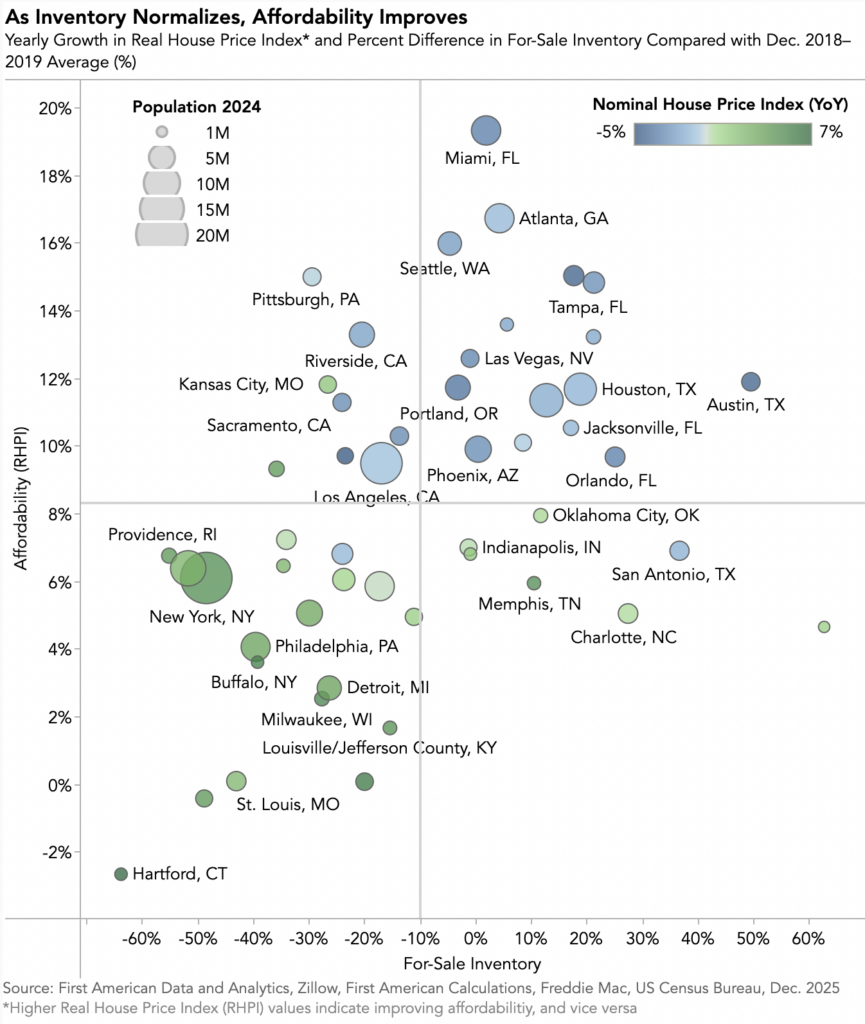
Market Analysis: Affordability Factors Driving Improvements
The different degrees of affordability recovery are influenced by local housing market factors. Comparing current supply levels with what was normal immediately prior to the pandemic—that is, the December 2018–2019 average—is a helpful method of understanding the variations between marketplaces.
Market-specific inventory levels differ significantly from the pre-pandemic norm for 2018–2019. In certain markets, the number of available homes for sale is still significantly less than it was prior to the pandemic, while in other places, the number has returned to nearly pre-pandemic levels. A number of markets currently have far more inventory than they did before to 2020, including some of the pandemic boom markets. The amount of affordability gains and inventory levels in comparison to that pre-pandemic benchmark are clearly positively correlated throughout the top 50 markets.
Markets with inventory levels at or above pre-pandemic norms have seen the greatest improvements in affordability, while many markets with supply levels well below those norms continue to see positive but more modest increases in affordability.
Price rise is slowed or even reversed when inventory levels are higher than historical averages because sellers have less pricing power and more competition. This moderation, rising income, and lower mortgage rates compared to a year ago directly boost the ability to purchase a home. In Austin, Texas, for instance, nominal home prices have decreased by 4% annually, inventory is almost 50% higher than it was before the pandemic, and affordability has increased by 12%. Similar trends may be seen in Tampa, FL, where inventory is 21% more than its pre-pandemic baseline, and Dallas, where it is 13% higher.
Conversely, there are markets where inventory levels are still significantly lower than they were prior to the epidemic. Inventory is 40% lower in Philadelphia and 52% lower in Chicago than it was prior to the outbreak. While nominal price increase has proven more robust in some markets, affordability has nevertheless improved when compared to a year ago. Although not all markets fall neatly into one group, the general relationship is clear: price growth is slower and affordability recovery is more robust in markets where supply is closer to or above pre-pandemic norms.
In conclusion, nearly the whole nation is seeing an improvement in affordability, and in markets where supply has increased the most, this improvement is happening more quickly. Price pressure lessens and household income has a better chance of catching up as inventory rises, whether it is near normal or much above it. Nominal price rise should be limited if supply keeps growing or, as in some markets, stays high in 2026, enabling affordability to continue its slow recovery.
Additional Real House Price Highlights — State & Local Markets:
The five states with the greatest year-over-year decrease in the RHPI are:
- Florida (-14.1%)
- Nevada (-12.3%)
- Washington (-11.8%)
- Utah (-11.3%)
- Georgia (-10.9%)

The markets with the most year-over-year growth in the RHPI among the Core Based Statistical Areas (CBSAs) monitored by First American Data & Analytics are: Hartford, CT (+2.7%), and Cleveland (+0.4%).
The five markets with the biggest annual decline in the RHPI among the Core Based Statistical Areas (CBSAs) monitored by First American Data & Analytics are:
- Miami (-19.3%)
- Atlanta (-16.7%)
- Seattle (-16.0%)
- Denver (-15.0%)
- Pittsburgh (-15.0%)
No U.S. state had an increase in the RHPI from the previous year.
The next release of the First American Data & Analytics’ Real House Price Index will be viewable to the public on March 23, 2026.