


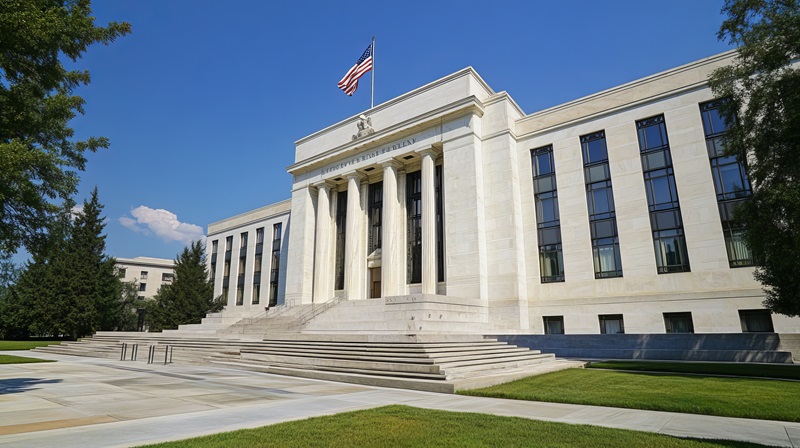
U.S. banking regulators on Thursday released a sweeping package of bank capital reforms, launching a 90-day public comment period on changes that would reduce capital requirements for the largest U.S. financial institutions, and substantially ease the burden on smaller regional banks.
In a joint statement, the Three key regulatory agencies, the Federal Reserve, Federal Deposit Insurance Corporation, and Office of the Comptroller of the Currency, announced the proposal Thursday morning that opened the public comment period.
The new draft rules are part of what’s known as the “Basel” framework, and are anticipated to slightly decrease the cash reserves that major banks must maintain as a buffer against potential losses.
The changes were previewed by Fed Vice Chair for Supervision Michelle Bowman in a March 12 speech at the Cato Institute.
The reforms represent the most significant overhaul of the post-2008 bank capital framework in years and are a victory for Wall Street institutions that spent years lobbying against an earlier, more stringent version of the regulations.
‘Four Pillars’ of Capital Framework
The reforms address what Bowman described in her earlier speech as “the four pillars” of the regulatory capital framework for the largest banks: stress testing, the enhanced supplementary leverage ratio (eSLR), the Basel III endgame rules, and the G-SIB surcharge applied to globally significant institutions.
Cumulatively the reforms would produce a net decrease in capital requirements for large banks “by a small amount,” while smaller banks focused on traditional lending would see “slightly larger reductions.”
The first proposal primarily applies to the largest, most internationally active banks, the regulators said, and would improve the capital framework by enhancing risk sensitivity, reducing burden, and improving consistency across banks, as well as implementing the final components of the Basel III agreement. They said the framework would be streamlined by having those banks use one rather than two sets of calculations to determine compliance with risk-based capital requirements. The proposal also would improve the calibration of the framework to better capture credit, market, and operational risks, they said.
All other banks could choose to adopt this proposed approach, they said. The market risk aspect of the framework would apply only to banks with significant trading activity.
The second proposal generally would apply to all but the largest banks, would better align capital requirements for traditional lending activities with risk, while maintaining the framework’s simplicity, the statement said. The second proposal would reduce disincentives for mortgage lending by modifying capital requirements for servicing and originating mortgages. The statement said that proposed modifications for mortgage servicing also would apply to banks that apply the community bank leverage ratio framework. The seconds proposal would also require certain large banks, subject to a transition period, to reflect unrealized gains and losses on certain securities in their regulatory capital levels.
Improving Systemic Risk
The statement said that the third proposal, from the Federal Reserve Board, would improve how systemic risk is measured in the framework for determining the additional capital requirement for the largest and most complex banks.
For years, regulators have worked to implement the “Basel Endgame,” representing the final component of international capital standards developed after the financial crisis. Those standards focus on how financial institutions evaluate and distribute funds to address credit, market, and operational risks.
Bowman’s predecessor, Michael Barr, had pushed a plan that would have increased capital requirements for certain banks by up to 20%. Financial institutions, however, mounted an extraordinary opposition campaign influenced numerous legislators and created disagreement among regulators.
That resistance delayed the project until the Trump administration took office.
Mortgage Banking Association President and CEO Bob Broeksmit said in a statement that the Basel III proposal is an important step.
“The federal banking agencies’ updated Basel III proposal represents a pivotal step toward a more balanced and risk-aligned approach to capital standards affecting mortgage lending and commercial real estate finance.
“Capital rules are notoriously complex, but based on our initial review, the re-proposal incorporates several priorities long advocated by MBA, including more risk-sensitive capital requirements using loan-to-value ratios and the opportunity to consider the recognition of credit enhancements such as private mortgage insurance. It also takes important steps to reduce the punitive treatment of mortgage servicing rights and commercial real estate loans.
“MBA will review the proposal closely and looks forward to engaging in the formal comment process, including on key technical elements such as the appropriate capital treatment of mortgage servicing assets and the broader application of these reforms across the banking system. We stand ready to work with the agencies on a final framework that better supports sustainable mortgage origination and warehouse lending, robust servicing capacity, and continued access to affordable home financing offered by both depositories and independent mortgage banks.”