
According to new data, approximately 8% of Zillow users who are looking to purchase a property in today’s volatile housing market are also browsing for rentals and exploring their options. These “dual shoppers” consider both choices before deciding, highlighting how the distinction between buying and renting is becoming more complex to navigate due to persistent financial constraints.
Zillow analysts revealed that measuring the rent-versus-buy decision is inherently difficult for many Americans seeking to attain the “American Dream.” Conventional methods rely on presumptions about matching homes in the two markets, and comparing a typical rental to a typical for-sale property often fails because the properties are not directly comparable. The recent report examined a more realistic view of the trade-offs households actually face by concentrating on dual shoppers and letting their own engagement behavior match their housing preferences.
For many, that choice usually boils down to monthly expenses and how much buyers can afford without ending up cost-burdened by monthly costs.. Assuming a 20% down payment and accounting for mortgage payments, property taxes, insurance, and upkeep, owning a home in the U.S. is usually an estimated $415 more expensive per month than renting. That difference is more than $3,400 a month in expensive housing markets like San Jose, CA.
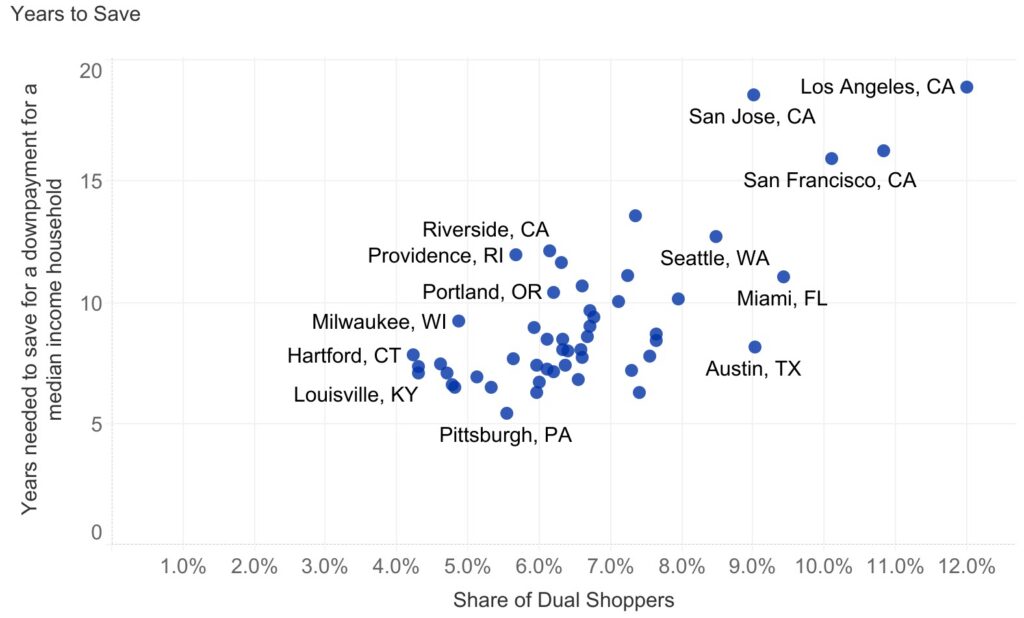
Note: Metros with a higher share of affordable inventory, lower home price to income ratio, and fewer years for potential buyers to save for a down payment are associated with a lower share of for-sale shoppers also engaging with rentals.
Property Size, Square Footage & Home Design Matter
Additionally, dual shoppers typically look at larger properties when browsing for-sale listings. On average, the rentals most researched are roughly 284 square feet smaller. These rental homes often offer a higher value per square foot, suggesting that they may have more contemporary amenities, finishes, or layouts.
Dual shopping also varies by region, cities and states nationwide. In markets where there is a significant financial gap between owning and leasing due to budgetary constraints, dual shopping is increasingly common. With approximately 12% of for-sale consumers also perusing rentals, Los Angeles metro leads the country in dual shopping, followed by San Diego (10.8%) and San Francisco (10.1%). With a 20% down payment, the median household in each of these coastal markets would have to spend around two-thirds of its income on a monthly mortgage payment, underscoring the affordability challenges forcing consumers to weigh their options. In contrast, renting reduces the burden to about one-third of income, or nearly half.
One notable exception is New York City. 29.9% of NYC house shoppers are also thinking about renting, which is 3.8 times the national proportion and 4 times the share for the larger New York metro area, according to StreetEasy data. New York City customers are likely to consider both options more frequently due to the city’s exceptionally high percentage of renter households (about 70%) and high housing costs.
“As many working people know, it is increasingly impossible to find an affordable home in New York City, to build a dignified life without making hundreds of thousands of dollars a year,” said Zohran Mamdani, Mayor of New York City.
Conversely, dual shopping is less prevalent in more reasonably priced marketplaces, where consumers are more likely to become homeowners. Lower percentages of for-sale shoppers also interacting with rentals are linked to metro areas with a higher proportion of affordable inventory, a lower home price to income ratio, and fewer years for prospective buyers to save for a down payment. At 4.2%, the report found that Hartford, CT, has the lowest percentage of dual shoppers.
| Metro area | Share of dual shoppers | Median monthly payment gap between owning and renting** | Median square footage gap between for-sale and rental home** |
| U.S. | 7.6% | $415 | 284 |
| Los Angeles | 12.0% | $2,174 | 219 |
| San Diego | 10.8% | $1,724 | 200 |
| San Francisco | 10.1% | $2,212 | 215 |
| Miami | 9.4% | $622 | 160 |
| Austin, Texas | 9.0% | $880 | 207 |
Note: **Among homes that dual shoppers engage with. Positive values indicate the median for-sale option is more expensive or larger than the median rental option
To read more, click here.