



The California Policy Lab at UC Berkeley demonstrates that residents who relocate outside of the state are more likely to buy a property and frequently find a lower cost of living. Soaring prices for housing and other necessities are detering out-of-state residents from relocating.
According to a recent report by UC Berkeley’s California Policy Lab, the exodus of Californians to other states during the epidemic has slowed, but thousands of citizens are still being forced to relocate for less expensive areas due to the often startling cost of living.
According to the survey, those who relocate—typically to nearby states like Oregon, Nevada, and Arizona, or to more distant locations like Texas and Florida—can find housing expenses that are almost half of what they would spend in California. Additionally, it claims that this discrepancy seems to be deterring people from other states from relocating to California.
In total, California lost nearly 150,000 residents in 2025. Although that represents less than 1% of its 39 million inhabitants, the consequences “could be severe” if that becomes the “new normal,” according to the research. A decreased revenue base for road construction, firefighting, and public safety could result from fewer people. Due to the reallocation of some of its congressional seats to states with expanding populations, California is likewise anticipated to lose influence in Congress.
“There are tremendous problems with affordability in the state,” said Evan White, executive director of the California Policy Lab. “We find that is probably impacting people’s relocation decisions. … What we show for the first time is that people who leave are, in fact, improving their financial positions, and are able to own homes in greater numbers after the move.”
Birth Rates, Population Trends & Housing Expenses
Beginning in the middle of the 20th century, the Golden State’s population grew steadily over a period of roughly 60 years. Currently, California is home to one in nine Americans. Its population exceeds that of the 22 least populous states put together. California’s economy would rank fourth in the world if it were a nation.
However, within the past 20 years, fewer foreign immigrants have arrived, births have decreased, and deaths have increased. During the COVID-19 pandemic, migration from other parts of the U.S. fell while departures increased and California lost many more residents to other states.
According to the latest analysis, the number of exits has virtually reached pre-pandemic levels, but California’s economic circumstances place it in a class by itself, with housing costs—even in the state’s least costly communities—being higher than in the majority of other U.S. regions. According to further data cited in the report, groceries are 11% more expensive here, petrol is 40% more expensive, and utilities are 61% more expensive.
To add more context to the current state of California costs and relocation, White and Policy Lab researcher Brett Fischer co-wrote the paper, “Priced Out: Relocation Amidst California’s Affordability Crisis.”
The paper claims that California migration is being significantly impacted by the high costs:
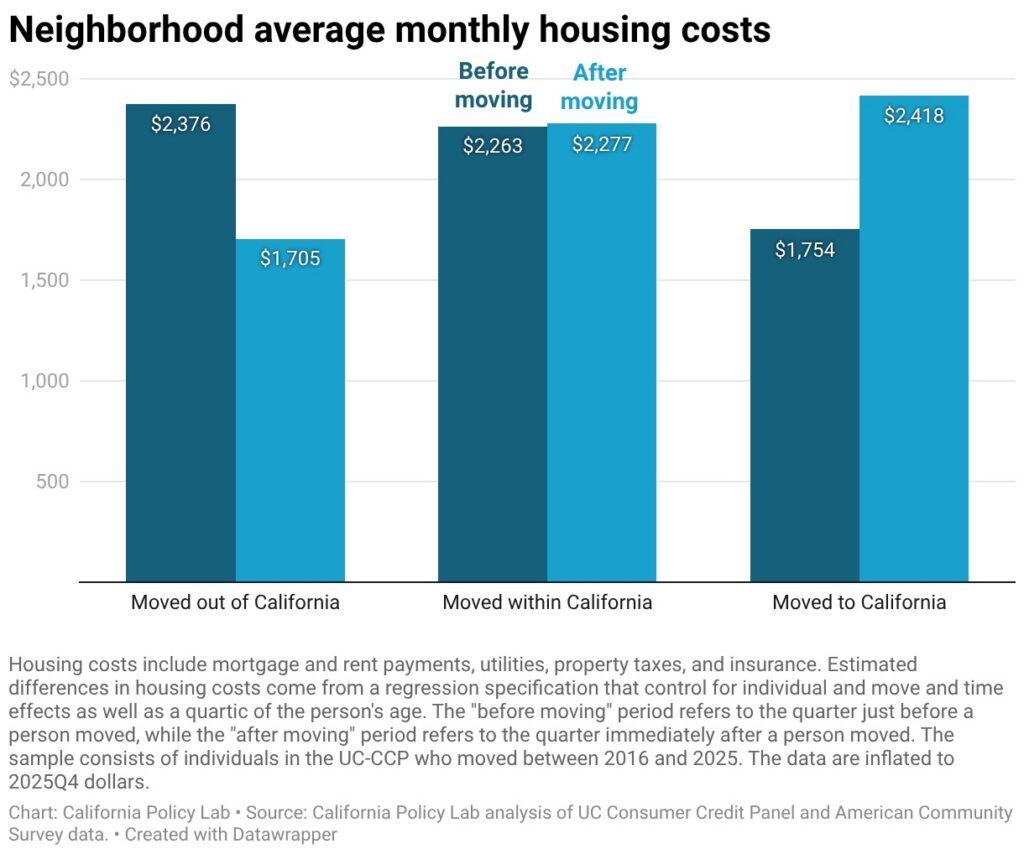
- The average monthly housing cost for individuals who relocated out of state was $1,706, which is roughly $670 less than the average cost of $2,376 in their previous California communities. The average monthly housing expenditures for those who relocated to California increased by 38% to $2,418 from their previous communities.
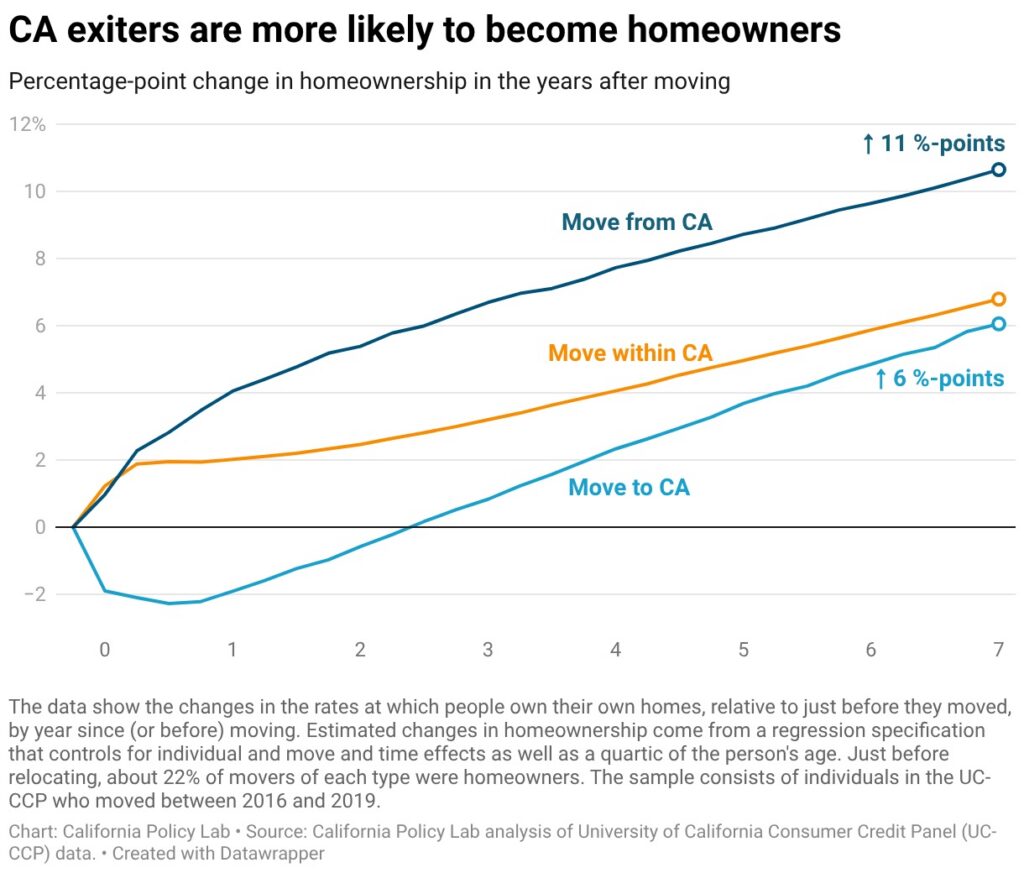
- Former Californians are 48% more likely to be homeowners after seven years in their new states. In 2012, “the state’s median household income was roughly sufficient to qualify for a mortgage on a mid-tier home, but it now falls substantially short of the level needed to qualify for even a bottom-tier home,” according to the California Policy Lab, citing another study.
- According to the survey, although the average salary in their new out-of-state areas is around 8% lower, the “difference is far outweighed by the lower costs of living.” Because they work remotely, at least some of the movers are able to keep their California salaries.
- Surprisingly, the proportion of individuals leaving California from lower-income regions has decreased, while those from higher-income neighborhoods are becoming more prevalent.
- Texas is the most sought-after place to relocate, according to raw data, followed by Arizona, Washington, and Nevada. However, according to White, per capita metrics more accurately capture the popularity of migration. Nevada leads in this regard: between 2016 and 2025, 226 Californians per 10,000 people moved to the state, whereas 146 Nevadans per 10,000 moved to California.
Economic Factors Affecting Americans Nationwide
White conceded that the migration patterns can be influenced by other causes. In addition to the ongoing threat of earthquakes and drought, parts of California are frequently destroyed by wildfires and storms. The state’s obvious homeless population or the fact that Democrats and liberal political agendas predominate in California turn off some people.
However, a sense of widespread economic uneasiness among Californians comes from the 21-page research. According to White, relocating to a new state is costly, and leaving might occasionally be “a move of last resort” motivated by financial concerns. White cited the financial strain caused by Proposition 13, the 1978 law that restricted increases in property taxes. New homeowners are effectively penalized because the law only permits property taxes to be raised and homes to be revalued after they are sold.
“New homeowners are paying really high property taxes,” White said, “whereas folks who have owned their home for 20 or 30 years are paying very low property taxes. With two neighbors, the person who’s lived in their home for a short time might be paying 10 or sometimes 20 times what their neighbor is paying. You’ve got a lot of people in the state who are living paycheck to paycheck or really struggling to meet the cost of living. That is a much bigger problem, and one that California should attend to.”
White gave credit to California politicians for realizing how serious the state’s housing issue is and for shifting their attention toward legislative fixes in recent years. However, he claimed that the issue has not yet been resolved by recent policy.
To read more, click here.