



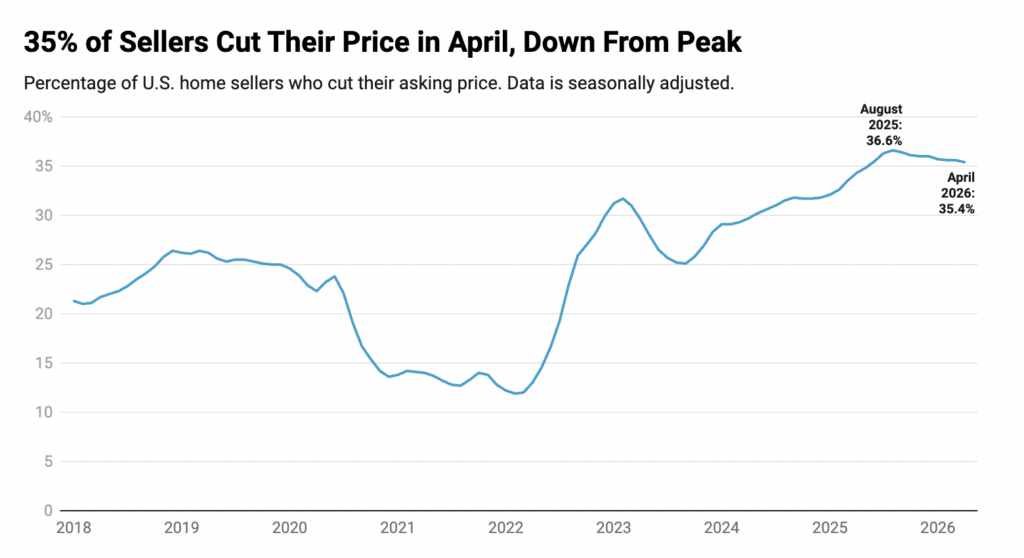
According to a recent research from Redfin, more than one-third (35.4%) of American house sellers lowered their asking price in April. On a seasonally adjusted basis, that is a modest decrease from 35.6% a month prior and from a record high of 36.6% in August.
Because the housing market is improving and homebuyer demand is increasing, price reductions have become somewhat less frequent, giving sellers more negotiation leverage. As the employment situation improves and Americans get some confidence in their paychecks, buyers are gradually coming back. The balance of power is changing because they are still outnumbered by sellers, which is why price reductions are still more frequent than they were during the pandemic homebuying craze.
In several markets, inventory is increasing more slowly than it did the previous year. Most regions still have more properties for sale, but the spike in listings that last year offered buyers the most negotiation leverage has subsided. Since there is less rivalry among vendors, fewer sellers are under pressure to lower prices in order to draw in offers.
Lastly, following a few years of sluggish demand for homes, many sellers are setting reasonable prices for their properties from the outset and modifying their expectations. A seller is less likely to use a price reduction when residences are priced more in accordance with the market from the time of listing.
To identify the appropriate asking price and reduce the danger of a price decline, home sellers can use technologies like as Redfin Early Access, which allows them to test the market through a “coming soon” listing.
“Earlier this year and throughout much of last year, homes were lingering on the market and price drops were fairly common as sellers worked to attract buyers. But as we head toward summer, the market is moving into a much stronger position,” said Justin Gomez, a Redfin Premier agent in Omaha, NE. “Sellers have become more in tune with current market conditions and are pricing their homes more accurately from the start. At the same time, buyer demand has picked up significantly across nearly all price points. In recent weeks, I’ve seen bidding wars on homes at all price points.”
In April, home sellers lowered their asking prices by an average of 4%. Over the past two years, that average percentage discount has been relatively constant.
Regional Shifts & Trends
In the majority of major U.S. metro areas, price reductions are becoming less frequent. In April, 30.3% of Philadelphia house sellers lowered their prices, compared to 33.7% the previous month. On a seasonally adjusted basis, that represents the largest month-over-month fall among the metro areas Redfin examined. 48 of the 50 most populous metro areas with adequate data were included in Redfin’s analysis.
Jacksonville, Florida, saw the second-largest drop, with some 44.9% of sellers lowering their prices, compared to 47.7% a month prior. Montgomery County, Pennsylvania, comes next (21.6%, down from 24.3%).
In 21 of the metro areas Redfin examined, the percentage of house sellers lowering their prices rose month over month on a seasonally adjusted basis. Phoenix saw the biggest increase in the share, rising from 48.1% in March to 50.8% in April. Seattle saw the second-largest rise (29.5%, up from 27.6%), followed by Orlando, Florida (47.8%, up from 46.3%).
Out of all the metro areas Redfin examined, just 13.9% of house sellers in San Francisco reduced their asking price in April. This is mostly due to the fact that San Francisco is hot; last month, the city turned into a seller’s market as demand for homes increased due to the AI boom.
Second place went to Newark, NJ, where 15.1% of sellers lowered their prices. Next were Providence, RI (19.9%), San Jose, CA (16.9%), and Chicago (19.8%). Chicago is a balanced market, and there are just seven seller’s markets in the U.S., including Newark, NJ, and Providence, RIWith almost twice as many house sellers as buyers, all five metro areas are among the nation’s strongest buyer’s markets. When sellers are vying for customers, they are more likely to lower prices.
It is noteworthy that price reductions are becoming less frequent in four of those five metro areas: San Antonio, Austin, Texas, Dallas, and Tampa, FL. On a seasonally adjusted basis, the percentage of San Antonio home sales with price reductions decreased by around one percentage point (from 59.6 to 58.7%) from the previous month. The proportion in Austin decreased from 57.8% to 55.8%, a drop of two percentage points from the previous month.
To read the full report, click here.