



According to the Realtor.com April 2026 Monthly Housing Trends Report, the spring housing market demonstrated unexpected resiliency in April despite a tumultuous start to the month defined by skyrocketing gas costs, soaring mortgage rates, and plummeting consumer mood.
Analysts revealed that the number of new listings increased by an estimated 1.1% year-over-year in April, median list prices decreased for the sixth consecutive month, and the percentage of sellers lowering prices actually decreased, indicating that sellers are entering the market with reasonable expectations rather than panicking due to economic uncertainty and potential affordability challenges.
“The worry going into April was that history would repeat itself,” said Danielle Hale, Chief Economist at Realtor.com. “Last spring, tariff-driven uncertainty and recession fears hit in early April, sidelining sellers and buyers and setting up a cruel summer marked by parties too far apart to transact. This year, different triggers like the Iran conflict, spiking gas prices, surging mortgage rates have threatened the same outcome. The hope was that sellers would continue coming to market at the strong March pace, and that buyers would keep engaging despite the volatility. By those measures, April delivered.”
| Metric | April 2026 | Change overMarch 2026 (MoM) | Change over Apr. 2025 (YoY) | Change over Apr. 2019 | Change over Apr. 2022 |
| Median listing price | $425,000 | 2.3 % | -1.4 % | 34.9 % | 1.3 % |
| Active listings | 1,002,935 | 4.0 % | 4.6 % | -11.8 % | 163.9 % |
| New listings | 477,116 | 8.7 % | 1.1 % | -13.6 % | -3.7 % |
| Median days on market | 52 | -6 | 2 | -2 | 22 |
| Share of active listings with price reductions | 16.7 % | 0.5 | -1.2 | 2.3 | 9.9 |
| Median list price per square ft. | $227 | 1.1 % | -2.4 % | 50.3 % | 3.8 % |
Further, in April, new listings increased 8.7% month-over-month. The Northeast (+9.4% year-over-year) and Midwest (+6.6%), two areas that have long suffered from low inventories, saw the biggest increases. Significantly less significant movement was recorded in the West and South (+0.6% and -3.5%, respectively). Louisville, KY, Virginia Beach, VA, and Indianapolis lead the U.S. in the rise of new listings at the average metro level.
Regional and Metro Housing Overview — April 2026:
| Region | Active listing count (YoY) | New listing count (YoY) | Median list price | Median list price (YoY) | Median list price per SF (YoY) | Median days on market, YoY (Days) | Price reduced share | Price reduced share, YoY (Percentage points) |
| Northeast | 9.3 % | 9.4 % | $537,450 | -2.3 % | -0.3 % | -1 | 10.2 % | 0.4 |
| Midwest | 11.5 % | 6.6 % | $319,450 | -0.1 % | 1.3 % | 3 | 13.4 % | 0.6 |
| South | 1.8 % | 0.6 % | $386,500 | -2.6 % | -3.4 % | 3 | 18.8 % | -1.8 |
| West | 5.8 % | -3.5 % | $599,450 | -3.1 % | -1.7 % | 4 | 17.9 % | -1.1 |
| National Average | 4.6 % | 1.1 % | $425,000 | -1.4 % | -2.4 % | 2 | 16.7 % | -1.2 |
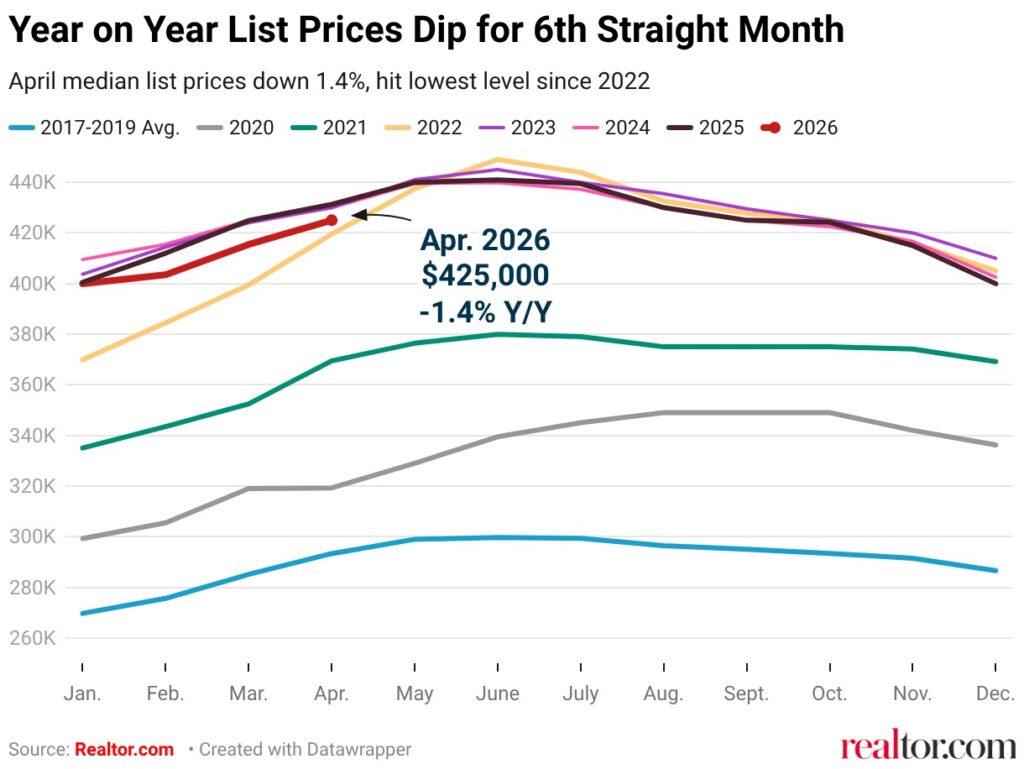
April’s nationwide median list price was $425,000, up 2.3% from March in a usual seasonal pattern but down 1.4% year over year, continuing a nine-month trend of flat or dropping annual prices. The price per square foot, which takes into consideration the shifting size distribution of available homes, decreased 2.4% annually to $227. All four of the major regions saw year-over-year drops in median list prices, which ranged from -3.1% in the West to -0.1% in the Midwest. Memphis, TN (-12.9%), Austin, TX (-9.5%), and Los Angeles (-8.1) saw the biggest drops in the South and West.
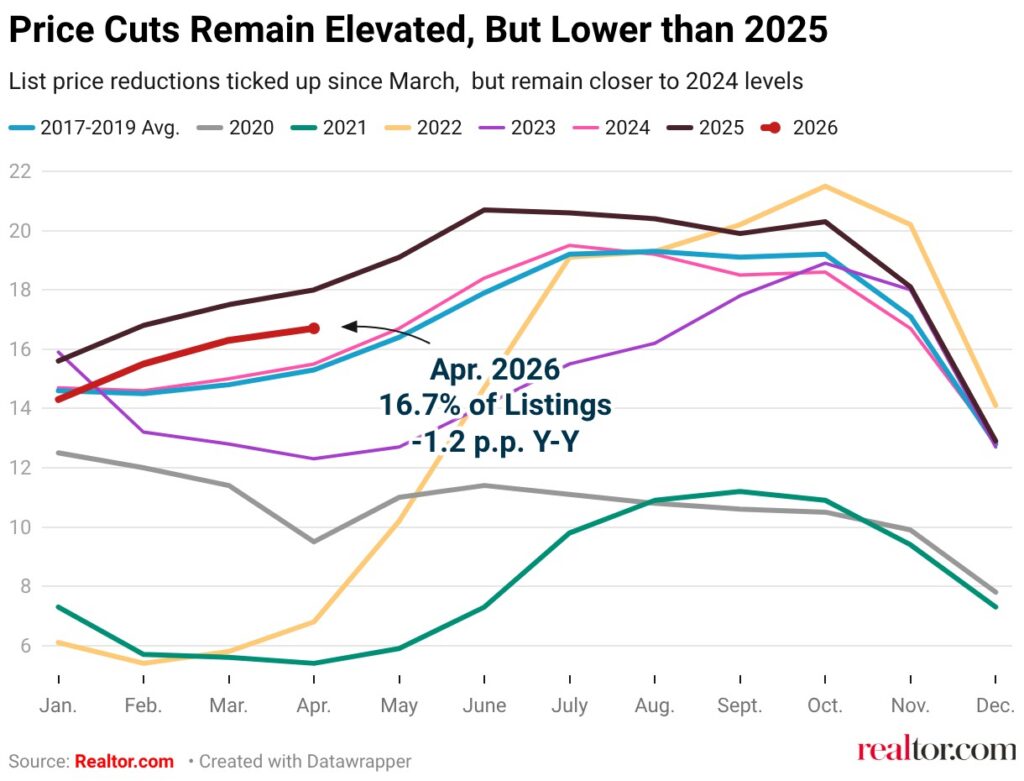
Perhaps the most telling price signal in April came from what did not happen, as price drops fell rather than spiking. The share of active listings with a price reduction declined 1.2 percentage points year-over-year to 16.7%—even as overall list prices continued to soften.
“Compared to last year, 2026 has seen both fewer price cuts and lower median list prices,” said Jake Krimmel, Senior Economist at Realtor.com. “That combination suggests sellers have internalized the generally more buyer-friendly market conditions and are adjusting price expectations before listing rather than after. This is a meaningful behavioral shift.”
Housing Inventory, Days On Market Show Signs of Movement
Even while the rate of growth has slowed from last month’s 8.1% increase, active listings increased 4.6% year over year to 1,002,935 in April. After a 13.8% shortfall last month, the national stockpile is still 11.8% below average pre-pandemic levels from 2017 to 2019. Interestingly, the rise of new listings is somewhat accelerating while the increase of active inventory is slowing down; this difference suggests that the market is cycling through fresher inventory. The main question for May will be whether that results in increased sales.
The median home was on the market for 52 days in April, which is two days longer than it was a year earlier. This is the 25th straight month that sales have slowed down year over year. Homes are still selling four days quicker than they did before the outbreak. All four regions had a little increase in time on market (Midwest +3; South +3; West +4 days), whereas the Northeast saw a decrease (-1 day).
Mortgage rates dropped for three weeks in a row after reaching a peak of 6.46% on April 2nd, ending the month below 6.30%. Although rates are still higher than they have been for the most of the previous six months, they are significantly lower than the previous two April rates (7.17% in April 2024 and 6.81% in April 2025), giving buyers a real increase in affordability over recent springs. Applications for mortgage purchases, which had declined in March, increased in April. This is in line with the rise in new listings and suggests that purchasers have not been completely ignored by the volatility.
“Although rates have eased from their peak in early April, they are still higher than earlier this year, but well below the past two Aprils,” Krimmel said. ” Between the rebound in mortgage purchase applications and the continued rise in new listings, it looks as though buyers are relatively unfazed by the volatility. Even so, a resolution to the recent geopolitical uncertainty would do a world of good for the U.S. consumer and homebuyer.”
Overall, the two most important factors to keep an eye on going into May are whether the momentum for new listings continues, especially in the Northeast and Midwest, where those gains are essential to reversing the cycle of high prices and low inventory lock-in, and whether reduced list prices result in more pending sales. There is a discrepancy between the increase of new listings and the rise of active inventory, which suggests more sales and fresher inventory. The effectiveness of the price adjustment will be verified by May’s forthcoming sales figures.
“It’s too early to declare the spring housing market has weathered the storm, but there’s renewed reason for cautious optimism,” Krimmel noted. “The leading indicators that would signal trouble—seller pullback, spiking cancellations, surging price cuts—are, if anything, moving in the right direction. New listings are up, contract cancellations are normal, and seller price cuts that can reveal concern are down.”
To read the full report, click here.