


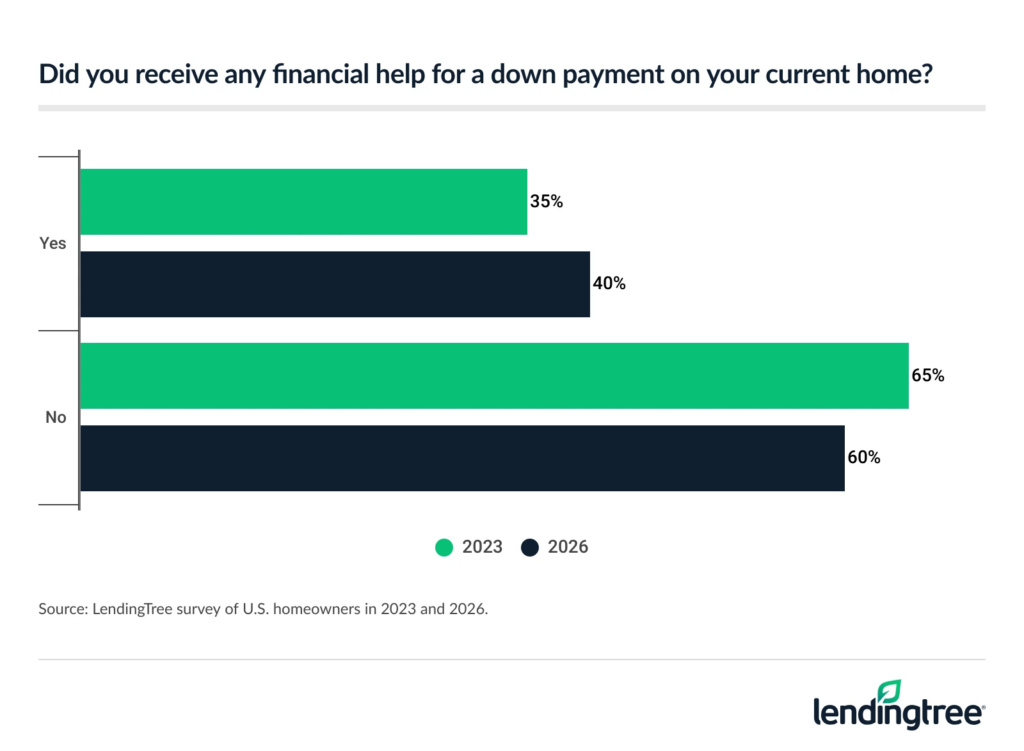
Nearly 80% of Gen Z homeowners are among the four out of 10 homeowners nationwide who received financial assistance with the down payment on their current home, according to LendingTree’s 2026 Mortgage Down Payment Survey. Over one-third of those who received assistance believe they would not have been able to purchase their home at the time they did without it. Nonetheless, almost two-thirds of Americans believe that homeownership is attainable without family wealth, demonstrating their continued optimism regarding the purchase of a home.
The share of Americans who received assistance with their current home’s down payment is rising. The percentage was 35% in 2023. It is 40% now. A closer look reveals a huge generational divide. We discovered that only 35% of Gen X (years 46 to 61) and 12% of baby boomers (ages 62 to 80) homeowners received financial assistance with their current home’s down payment, compared to 78% of Gen Z (ages 18 to 29) and 56% of millennials (ages 30 to 45).
Notably, there is far less of a difference in income levels. We discovered that 42% of homeowners making $100,000 or more received assistance with their down payment, compared to 43% of those making less than $30,000 annually. But in the lower-income group, the sample size is much less, suggesting a larger possible margin of error.
Homebuyers, Owners Need Financial Help in Today’s Market
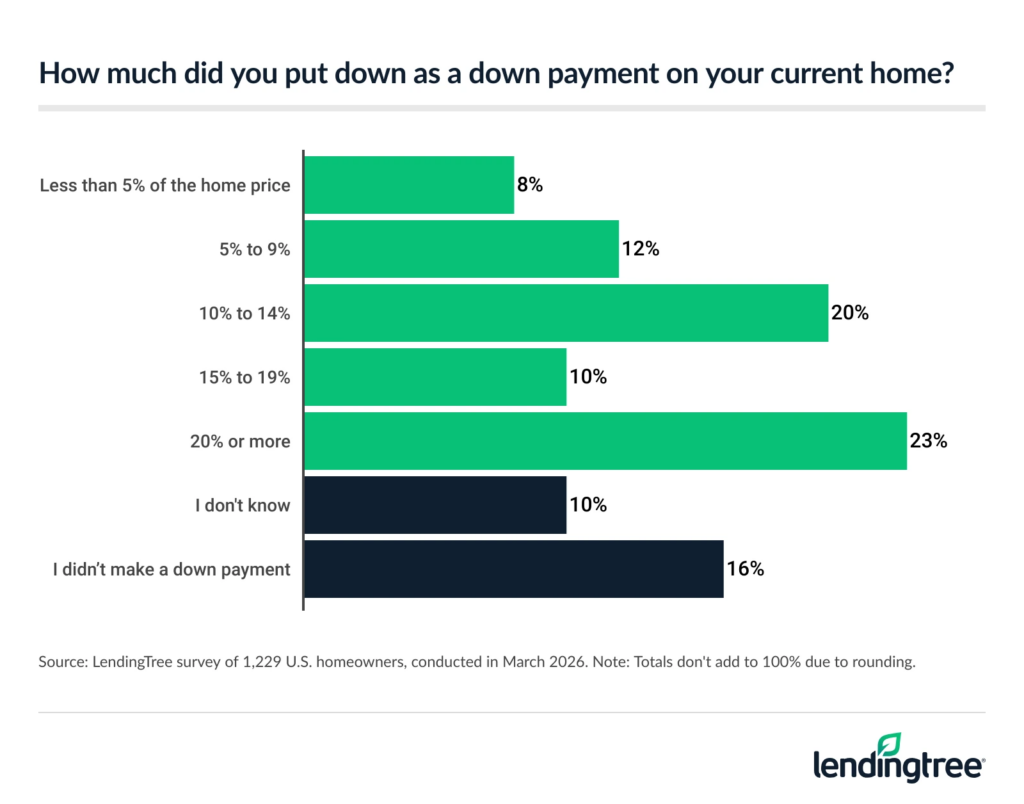
Even financial assistance is insufficient for the majority of homeowners to make a down payment of at least 20%, which is the magic number that enables homeowners to significantly lower their monthly mortgage costs and avoid private mortgage insurance (PMI). Just 23% of homebuyers paid 20% or more, while slightly over half (51%) spent less than 20%. Further, an additional 10% were unaware, and 16% failed to make a down payment.
At least 40% of the down payment was provided by aid, according to half of the homeowners who received it. This includes 11% who claim aid accounted for at least 80% of their down payment and 22% who claim assistance accounted for at least 60%.
That percentage is likely to be higher the younger you are. According to data, only 39% of Gen Xers claim that assistance paid 40% or more of their down payment, compared to an estimated 59% of Gen Zers and 55% of millennials. Additionally, men are significantly more likely than women (56% versus 42%) to report that aid accounted for at least 40% of their down payment.
Note: The baby boomer sample size is too small to be statistically significant.
Some may ask, in today’s economy, where is the most popular place to get help? The simple answer: Mom and Dad. According to LendingTree research, approximately 16% of homeowners claim that their parents assisted with their down payment; this number rises to 27% among Gen Zers, 26% among parents of small children, and 24% among millennials.
Other sources include:
- Friends or other family: 12% (27% of Gen Zers and 19% of millennials say this)
- An inheritance or trust fund: 11% (24% of Gen Zers and 15% of millennials say this)
- Seller concessions: 8%
- A down payment assistance program: 6%
- Employer assistance: 5%
According to survey respondents, the assistance with the down payment was much more likely to be a gift than a loan. Of those who received assistance with their current home’s down payment, some 48% received it as a gift, some 28% as a loan, and 25% as a combination of the two.
Without Financial Aid, Many Americans Can’t Afford Homes
Many people who got aid with their current home’s down payment found that the additional support was more than merely helpful. It was crucial. Over one-third (35%) of those who received assistance with their down payment on their present home claim that they would not have been able to purchase it at the time they did without it. Compared to men, women are far more likely to say this (44% versus 29%).
Further, of those who received down payment aid, 43% say it helped them get a mortgage, 33% say it helped them lower their monthly payment, 31% say it helped them afford a larger down payment, and 30% say it allowed them to buy a more costly property. Even if the help had a significant impact, the beneficiaries report feeling conflicted about it. Some 46% of receivers report that their first emotion was thankfulness, followed by relief (19%) and support (14%). However, 21% of Gen Zers reported feeling humiliated, compared to 11% overall.
Nearly half of Americans (46%) anticipate helping a kid or relative purchase a home in the future, according to LendingTree analysts. This percentage rises to 60% of millennials, 63% of Gen Zers, and 75% of parents with small children. But for the majority of Americans, hope endures despite this and the other frequently depressing findings in the study. Homeownership is attainable without family wealth, according to nearly seven out of ten Americans (68%).
With 77% of those earning $100,000 or more annually and 74% of those earning $50,000 to $99,999, high earners are among the most likely to concur. Additionally, 70% of men, 74% of parents of older children, 73% of parents of younger children, and 77% of baby boomers agree. You don’t need family wealth to own a home, according to 61% of Gen Zers and 65% of millennials, Gen Xers, and women.
In conclusion, Americans have good cause to be confident about their capacity to finance a home without assistance from a wealthy relative, despite high interest rates and home prices. The fact that there are numerous other forms of assistance accessible to people who desire it—some of which we briefly discussed previously in the report—may be the best explanation.
To read the full report, click here.