



Announcing a $115 million initial investment, the America’s Workforce Academy (AWA) will launch a pilot program in Louisiana, Ohio, Indiana, and Texas this year. According to Meta, it’s the biggest private-sector commitment to skilled trades training with a job guarantee in American history. The revelation presents a challenging dilemma for those states’ homebuyers: How will an inflow of recently educated tradespeople impact the neighborhoods where they work, and will those workers ultimately build homes or just the data centers that are becoming more and more competitive?
“The AI infrastructure we’re building today requires an incredible workforce to make it a reality,” Rachel Peterson, VP of Data Centers at Meta. “America needs hundreds of thousands of skilled tradespeople—electricians, mechanics, fiber technicians, and more—and this program creates clear, accessible pathways into those careers.”
The significant recent expansion of AI data centers—a construction wave that calls for a large number of skilled personnel that don’t already exist—led to the launch of the AWA. The National Center for Construction Education and Research (NCCER) credential and an AWA certificate, which are both intended to travel with workers across companies and industry sectors, are two quick certifications that may be obtained through this free, debt-free program. For this initiative, Meta is collaborating with the Associated Builders and Contractors, the National Urban League, and the mikeroweWORKS Foundation.
Grading the States: Affordability & Homebuilding Report Cards
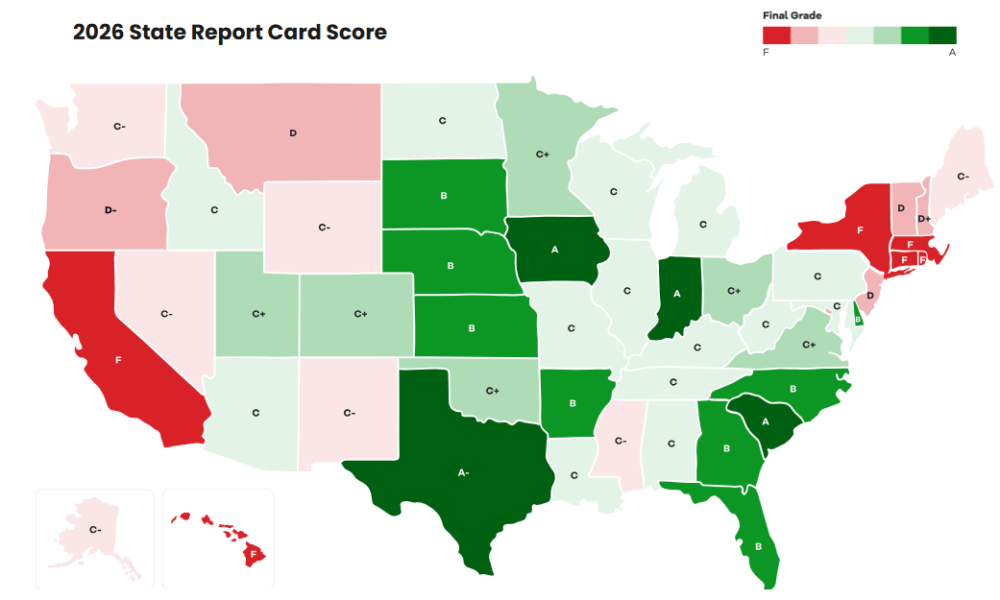
Examining the Potential Ripple Effects
Housing demand typically follows the arrival of large businesses or significant infrastructure projects in a city, and the four pilot states of the AWA are no exception, according to one expert.
“In Texas, I expect data center construction to bring in new workers while also creating opportunities for existing residents to stay and build their careers locally,” said Michael Reisor, a real estate agent based in Austin, Texas.
Rather than in large metro areas, he believes that the greatest impacts are occurring hyper-locally, in the tiny villages that surround data center clusters.
“Even a few hundred new jobs can create meaningful demand for housing,” Reisor said.
New residents would also fuel demand for retail, grocery, and other services, compounding the economic impact, he adds.
However, not everyone sees a direct correlation between the demand for homes and the creation of jobs.
According to Ryan Dossey, Co-Founder of SoldFast, which has operators in all four AWA pilot states, large corporations investing in skilled trades frequently have incentives to move workers from project to project rather than allow them to settle. This is because construction workforces are inherently transient.
“These programs can be hit or miss when it comes to lasting changes in the housing market,” Dossey said. “Some new workers are expected, but others will already be living in those states.”
Workers might only remain in a particular market for a few years, he continued, “unless they make local industry contacts that tip the scales toward settling down.”
The AWA’s flexible credentials, which allow employees the option to continue moving or the flexibility to establish long-term careers in one location, may play a role. Experts revealed that it’s one thing whether or not workers will remain in their current locations, but perhaps more importantly, what happens to the housing needs of the areas where these workers are stationed? According to iRecruit, there is already a projected shortage of up to 499,000 workers in the data center building sector. These workers are being taken straight out of the residential sector in markets where major projects have landed.
Although it is a long-term goal, Meta’s AWA is intended to increase the total labor pool rather than steal from it. In the foreseeable future, house building is already fighting for a declining trained workforce in the same four states where the academy will launch. In the end, how many employees decide to stay and how many wind up constructing data centers rather than residences will determine if Meta’s investment changes local housing markets.
In conclusion, although the initiative is still in its early phases, the conflict between housing supply and AI infrastructure may become apparent before the first AWA class graduates due to the acceleration of construction in all four states.