


For a long time, manufactured homes have been viewed as the inferior version of the American housing dream since they are less expensive to purchase and are seldom regarded as investments that increase wealth. However, according to recent research from Realtor.com, this preconception ignores the fact that these properties can produce significant equity—just not on equal terms.
According to the survey, manufactured homes sold with land saw an estimated 70.1% increase between 2019 and 2026, surpassing the 58.6% increase for single-family homes. The value of manufactured homes sold without land increased as well, albeit less dramatically, at 51.6%.
“The usual narrative seems to be ‘Don’t buy a mobile home, it will lose value,’ to which we are saying, ‘Not necessarily,’” said Joel Berner, Senior Economist at Realtor.com.
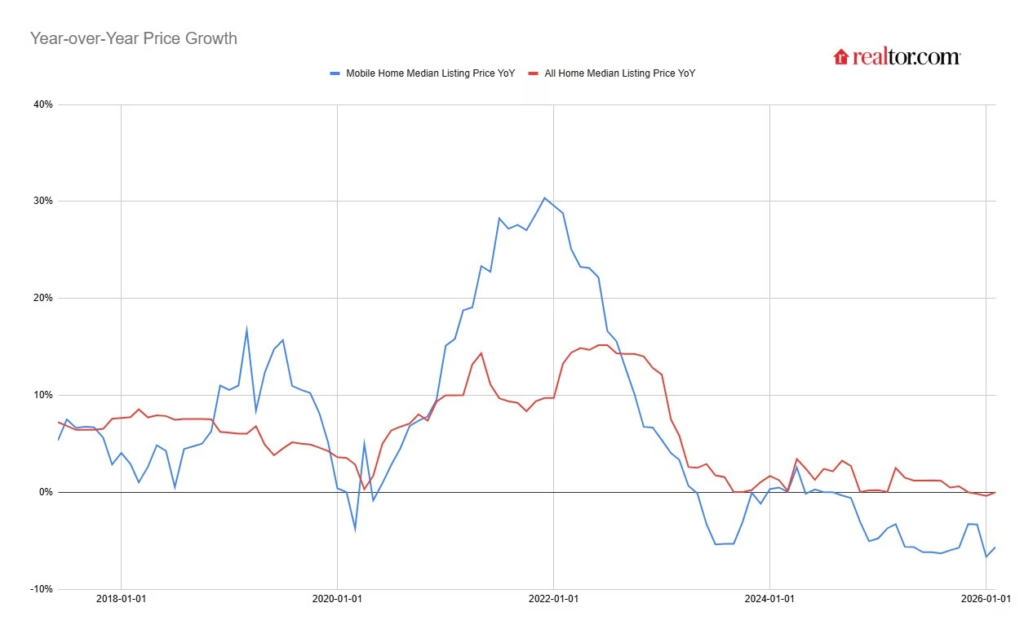
According to Realtor.com data, mobile home values increased during the COVID-19 epidemic boom before drastically declining over the following two years.
Mobile Homes Can Offer Americans a Path to Homeownership
These results come at a time when politicians at all levels are considering manufactured housing as one of the few scalable solutions to the affordability challenge, as well as a potential gateway to the stability and prosperity that owning has long promised.
A single-family home costs $410,000, but the median mobile home listing price was only $141,450. The typical mobile home’s projected monthly principal and interest was $678, while the median non-mobile home listing was $1,918. However, the research clearly clarifies that equal footing does not equate to cheaper admission.
“Mobile-home buying and selling is really on the margin of homeownership, so it’s quite volatile in terms of price, with the makeup of buyers and sellers constantly changing and surging in and out,” Berner said.
Further, manufactured homes tended to sell more slowly and were more likely to need price reductions than site-built homes, even though they provided a less expensive route to ownership.
“Mobile homes do offer an affordable way into getting exposure to the real estate market, especially if the land they’re on is owned instead of leased,” Berner added. “With that exposure comes the opportunity for big gains, but also for big losses.”
Mobile Home Median Listing Price Trends (Jan. 2018-Jan. 2026):
U.S. Homeownership Comes in Many Different Forms
Berner suggests that “manufactured housing is not a monolith.” Depending on what is included, it can serve as an asset in a variety of ways. However, the report revealed that land is the largest boundary between areas. The appreciation of manufactured homes with land was about 20 percentage points more than that of those without (70.1% against 51.6%). This implies that a large portion of this segment’s wealth-building potential is dependent on the owner’s ownership over the land beneath the house in addition to the property itself. The report’s conclusions cast doubt on the long-held belief that mobile homes on leased land are a bad idea, despite the appreciation disparity.
“We are definitely fighting the narrative that mobile homes are necessarily depreciating assets,” Berner said, pointing to the seven-year appreciation horizon. At the same time, he adds, the report leaves room for the fact “that they can depreciate when the market is flat or down,” as reflected in the past two years of mobile home listing prices.
Another major flaw is financing. On terms that resemble traditional homeownership, buyers whose properties are eligible for a conventional mortgage might be in a better position to accumulate wealth. However, buyers may have to rely on cash, chattel loans, or personal loans when a manufactured house is viewed more like personal property—for example, because it is situated on leased land or does not meet mortgage requirements—which alters the long-term value proposition and the economics of the purchase.
The overall takeaway from the study is that manufactured housing is still a viable route to ownership and all of its advantages.
“If you feel locked out of the traditional housing market but are concerned about passing along generational wealth, buying a mobile home, especially one on a piece of land that you own, is a good alternative to renting,” Berner said. “Each month, your payment builds your equity stake in your home, which can be passed along to your beneficiaries, instead of going entirely to your landlord, where it cannot.”
Mobile Homeowners Weigh In
However, Berner’s disclaimer helped Kiah Ranstead understand why, despite providing her family with security, property has not appeared to be a straightforward route to prosperity. In an interview, Ranstead revealed to Berner that about 25 years ago, her parents purchased a manufactured home in Kent, IL, a small hamlet that, according to Ranstead, currently has 74 residents. Ranstead grew up there with her parents, brother, and other animals for nearly three decades.
“We’ve lived in this house for 25 years,” she told Realtor.com. “We’ve never really moved or anything.”
That stability took on extra significance as her parents’ health deteriorated. Ranstead returned home to take care of them after graduating from college. She still resides there with her father now following the passing of her mother. The reason the house means more to her than what it may bring in on the market can be explained by its past. It provided the family with a stable place to live, support one another, and stay anchored in a neighborhood where several generations had grown up.
“My mom grew up in this town,” Ranstead said. “She went to school here. I went to school here. My brother went to school here. I grew up in this house. I went through so much in this house with my family. Really, the benefit that we have gotten is that nobody can tell us to leave. We have somewhere to sleep at night and somewhere for our animals to be.”
As mounting property taxes threaten to force Ranstead and her father out of the house, the limitations of manufactured housing as an asset have become more apparent to her.
“Because of the tax increase, I might lose my house that I’m living in with my dad now,” Ranstead said. “It really eats away at your income throughout the year.”
Theoretically, selling might provide an escape route. Ranstead, however, doesn’t see it that way in reality. According to her, real estate brokers have informed the family that they could make roughly $50,000 from a sale, but that amount may still be significantly less than what they would need to purchase a new house. Their difficulty highlights yet another important conclusion in the research. With a median duration on the market of 89 days compared to 71 days for all property listings, mobile homes are typically slower and more difficult to sell than the larger housing stock.
Additionally, they are more likely to need price reductions: in February, 18.3% of mobile home listings received a reduction, compared to 15.5% of non-mobile home listings. Even if Randstead’s family were to receive $50,000, it wouldn’t make up for their struggles or ensure that they would have another place to live. But instead of rent money that vanished month after month, it would still stand for something that years of ownership made possible: an asset her family developed over time.
Considering the areas where manufactured housing is most prevalent, this is a particularly crucial lesson. More than 80,000 mobile homes were offered for sale in February, according to Realtor.com. Of these, more than 80% were in suburban or rural ZIP codes, and 9.5% were completely outside of metro areas—exactly the locations where less expensive housing options can be most difficult to replace.
Ranstead’s testimony sheds light on what that promise actually entails. Ownership can leave a family with something rather than nothing at all, even if the payout is small.