


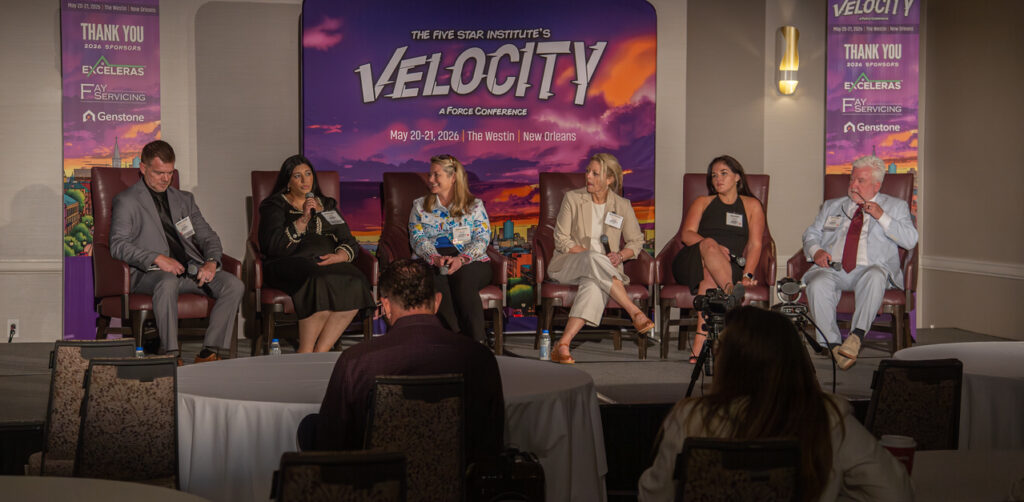
Successful default outcomes depend on strong collaboration between legal and real estate professionals, and it was the topic for a recent panel at the Velocity, a Force Conference, in New Orleans. The Legal League panel explored how default services attorneys and real estate agents can work together more effectively by sharing key information, marshaling resources, and aligning timelines and expectations to minimize delays.
Panelists talked about how these partnerships can evolve into valuable, reciprocal relationships, helping both attorneys and agents expand their networks, strengthen and expand client services, and grow their businesses in an increasingly competitive default market.
The panelists included Frederick Golding, Associate Broker at RE/MAX Advantage Realty; Reneau Longoria, Managing Member and Owner of Doonan, Graves & Longoria LLC; Melisa Manganelli, Partner at Law Offices of Manganelli, Leider & Savio, PA; Tasha Massey, Owner of On Point Realty; and Kent McPhail, Senior Partner with McPhail Sanchez, LLC.
Strong attorney-agent partnerships create better outcomes for everyone
Strong partnerships between attorneys, real estate brokers and mortgage servicers are becoming one of the most important competitive advantages in default servicing, according to industry leaders on the Velocity panel, who said communication, trust and responsiveness can improve asset values while reducing costs and delays.
During a panel discussion on building stronger professional partnerships, attorneys, brokers and servicing executives agreed that the industry’s most successful organizations no longer operate in silos. Rather, they collaborate throughout the foreclosure, receivership, and REO process to solve problems more quickly and deliver better outcomes for investors, borrowers and communities.
“When I was first asked to talk on this topic, I was thinking, wow, this is really an untapped avenue,” Golding said. “Agents and brokers are running in different lanes than the attorneys that are working on the same files. But at the same time, we do have opportunity to learn from one another, help one another, assist one another, and lean on one another.”
That collaboration, panelists said, has measurable financial benefits.
“To make more money for our clients and ourselves to do a better job,” attorney Renee Longoria said when asked about the goal of strengthening relationships among brokers, attorneys and servicers.
She talked about weekly 15-minute stand-up meetings between her firm and broker Tasha Massey that keep every file moving. By reviewing receiverships, property conditions and sales progress each week, the teams avoid communication breakdowns that can delay transactions and increase carrying costs.
McPhail said every day matters in the default servicing industry.
“Every additional day is carrying cost for the servicers,” he said. “The brokers that reach out and work with us, it makes such an impact.”
Communication is the most valuable tool in default servicing
Panelists emphasized that communication, not technology alone, is what keeps files moving.
Manganelli, whose Florida law firm handles foreclosure, bankruptcy and REO matters, said attorneys should work proactively with municipal officials, code enforcement officers and brokers to prevent unnecessary fines and preserve distressed properties.
“It’s important to have definitely, number one, communication,” she said.
Golding said that brokers should “lead with kindness” when dealing with local officials, noting that a simple phone call often resolves problems more effectively than a string of emails.
The panelists also highlighted how brokers can create value far beyond listing homes.
Massey talked about moving debris inside distressed properties to improve photography, creatively staging homes using existing contents, and employing artificial intelligence to generate renovation visualizations that help buyers see a property’s potential.
Longoria, who praised that hands-on approach, recalled properties ranging from million-dollar homes to neglected trailers.
“Get your hands dirty and get it done, for goodness’ sake,” Longoria said.
The panel said that strong professional relationships often begin by helping without expecting immediate compensation.
“If Renee texts me and says, ‘Hey, I’m working on this property, can you do a drive-by?’ I’ll say yes and I’m not expecting compensation,” Massey said. “What goes around comes around. The more I give, eventually the more I will receive.”
Researching prospective clients before meetings
Networking also was a recurring theme for panelists.
Daya urged professionals to research prospective clients, understand their business challenges, and focus on adding value rather than making a sales pitch.
“You never know where that person is going to be in six months, nine months or a year,” she said. “This person could be your peer, they could be your boss.”
Panelists warned against overreliance on email for resolving problems, recommending direct phone conversations when issues arise.
“Email is way too easy for someone to be passive aggressive,” McPhail said. “A reasonable voice on the phone saying, ‘This is the problem. This is what we did to fix it,’ goes a long way.”
Respect remains the foundation of successful partnerships, they said.
“If you go to our firm’s website, it says, ‘Respect everyone, it costs nothing,'” McPhail said. “This is a difficult, stressful industry and being difficult with the people around you doesn’t make it flow better.”
That philosophy extends beyond professional relationships, McPhail said, to interactions with homeowners facing foreclosure.
“I can’t tell you how many times I’ve taken somebody’s home and at the end of the day they’ve said, ‘Thank you,'” McPhail said. “They said, ‘Yes, but you had talked to me.'”
Technology, including AI, is transforming the industry, but expertise remains essential
Panelists also discussed how artificial intelligence is changing the legal landscape. Attorneys said they are increasingly encountering AI-generated legal filings submitted by self-represented borrowers, many containing fabricated case citations that increase litigation costs and that delay proceedings.
They agreed that AI can be a valuable productivity tool but cautioned that legal professionals must verify its output rather than rely on it as an authoritative source.
Panelists identified industry consolidation, shrinking profit margins, workforce turnover and the transfer of institutional knowledge as major challenges facing mortgage servicers and their partners.
The panelists concluded, however, that firms willing to communicate openly, share information and build lasting professional relationships will continue to differentiate themselves.
Daya summarized it this way: “You are your brand. Be an extension of your brand.”