



As the nation marked 250 years of independence, new data revealed that just over 65% of American households now own their homes, amid the ever-changing U.S. housing market. A new Realtor.com analysis of federal housing legislation indicated that notable surges in U.S. homeownership have each been preceded by an act of Congress—from the Homestead Act of 1862 to the Housing and Economic Recovery Act of 2008—and that the tools that it would take to accomplish it further for millions of citizens.
The report, published alongside the country’s 250th anniversary, outlines five significant bills and their quantifiable impacts on the homeownership rate, monitored by the Census Bureau since 1890.
“Homeownership has never been purely a product of markets, from 44% in 1940 to 62% by 1960, federal legislation has been a driving force in American homeownership history and a 4-million-home supply gap is waiting for its moment,” said Joel Berner, Senior Economist at Realtor.com. “At several major inflection points in this country’s history, from the Great Depression, World War II, the Civil Rights era to the financial crisis, Congress stepped in and changed who could own a home and how they could afford one. The history is remarkably consistent: legislation works.”
The Homestead Act of 1862, enacted during the Civil War, provided 160-acre parcels to any adult who could pay a minor filing fee and agree to work the land for five years. Over 270 million acres in 30 states were acquired from 1862 to 1976. The legislation served as the nation’s initial homeownership aid, providing access through individual effort instead of pre-existing wealth, and established a foundation for American property ownership that future Congresses would expand upon.
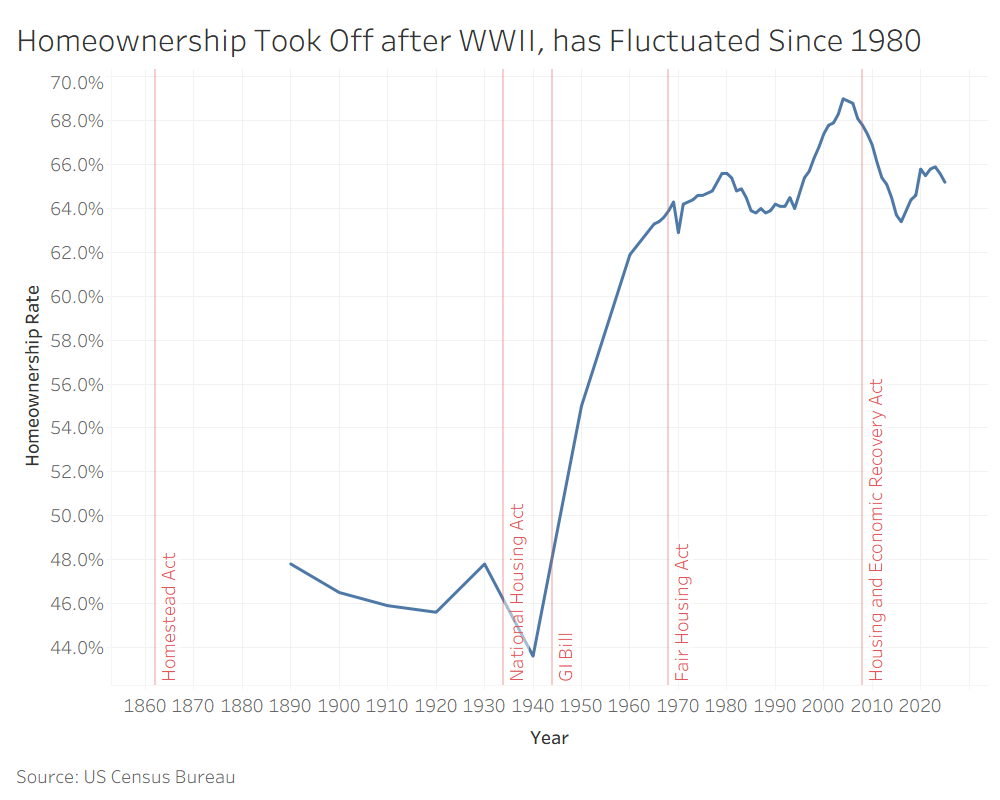
An Overview of the Legislative Development of Homeownership
History and experts can confirm that the Great Depression nearly dismantled that foundation. In the early 1930s, mortgage defaults surged across the nation, leading lenders to cease the issuance of new loans, which caused the housing market to come to a standstill. In response, Congress enacted the National Housing Act of 1934, which established the Federal Housing Administration and reformed the conventional mortgage system by reducing down payment requirements, lengthening repayment terms, and providing loan insurance to bolster lender confidence. The mortgage market as it is recognized by Americans today originated from this legislation; however, the FHA’s underwriting practices also entrenched redlining, a discriminatory legacy that would require another generation of legislative efforts to begin to rectify.
This adjustment was partially facilitated by the GI Bill. The Servicemen’s Readjustment Act of 1944 ensured that veterans could access low-interest, no-down-payment home loans supported by the federal government. By 1950, the Veterans Administration had guaranteed over two million home loans. The statistics illustrate the narrative clearly: in 1940, 43.6% of households in the United States were homeowners. By 1960, this percentage had risen to 61.9%.
“The postwar homeownership surge is the most dramatic in American history, and it was not organic,” Berner said. “It was the direct result of Congress making homeownership financially accessible to a generation of Americans who would not otherwise have been able to achieve it. That’s the playbook.”
The Civil Rights Act of 1968, widely known as the Fair Housing Act, sought to address the redlining that the FHA had helped to establish. By banning discrimination in the sale, rental, and financing of housing on the basis of race, color, national origin, religion, sex, familial status, and disability, it broadened access to credit for home purchases in minority communities. Homeownership rates persisted in their upward trend from the time the bill was enacted until approximately 1980, now characterized by greater inclusivity.
The latest legislation reviewed, the Housing and Economic Recovery Act of 2008, was not intended to enhance homeownership but rather to avert its decline. With Fannie Mae and Freddie Mac nearing failure, HERA placed both entities under federal conservatorship, increased FHA loan limits, instituted a minimum down payment of 3.5%, and introduced a tax credit for first-time homebuyers. The homeownership rate had reached a high of 69.0% in 2004 and fell to a low of 63.4% in 2016, a decrease that, in the absence of HERA’s stabilizing measures, could have been significantly worse.
Hurdles, Hope & What It Means for Americans Today
The housing market is not currently experiencing a financial collapse or the consequences of a global conflict. Rather, it is grappling with a significant shortage of available homes. Realtor.com’s analysis indicates that the gap in U.S. housing supply is projected to expand to approximately 4.03 million homes by 2025, an increase from 3.8 million in 2024. New construction has once again failed to keep pace with household formation, and there remains a strong demand from younger households.
U.S. households that acquire their first home by the age of 30 tend to amass an average net worth that is $119,000 greater—a 22.5% increase—by the time they reach 50, compared to those who delay their purchase until their 40s. In 1990, the median age of first-time homebuyers was 30; by 2025, this figure is expected to rise to 40. Over this period, home prices have escalated at nearly double the rate of income growth, and the average duration required to save for a down payment has extended from around three years to nearly 10.
Children who grow up in households owned by homeowners are 18.4 percentage points more likely to achieve homeownership by the age of 35. Furthermore, homeowners are 1.3 times more inclined than renters to anticipate passing on assets to the subsequent generation.
The primary challenge in addressing the supply gap is regulatory constraints. Recent studies have shown that local zoning and permitting regulations have rendered home construction both slow and costly. The National Association of Home Builders (NAHB) estimates that these regulations contribute over $130,000 to the price of a newly constructed home. Additionally, the U.S. Conference of Mayors has adopted a bipartisan policy statement that underscores the pressing necessity for national intervention regarding housing supply.
The federal government does not oversee local zoning practices. However, it can influence them by making federal grant funding conditional on the acceptance of standardized, permissive zoning laws and simplified permitting processes, a tactic that reflects the indirect policy strategies that have been effective in American cities historically. The 21st Century ROAD to Housing Act includes a provision for this, along with a variety of other policies intended to enhance the housing supply in the U.S. With considerable support across both houses of Congress, this bill could become a notable example of legislation that enables Americans to achieve their homeownership dreams.
In conclusion, the trend observed over 250 years of American history is when opportunities for homeownership diminish, federal legislation has the ability to effectively restore access for aspiring property owners in today’s economy.